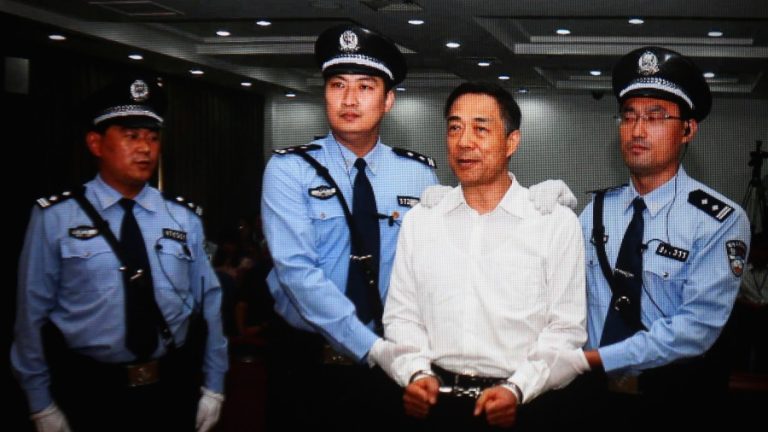
On Sept. 22, 2013, a Chinese court sentenced Bo Xilai—once one of the country’s most powerful politicians—to life imprisonment for bribery, embezzlement, and abuse of power. Yet some of the darkest accusations surrounding Bo—organ harvesting and body trafficking—were never addressed in court and remain deeply censored in China.
Under Bo and his wife Gu Kailai, the coastal city of Dalian became the center of China’s plastination industry—the chemical preservation of human bodies for public display. Investigations suggest Dalian’s “body factories” thrived under political protection, and that Bo personally approved at least one such operation.
In 1999, German anatomist Günther von Hagens, inventor of the plastination technique, founded von Hagens Biological Plastination (Dalian) Co., processing human remains for education and exhibition.
That same year, Dalian Medical University launched a similar facility, making the city one of the few places worldwide with two large-scale body-processing plants.
Von Hagens reportedly invested US$25 million after several visits between 1995 and 1999. Chinese media said Bo even granted him honorary citizenship.
Success
You are now signed up for our newsletter
Success
Check your email to complete sign up
Meanwhile, foreign investors in Dalian were allegedly encouraged to hire Gu Kailai’s law firm, which charged steep “consulting fees.” The arrangement purportedly brought tens of millions of yuan to the Bo–Gu family network.
The disappearance of a TV host
One of the most haunting rumors from that era concerns Zhang Weijie, a former Dalian television anchor long rumored to be Bo’s mistress. Zhang vanished in the early 1990s after a falling-out with Gu Kailai, who reportedly used state security forces to intimidate her.
Friends said Zhang—believed to have been pregnant—disappeared soon after losing her job. Years later, speculation surfaced that she might have become the “pregnant body” displayed in international plastination exhibitions.
The exhibit of a pregnant woman with a fetus still inside her womb stunned visitors around the globe. Audiences asked:
“She wasn’t a death-row prisoner. Who was she? How did she die?”
Chinese netizens debated whether the woman was Bo’s mistress, a political detainee, or even a Falun Gong practitioner. Under Chinese law, pregnant women cannot be executed, deepening suspicion that her body came from an illicit source.
Author Chen Lan captured the public unease in an allegorical short story about a jealous wife who turns her husband’s lover into a “doll” for display—a tale widely read as a metaphor for Zhang’s fate.
Body sources under scrutiny
Most plastinated specimens from von Hagens’s factory were Chinese citizens.
His apprentice-turned-rival Professor Sui Hongjin managed the Dalian plant before establishing Dalian Medical University Biological Plastination Co. in 2002.
Sui’s U.S. partner, Premier Exhibitions, later admitted in a disclaimer that its specimens came from Chinese police sources, though it claimed they were “voluntary donations.” No verifiable documents were ever made public.
Human-rights advocates and Falun Gong practitioners have long accused Chinese authorities of using executed prisoners and political detainees as an illicit source for both organ transplants and plastination.
Because many Falun Gong detainees in the early 2000s refused to reveal their identities, officials could process their bodies without oversight—a loophole that, activists argue, enabled a hidden trade in human remains.
In 2004, Der Spiegel revealed that von Hagens’s Dalian facility produced about 80 percent of his global plastinated output. Subsequent reports by The Guardian (UK) and ABC’s 20/20 (U.S.) examined the human-rights implications of exhibitions marketed under titles such as Body Worlds and Mysteries of the Human Body.
In 2005, a Seoul exhibition displayed dozens of plastinated Chinese corpses, including the pregnant woman. Photographs of the display sparked international outrage and calls for investigation.
“The fetus was still in her womb,” wrote one reporter. “It was impossible to look without asking where these bodies came from.”
Collapse and aftermath
After Wang Lijun’s defection in 2012 exposed Bo’s corruption, Dalian’s body factories came under scrutiny. Just 23 days after Wang fled, von Hagens’s plant in Dalian was sealed by authorities.
That April, Sui Hongjin moved his Mystery of Life Museum from Dalian’s Lüshun District to Jinshitan, expanding it into mainland China’s largest private plastination museum, covering more than 6,000 square meters.
During her 2012 murder trial for the death of British businessman Neil Heywood, Gu Kailai allegedly whispered a cryptic line:
“This case has finally torn a corner of the dark curtain.”
Observers have long debated what she meant. Some believe “the dark curtain” referred not merely to corruption or murder, but to a state-linked network of body trafficking and organ harvesting—acts that, if proven, would constitute crimes against humanity.
As one courtroom witness put it:
“Those capable of such evil are no mere criminals — they have stepped into the realm of darkness.”
Editorial Note:
This article summarizes publicly available reports and testimonies concerning Dalian’s plastination industry and its alleged political connections. Many claims — particularly those involving missing persons, body sourcing, and organ harvesting — remain unverified.
Readers are urged to treat this information with caution and await confirmation from independent forensic or legal investigations.