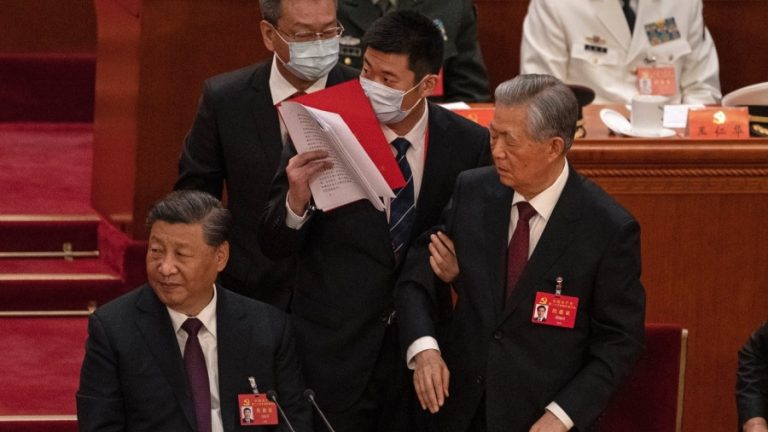
With less than a week before the Fourth Plenary Session, infighting at the top of the Chinese Communist Party (CCP) has intensified. Because the regime operates under secrecy, each faction has turned to state-run media or overseas outlets to leak or test the political winds.
Former Wen Wei Po senior reporter Jiang Weiping claimed that the People’s Daily has become increasingly explicit in signaling support for Vice Premier Hu Chunhua, once groomed by Hu Jintao as a successor.
He noted that an Oct. 14 article titled “Niu Bole (The Great Talent Scout)” is a veiled reference to Hu Jintao as the “Bole” who discovered Hu Chunhua — implying endorsement for Hu’s leadership.
“It’s obvious the Party elders have regained influence,” Jiang said. “Hu Chunhua’s rise reflects a consensus reached among the old guard.”
The People’s Daily also formed an “Inner Mongolia Research Team” — which Jiang interprets as symbolic of Hu Chunhua’s regional background and signal of his political return.
Success
You are now signed up for our newsletter
Success
Check your email to complete sign up
‘Qing Hu Chunhua Zhangduo’ — A hidden message
Jiang pointed to another People’s Daily article on Oct. 13 titled “Youthful Chapter — Six Thousand Voices Sing in Praise of the River and Sea.”
According to him, the phrase “Qingchun Huazhang” (Youthful Chapter) sounds nearly identical to “Qing Hu Chunhua Zhangduo” — “Please let Hu Chunhua take the helm.”
“‘Da zai’ means praise; it’s an ancient expression of admiration,” Jiang explained. “‘Hehai ben qiancheng’ refers to Wang Yang, another reformist figure — symbolizing the resurgence of the Hu–Wang faction.”
He added that Xi Jinping has already lost much of his authority, and if Hu Jintao’s allies consolidate control after the Plenum, Xi’s loyalists — including Li Zhanshu — may fall, and the cases of Ling Jihua and Li Keqiang’s death could be reopened.
“If the Li Keqiang investigation proceeds, it would be devastating for Xi’s inner circle,” Jiang said. “The upcoming Plenum will determine the survival of both factions.”
The civilians follow the generals
Jiang noted that in China’s political hierarchy, civilian officials ultimately defer to the military. For the People’s Daily to hint so directly, he said, indicates military endorsement for Hu Jintao, Wen Jiabao, Wang Yang, and Hu Chunhua.
“When I worked in state media,” Jiang recalled, “colleagues at Xinhua, People’s Daily, and CCTV all said their core departments were under military supervision. That hasn’t changed.”
Xi Jinping’s declining authority was also apparent during his appearance at the Global Women’s Summit. Observers noted that CCTV’s coverage was unusually restrained — Xi’s close-up shots were shortened, his ascent to the podium shown only from a distance, and no footage of the banquet was released.
Commentator Zhou Xiaohui interpreted this as a signal of Xi’s deteriorating health and weakened standing.
Zhou also pointed to subtle political messaging before the Plenum. In addition to the high-profile reappearance of Hu Haifeng, Hu Jintao’s son and now vice minister of civil affairs, Zhou cited another telling move:
On Oct. 11, the People’s Political Consultative Conference Daily reported that the Ethnic and Religious Affairs Committee held a study session on Xi’s speech to the Politburo. However, the committee’s statement omitted the usual loyalty formula “Two Upholds, Four Consciousnesses” — a deliberate failure to pledge allegiance to Xi.
“That omission is itself a political signal,” Zhou said. “It suggests key departments are preparing for leadership changes at the Plenum.”
Analysts: ‘Xi is fighting for his life’
Political commentator “Ordinary Citizen Inside the Wall” wrote that Xi Jinping is now in his death throes.
“If Xi steps down at the Fourth Plenum,” he said, “the U.S.–China trade war will end. But if he clings to power, he’ll look for excuses to restart conflict — even military confrontation.”
For Xi, he said, “power means survival.”
“He doesn’t care whether the Chinese people have food or freedom — only whether his dynasty endures.”
The commentator argued that Xi’s 13 years in power have been defined by a return to Maoist authoritarianism.
“If the Fourth Plenum fails to remove Xi and restore Deng Xiaoping’s reform path, China faces total ruin.”
According to the same insider, Xi’s support within the Central Committee has crumbled.
“Only Cai Qi, He Lifeng, and Wang Xiaohong remain die-hard loyalists,” he wrote. “Even Li Qiang and Wang Huning have jumped ship.”
He revealed that Vice Premier He Lifeng provoked outrage among Party elders last week by launching a “rare-earth war” while Li Qiang was visiting North Korea. This escalation, he said, backfired and galvanized anti-Xi forces.
Meanwhile, U.S. and Chinese trade negotiators reportedly agreed to pause talks until after the Plenum, a move that former President Donald Trump later described as evidence that “Xi is having a hard time and is in low spirits.”
Hu Jintao’s moment of clarity
After the rare-earth dispute, insiders say Hu Jintao finally reached full clarity:
“The Fourth Plenum must resolve Xi’s faction once and for all,” one source said. “If it drags on to the 21st Congress, no one will be safe. This Plenum is the final showdown.”
The insider quoted Trump’s remarks as further indication of Xi’s impending downfall.
“Trump said Xi is in trouble — that means he’s on the way out. The rare-earth fiasco has only unified the anti-Xi coalition.”
Even with internal differences, the commentator added, removing Xi at the Fourth Plenum has become the shared objective of all rival factions.