Nearly 2,200 years ago, a tribe called the Yuezhi (月氏) from north of the Qilian Mountains on China’s frontiers was pushed out of its homeland by the Xiongnu, a multi-tribal nomad confederation. The Yuezhi fled westward to the upper reaches of the Oxus River basin in Central Asia. As the Indo-Greek kingdoms weakened, they moved further south, replacing them in Bactria and establishing one of the most powerful empires of its time — the Kushan Empire — connecting China, Central Asia, India, and the Roman world.
The Kushans became central to the geopolitics of their age because of the strategic location of their kingdom, whose patronage played a major role in the spread of Buddhism, particularly to China, where the Kushan empire was known as Guishuang (貴霜). Bactria roughly covered present-day Afghanistan, Tajikistan, Uzbekistan and parts of Turkmenistan.
It was during the Kushan era that two Indian monks, accompanied by a Chinese envoy, entered Luoyang, the capital of the then-reign Han Dynasty, carrying Buddhist texts and sacred images on white horses. There they established the White Horse Temple and monastery — the first Buddhist place of worship in China.
Remnants of a lot of Kushan archeological heritage are today visible and preserved in Central Asia, Afghanistan, Pakistan, India, and China, offering a rare window into the history of this horse-riding warrior tribe that went on to build a great empire.
Kanishka, the great Kushan emperor who shunned violence
The best-known Kushan emperor was Kanishka, who lived roughly 100 years after the Indo-Greek king Menander, who is said to have embraced Buddhism after his famous debate with the monk Nagasena, which I shared in the previous installment of Eusebia. Kanishka also lived about 350 years after Emperor Ashoka, who turned to Buddhism after victory in a bloody battle and whose missionaries helped spread the faith across much of the known world.
Success
You are now signed up for our newsletter
Success
Check your email to complete sign up
Like Ashoka and Menander, Kanishka sought religious guidance at the height of his power. He was dismayed by the scale of the violence and suffering caused during a battle with a Parthian (Iranian) king and sought advice from religious leaders. It is not entirely clear, however, whether he formally embraced Buddhism, as his coins depict deities from several faiths. This may suggest that he saw himself as the ruler of a religiously diverse empire whose subjects included followers of Shaivism, Buddhism, and Zoroastrianism.
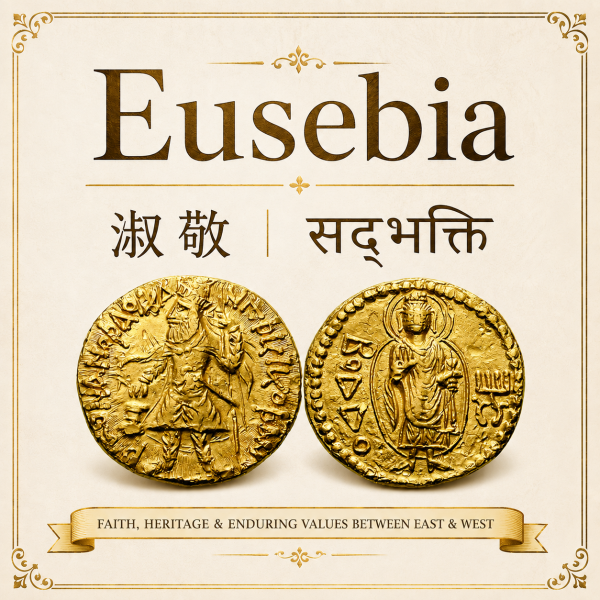
Raoul McLaughlin writes in Roman Empire and the Silk Routes that Buddhist traditions preserve another story of Kanishka’s remorse after battle. After building a vast empire, Kanishka assembled a huge army from his subordinate kingdoms to attack the kingdoms of the Tarim Basin (today’s Xinjiang). But his troops refused to cross the dangerous, high-altitude passes of the Pamir Mountains between present-day Pakistan, Afghanistan and Tajikistan.
Particularly striking is the description of “white elephants” ridden by his foreign troops as they led the advance while Kanishka followed with his army. The horses and elephants refused to cross the steep mountain pass, and at that critical moment between life and death, Kanishka experienced a divine revelation and renounced bloodshed.
A Chinese envoy visits the Kushan empire
Kanishka is known as a great patron of Buddhism because of the temples and monasteries he established and the Buddhist conferences and missions he supported to far off lands, particularly to China and other nations of the east.
Kushan Buddhist traders and missionaries travelled extensively along the Silk Roads to China. Buddhism, however, also reached Han China by sea from the eastern shores of the Indian subcontinent. It was during this period that Emperor Ming’s (AD 58–75) younger half-brother, Liu Ying, became one of the earliest converts to Buddhism in China. McLaughlin writes that in AD 65, an investigation concluded that Liu Ying’s beliefs posed no threat to the empire. The emperor then dispatched an envoy all the way to the land of the Buddha to learn more about this new and mysterious faith.
The envoy returned to China in AD 67 accompanied by two Indian Buddhist monks — Jie Yemoteng (Kashyapa Matanga, 迦葉摩騰) and Zhu Falan (Dharmaratna, 竺法蘭). They entered the Han capital, Luoyang, carrying Buddhist scriptures, called sutras, on white horses. For this reason, the monastery they established on the outskirts of the capital came to be known as the White Horse Temple (白馬寺). Following this, Buddhism began receiving imperial patronage in China, and paintings and statues of Buddha Shakyamuni gradually appeared across the country.
Another notable Kushan Buddhist missionary who helped spread Buddhism in China was Lokaksema (支婁迦讖, Zhiluojiachen), who taught in Luoyang from AD 150 to 189. Fluent in Chinese, he translated the Prajnaparamita Sutra, or The Practice of the Path.
The Kushans’ Greek heritage
Since the Kushan empire stood at the crossroads of civilizations, the Kushans became patrons not only of multiple faiths but also of cultural amalgamation and refinement. Two of their cultural-economic centers deserve special mention here: the Gandhara region and the Indian city of Taxila.
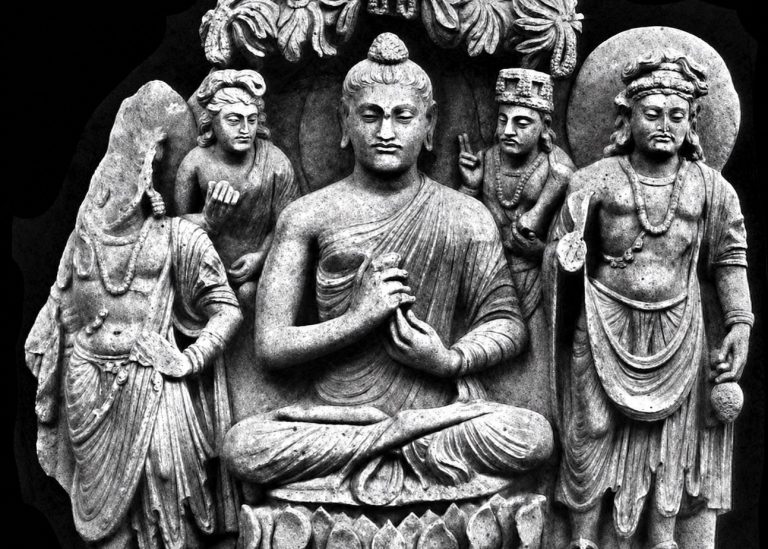
In the historical timeline, as the Kushans succeeded the Indo-Greeks in the region, they oversaw the continued flourishing of Gandhara and Taxila, where Greek and Kushan cultures blended even further. Gandhara, located in present-day northwestern Pakistan and eastern Afghanistan, became renowned for combining Greek artistic techniques, Roman realism, Persian decorative motifs and Indian Buddhist themes. Its temples and monasteries were later described in the travel accounts of the Chinese monks Faxian (法顯) and Xuanzang (玄奘), centuries after the Kushan Empire had disappeared.
Taxila became another major Kushan centre of learning, trade and Buddhism in present-day Punjab, Pakistan. The Greco-Bactrian king Demetrius had earlier established the walled Greek city of Sirkap opposite Taxila. According to McLaughlin, the two centres shared administrative functions, while the royal mint remained at Taxila. In 1913, British archaeologists unearthed the Dharmarajika Stupa, also known as the Great Stupa of Taxila, originally built by Emperor Ashoka in the 3rd century BC to house relics of Buddha Shakyamuni. Archaeological findings show that the stupa featured Greek (Hellenistic) motifs alongside other Greco-Buddhist artistic elements.
Encountering Kushan heritage and people in today’s South Asia
My interest in Kushans started when some years ago I visited the Kushan period’s Buddhist site of Ambaran on the banks of the river Chenab, a major river of the Indus basin, near my native city of Jammu in northern India, close to today’s India-Pakistan border. It was fascinating to think how the Yuezhi migrated all the way from the frontiers of China through high mountain passes and inhospitable geography to establish the mighty Kushan empire between Central, West, and South Asia.
My interest deepened when I came across A Short History of Gurjars, written by the Pakistani author Rana Ali Hasan Chauhan and published in India by the Gurjar Desh Charitable Trust. The book notes that the British archaeologist Alexander Cunningham identified the present-day Gurjar population of India, Afghanistan and Pakistan with the Kushans — who comprise a substantial community even today. Interestingly, many nomadic Gurjars still travel with their horses, mules, goats and sheep for hundreds of miles each year along traditional routes through the Himalayas of India and the high mountain ranges of northwestern Pakistan and eastern Afghanistan.
The book goes even further, stating that the region east of Iran, corresponding broadly to present-day Afghanistan, was referred to as the land of “Kush” in the Old Testament. This same land lay south of Central Asia beyond the mountain range known as the Hindu Kush. Thus, when Kanishka rose to power there, he was called a Kushan, and that is how the horse-riding warrior tribe, the Yuezhi from north of the Qilian Mountains, became the Kushans.
History never unfolded along a linear path, and nor has it ever been static. Human civilizations have connected, interacted and merged in dynamic ways, shaping human knowledge and potential — across the continents in all the nations we know today.
Despite being born into an Indian family, I bear a Greek name. Until recently, that was my only connection to Greece. Then I began exploring the history of my region, a history that spans centuries across the Indus River basin — from Ladakh, Jammu and Kashmir, Punjab, and Himachal Pradesh to present-day Pakistan and eastern Afghanistan.
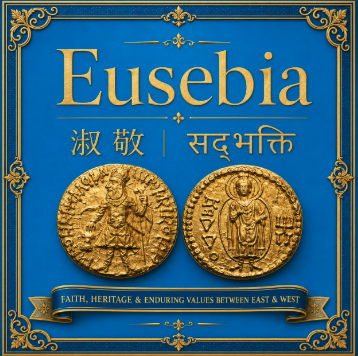
In the process, I discovered not only place names with Greek connections but also deep links between Greek and Indian culture, religion, spirituality, history, and archaeology, particularly in northern India. When the Buddhist Dhamma (Dharma) reached the Greeks, it was rendered as Eusebeia (“piety” or “reverence”). Thus, Eusebia (सद्भक्ति in Sanskrit; 淑敬 in Chinese) is an attempt to explore that connection seriously and share it with the world — hopefully in ways that illuminate the enduring ties between East and West.