The 138th session of the China Import and Export Fair, widely known as the Canton Fair, opened on Oct. 15 in Guangzhou.
Long regarded as a barometer of China’s foreign trade, this year’s event was marked by empty halls, a near absence of Western buyers, and strict new exhibitor rules.
As the United States prepares to impose 100 percent tariffs on Chinese imports and Beijing tightens export controls on rare earths, the fair offered a bleak snapshot of China’s shrinking export economy.
“This year’s Canton Fair is driving business owners crazy,” one exhibitor said in a video widely shared on Chinese social media.
He described the 138th session as “the strictest in history,” noting that 87 percent of applicants were rejected due to new documentation rules.
Success
You are now signed up for our newsletter
Success
Check your email to complete sign up
“You now have to show proof of social-security payments—three months for company owners and one month for staff,” he said.
“The rule was issued on Sept. 20, leaving no time to make back payments.”
Empty aisles, missing buyers
Despite its vast scale, the fair’s exhibition halls were eerily quiet. Multiple vendors reported seeing almost no European or American clients, with corridors filled mainly by domestic competitors.
“Today is the first day,” said one exhibitor while filming his booth. “We’re right by the aisle—and there’s no one here.”
Footage from the venue showed rows of empty booths and vendors scrolling on their phones beside idle display tables.
“The shoe section is dead quiet,” another vendor remarked. “It feels like a village gathering—only without customers.”
A merchant from Jiangxi Province detailed the steep cost of attending the fair:
- Three booths: RMB 25,800 each (about US$3,600) — total over RMB 70,000
- Decoration: RMB 20,000 (about US$2,800)
- Travel for eight people from Nanchang: RMB 24,000 (about US$3,400)
- Hotel for 15 days: RMB 36,000 (about US$5,000)
- Meals: RMB 14,400 (about US$2,000)
“Altogether, we spent about RMB 179,800 (US$25,000). Was it worth it?” he asked.
Other vendors complained of restrictions on assistants and translators.
“One foreigner can only bring one assistant and one translator,” said a Shenzhen exhibitor.
“Translators must hold a certification in English or translation. Registration costs 300 yuan plus 50 yuan for the card—and you still might not get in.”
Tariff threats and shrinking orders
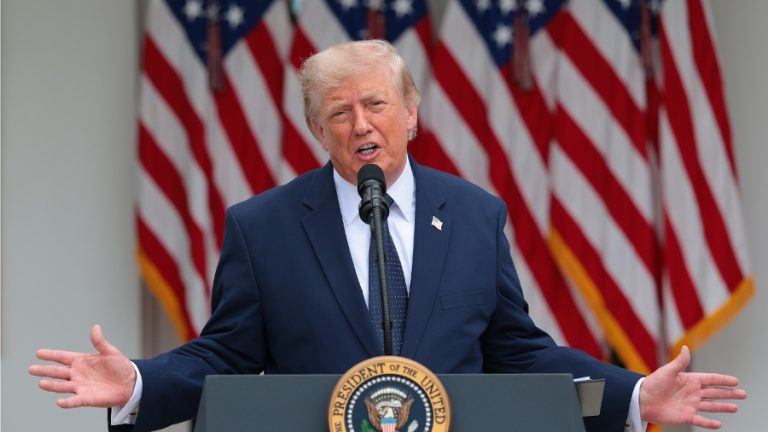
The fair took place amid escalating trade tensions. Days earlier, China expanded its rare-earth export controls, prompting U.S. President Donald Trump to announce a 100 percent tariff on all Chinese imports effective Nov. 1.
Exporters across Guangdong and Zhejiang described a “double squeeze”—external tariffs and internal market saturation.
“If the U.S. really imposes 100 percent tariffs, it’ll be devastating,” said a Zhejiang shoe manufacturer whose main market is the United States. “Europe and Southeast Asia are too small to offset the losses. Everyone I know is barely hanging on.”
Another exporter was blunt: “If a pair of scissors costs 10 yuan but faces 15 yuan in tariffs, American clients will slash prices or cancel orders. Our inventory will pile up, and profits will hit zero.”
Many small and medium-sized manufacturers are now turning inward, flooding China’s domestic market—where competition is equally fierce.
A blogger visiting Shenzhen’s Hua Nan City described the scene as “bleak and empty—no customers, no deals.”
“Closed, closed, closed—every store is shuttered,” another post read.
“This is Nanshan’s Coastal City. Five years ago, shop owners fought overnight to buy these storefronts for RMB 400,000 to 500,000 per square meter—plus extra ‘tea fees.’ Now they’re all vacant. Tens of millions have gone up in smoke.”
Behind these empty storefronts lies a deeper personal crisis.
“Most shop owners are middle-aged,” one commentator wrote. “They’re too old to change careers, lack technical skills, and after years of being their own bosses, they can’t adapt to working for others. They can’t keep the stores open, can’t afford to close them, and end up trapped—hard to earn, hard to hold, hard to quit, hard to survive.”
Analysis: China’s export engine stalls
Economists say the Canton Fair’s decline mirrors the broader stagnation of China’s export-driven economy.
With Western buyers shifting to Southeast Asia and India, and U.S.–China trade relations at their lowest point in years, Chinese exporters are losing both markets and confidence.
For decades, the Canton Fair symbolized China’s status as the “factory of the world.”
This year, the empty halls tell a different story — of an export engine running out of fuel and of small businesses struggling to survive in a shifting global order.
“If the fair once represented global demand for ‘Made in China,’ its emptiness now reflects a sobering reality,” one trade analyst said.
“Factories that once exported abroad are fighting just to stay alive at home.”