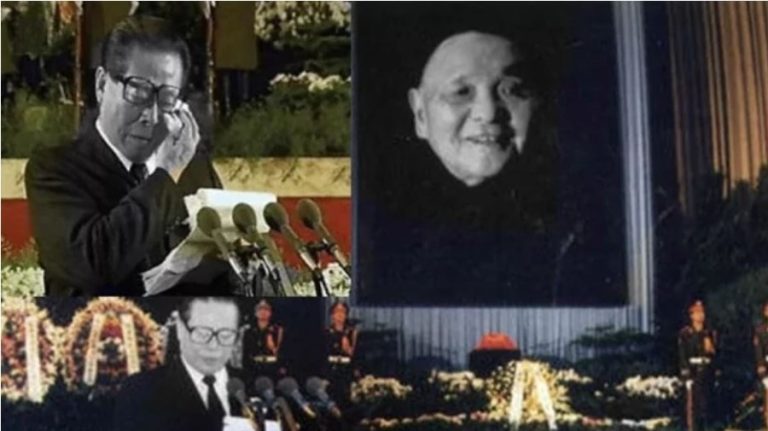
At Deng Xiaoping’s farewell ceremony in 1997, then–Party leader Jiang Zemin appeared overcome with emotion, his voice trembling as he delivered the eulogy. He removed his glasses three times to wipe away tears — a moment captured in a now-famous photograph that continues to circulate online.
Members of the Chinese Communist Party’s (CCP) “Red Second Generation” — descendants of senior revolutionary leaders — have long ridiculed the performance, calling Jiang’s display “too fake.”
“He acted like he was in a play,” one attendee later remarked.
The photo became an enduring symbol of Jiang’s reputation for theatricality. Domestically and abroad, he was frequently mocked as the “Jiang Actor” — a leader whose flair for dramatics often bordered on parody.
According to Radio Free Asia, Jiang’s exaggerated grief contrasted sharply with his true feelings. In private, he viewed Deng’s death not as a tragedy but as a political opportunity.
Success
You are now signed up for our newsletter
Success
Check your email to complete sign up
At the time, Deng’s declining health had kept Jiang under constant pressure. Although Jiang held the title of general secretary, real authority still flowed from Deng’s residence through his family and trusted aides.
When Deng passed away on Feb.19, 1997, Jiang’s faction swiftly issued a joint statement in the name of all five central organs — including the Central Military Commission — declaring the “Central Committee of the CCP with Comrade Jiang Zemin at its core.”
Within days, the People’s Daily echoed the phrase nine times in a single editorial, cementing Jiang’s supremacy.
Behind the tears
Those close to the inner circle knew that Jiang’s so-called mourning was carefully staged. A relative of a Party elder who attended the ceremony said Jiang had long rehearsed his tone and gestures to project loyalty and humility.
Two days after the funeral, military and police officers were ordered to study Jiang’s eulogy, further consolidating his control.
However, privately, Jiang treated Deng’s death as a cause for celebration. According to Hong Kong media reports, he told close associates there were “two great celebrations” that year — Deng’s passing and Hong Kong’s return to Chinese rule.
The remark left his audience stunned, though nobody dared respond.
Jiang’s relief stemmed from years of subordination to Deng’s shadow. During the 1990s, he and his confidant Zeng Qinghong sought to tighten their grip over the Party through personnel manipulation and selective anti-corruption campaigns — strategies Jiang would later perfect as tools of political survival.
Until Deng’s final days, Jiang remained cautious. When the elder statesman was hospitalized in late 1996, Jiang reportedly fretted that a recovery might delay his own ascendancy.
After Deng’s death, Jiang wasted no time:
- He expanded his factional base, using patronage and corruption to secure loyalty.
- He marginalized Deng’s protégés and pressured the family to retreat from public life.
- He claimed credit for the 1997 Hong Kong handover, framing it as his personal achievement and signaling the end of the Deng era.
The legacy of a political actor
Author Zhongnanke, in Jiang Zemin: The Man, argues that Jiang’s obsession with performance was both political and psychological — a way to mask his insecurity.
His public image combined vanity, opportunism, and showmanship, traits that earned him admiration among loyalists but ridicule among peers.
“Jiang’s deepest resentment,” Zhongnanke writes, “came from Deng’s warning during his 1992 Southern Tour: ‘Whoever fails to pursue reform must step down.’”
By the time Jiang took full power, his elaborate displays — tears included — had become part of the CCP’s political theater: a system where emotion serves propaganda, and grief becomes choreography for power.
The “tear-wiping photo” endures not because it was moving, but because it was transparent.
To the Party elite, it exposed Jiang’s hunger for legitimacy; to the public, it symbolized the hollowness of official emotion in a regime built on performance.
Nearly three decades later, the image still provokes laughter among those who lived through it — a reminder that in the CCP’s political stage, sincerity is often the first casualty.
By Yitian, Janet Huang