By Li Deyan, Vision Times
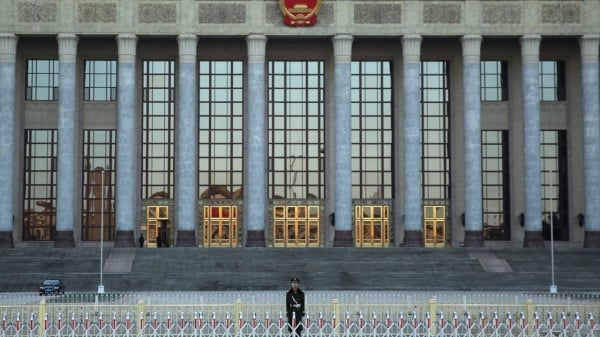
On Oct. 24, the closing ceremony of the Chinese Communist Party’s (CCP) 20th Plenum was abruptly moved from the Jingxi Hotel to the Great Hall of the People in Beijing — a highly unusual decision that immediately triggered speculation of an emergency or crisis within the Party.
Observers were quick to draw parallels to the 2019 19th Plenum, when an alternate Central Committee member reportedly fell to his death at the same hotel, forcing a last-minute venue change. Now, five years later, analysts believe a similar crisis may have unfolded behind closed doors.
Though leader Xi Jinping retained his position as chairman of the Central Military Commission (CMC), (much to the surprise of analysts), political commentators say his authority has been severely weakened. The Plenum reportedly showed unusual vacancies in top Party and military ranks, suggesting internal turmoil within the CCP’s top echelons.
RELATED: Beijing Daily’s ‘Population Extraction Manual’: The CCP Shows Its Fangs
Empty seats
Success
You are now signed up for our newsletter
Success
Check your email to complete sign up
According to commentator Zhong Yuan, only 168 Central Committee members attended the 20th Plenum — 31 fewer than the previous session — meaning over 15 percent were absent. Among them were officials already dismissed, such as former CMC Vice Chair He Weidong, and others believed to be under investigation or unwilling to participate.
CCTV footage showed three rows of empty seats at the conference center, one still with a teacup placed on the table — implying some delegates were removed at the last minute. Analysts say such images hint at a serious split within the Party’s top leadership.
Political commentator Tang Jingyuan noted that two sensitive military figures — General Wang Qiang of the Central Theater Command and Tibet Military Commander Wang Kai — unexpectedly appeared at the meeting. Both are considered loyal to Zhang Youxia, a rival power center within the CMC.
Tang highlighted earlier irregularities: Wang Qiang was supposed to command the Sept. 3 military parade but was sidelined; Wang Kai failed to attend Xi’s August visit to Tibet. “These are not coincidences,” Tang said. “They show Zhang Youxia’s team no longer wants to stand behind Xi Jinping publicly.”
Dwindling power
Rumors swirled on Oct. 20, the day the Plenum opened, that Xi would step down as military chief and Zhang Youxia would take over. That did not happen, but U.S.-based commentator Chen Pokong believes Xi’s authority has already been hollowed out.
“Although Xi kept his three titles, he has lost decision-making power — especially over personnel,” Chen said. “At the start of his third term, he is already a seriously lame leader.”
Tang added that both CMC vice chairmen are aligned with Xi’s political rivals and that no core military figures remain loyal to him. “Essentially, Xi is a commander without an army — the CMC is three against one,” Tang said.
According to Tang, the Defense Ministry’s recent announcement of nine generals being sacked reflects a power struggle between Party and military factions. Although the Plenum formally approved the purge, state media has remained silent, “highlighting the split between Party authority and military command.”
‘Xi’s private army’
On Oct. 25, former Central Party School professor Cai Xia revealed on her program “Fangfei Time” that former CMC officials Miao Hua and He Weidong secretly formed an armed unit in Hebei’s Langfang region — a force reportedly outside the CCP’s official military structure.
Cai said the unit was nominally ranked as a “deputy division,” but its equipment and funding matched a “deputy army level,” a classic example of low rank with high resources. The chain of command, she claimed, answers only to Miao and He — not to the PLA or the CMC. “This was a force tailor-made for Xi Jinping — his personal bodyguard and backup army,” said Cai, adding, “Langfang was chosen because it’s close to Beijing, allowing rapid deployment to protect Xi in a crisis.”
Cai also stated she had heard about the force through multiple sources inside the system but had not publicly disclosed it until now. The report has not been independently verified.
A commentary from the account Old Farmer Asks the Way suggested the force may have been established under the cover of creating a new “Information Support Force,” enabling it to bypass normal PLA oversight through Miao Hua’s political department.
A Party at war with itself
If true, the unit may have been an attempt by Xi to retain influence after losing formal control of the military — a plan that was ultimately intercepted by anti-Xi factions within the PLA.
Commentator Zhou Xiaohui believes something major occurred at the Plenum that the regime has yet to disclose. “Xi’s authority was likely severely challenged, but for the sake of preserving the Party, the factions chose compromise,” he wrote.
Though the Plenum has formally concluded and Xi still holds his titles, experts say the power struggle is far from over. As Zhou noted, “Xi’s weakened control, his confrontation with the military, and his clashes with Party elders remain unresolved — ensuring continued instability at the top of the CCP.”
Editorial note: The following report compiles claims and background details currently circulating online. None of these allegations have been independently verified.