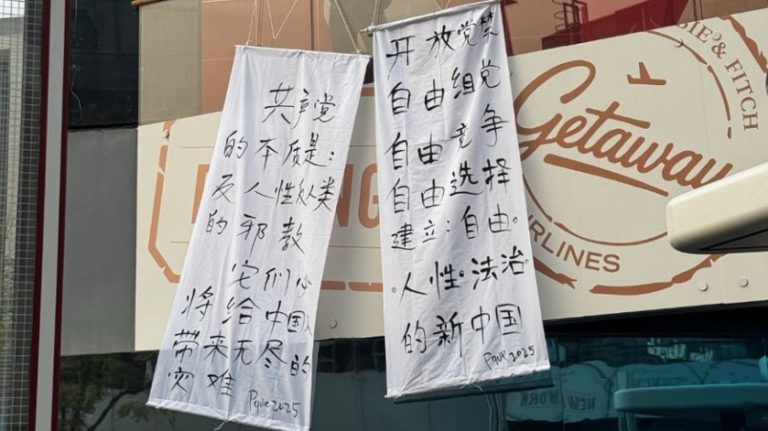
Two rare anti-Communist banners appeared briefly in central Beijing on Oct. 25, just two days after the Chinese Communist Party (CCP) concluded its sensitive Fourth Plenary Session—an unusually bold act of dissent in the Chinese capital.
Photos circulating on X (formerly Twitter) showed two long white banners hanging over a street in Sanlitun, a popular commercial area frequented by diplomats and foreign visitors.
The messages read: “The Communist Party’s nature is that of an anti-human cult. It will bring endless disasters to China.”
“Lift the party ban. Allow free political parties, free competition, and free choice. Build a new China founded on freedom, humanity, and the rule of law.”
Security guards reportedly removed the banners within minutes. While Vision Times could not independently verify the authenticity or timing of the images, they spread rapidly across Chinese-language social media and were widely shared among overseas users.
Success
You are now signed up for our newsletter
Success
Check your email to complete sign up
Despite Beijing’s near-total online censorship, news of the banners triggered an outpouring of support among overseas Chinese communities and social-media users.
A user identifying as Shaonan Xu wrote that hanging a banner in Beijing during such a politically sensitive week showed “extraordinary personal courage and a deep longing for freedom.”
Another user, Bocal, commented that “society is slowly awakening,” adding that democratic change “will ultimately come when ordinary people demand it.”
User Maoan Xu wrote that after a century of existence, the CCP “has become the world’s largest criminal organization of corruption,” harboring “the most corrupt officials and the greatest sums of bribery—all under absolute political control.”
He further accused the Party of exporting anti-democratic ideology abroad, supporting Russia’s invasion of Ukraine, and aiding terrorist groups such as the Taliban, Hamas, and the Houthis.
Domestically, he alleged, the regime carries out forced organ harvesting, suppresses democracy advocates, and plunders citizens’ wealth—calling it “the largest terrorist organization in the world.”
Another commentator, Ziyousuiwo, compared the Sanlitun banner incident to earlier acts of defiance:
- The Sitong Bridge protest by Peng Zaizhou in 2022;
- The Loudi banner case in Hunan (2024);
- The Chadianzi protest in Chengdu (April 2025); and
- The University Town demonstration in Chongqing (Aug. 2025).
He observed that the intervals between such protests “are growing shorter,” while their messages—freedom, democracy, and an end to CCP rule—remain unchanged.
“This suggests,” he wrote, “that a broader wave of social protest may be drawing near.”
Echoes of a 2004 publication: ‘The CCP Is a Cult Against Humanity’
The phrase “anti-human cult” mirrors one of the core assertions made in The Nine Commentaries on the Communist Party, a 2004 publication by The Epoch Times analyzing the CCP’s ideology and political structure.
The book describes the Party as a “cult that rejects divine belief, glorifies violence, and destroys human morality.”
It outlines six defining characteristics of what it terms the CCP’s cult-like nature:
- Fabricating doctrine and eliminating dissent.
- Idolizing its leader while forbidding rivals.
- Using indoctrination and coercion to control members.
- Glorifying bloodshed and demanding loyalty through sacrifice.
- Suppressing spirituality and conscience.
- Seizing power by force and monopolizing the economy for political ambition.
The Nine Commentaries argue that a century of communist rule has brought “red terror” to much of the world—causing tens of millions of deaths through revolution, famine, and repression.
Observers note that even short-lived protests like the Sanlitun incident carry symbolic weight in today’s hyper-surveilled China, where dissent is met with immediate punishment.
Though the banners lasted only minutes, their message—amplified by the internet—has resonated with those who see the CCP as increasingly disconnected from human values and moral restraint.
As one overseas commenter summarized: “In a country where speech itself is a crime, even a single banner becomes an act of heroism.”
By Muzi Li