To watch the full episode, please click on the FinalWar’s official YouTube channel here.
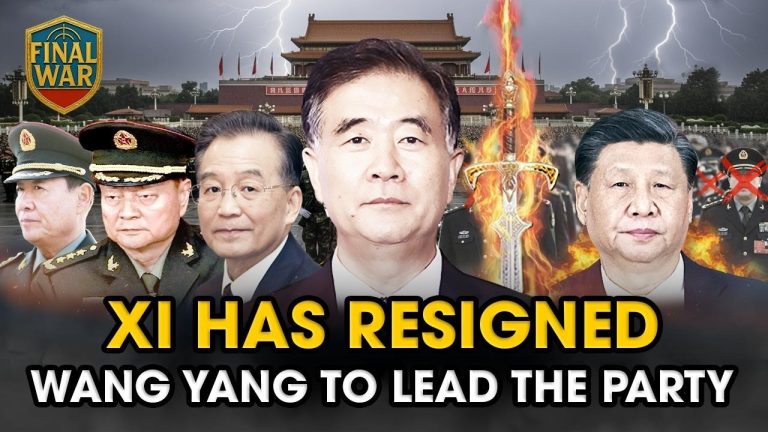
In a development that could reshape the future of China’s leadership, the recent plenary meeting inside the Chinese Communist Party (CCP) has revealed what analysts are calling a secret power shift — one in which the reform-oriented wing of the Party appears to have seized the initiative and positioned Wang Yang as the reluctant yet much-needed successor.
According to FinalWar host Katherine Hu, “On Oct. 20, the opening day of the meeting… Xi Jinping, now weakened but still holding his titles, was required to lead by example.” But in an unprecedented move, Xi reportedly delivered “a lengthy self-criticism, admitting to a series of major mistakes made since the Twentieth Party Congress… Taking responsibility, he asked to step down as General Secretary and Chairman of the Central Military Commission.”
RELATED: Exclusive: Record-Breaking Military Purge at China’s Fourth Plenum Raises Major Red Flags
What follows is the narrative of Wang Yang and how his journey took him from the lowest rungs as a factory worker to the highest echelons of Chinese politics — and the broader story of what appears to be a subtle but significant shift in power away from Xi and toward the reformist camp led by Wen Jiabao.
The hidden drama behind the Fourth Plenum
Success
You are now signed up for our newsletter
Success
Check your email to complete sign up
The Fourth Plenary Session, as convened by the party’s top leadership, was officially presented as a review of the “Fifteenth Five-Year Plan.” But insiders describe the meeting as far more consequential: A showdown over the very soul of the Party. The battle, in effect, mirrored the historical clash between Mao Zedong’s hard-line legacy and Deng Xiaoping’s reform-and-opening path.
Inside Zhongnanhai, Xi’s control over the military was reported to have finally eroded. In what amounts to a forced transition, the Coordination Body under Wen’s leadership formally endorsed Xi’s exit as General Secretary. Wang Yang was appointed as acting General Secretary, and General Liu Yuan temporarily assumed leadership of the Central Military Commission.
“Wang Yang would serve as acting General Secretary until the 21st Congress,” said Hu, adding, “And Liu Yuan would temporarily head the Central Military Commission.” So despite Xi retaining his titles in an official capacity, the power levers appear to have shifted.
The reformist faction prevails
Wen Jiabao’s intervention at the session was decisive, noted Hu. During the Fourth Plenum, Wen reportedly argued that the anti-corruption campaign initially justified by Xi had devolved into “a political weapon… What began as discipline had become suppression. The result was chaos inside the Party.”
“Unity was essential: the Party must recognize its mistakes, abandon the far-left course, return to reform and opening, and once again make economic development the center of national policy,” Wen was heard telling the Central Committee. In other words: The reform wing, once sidelined, has made its comeback. Their victory means not just a change of faces but a pivot in ideology — away from ideology-first control, toward economic growth and openness, notes Hu.
Because Xi’s resignation was voluntary, the investigation into Li Keqiang’s case will “remain permanently buried.” In the world of Chinese elite politics, what doesn’t get written down still gets acted upon.
Wang Yang: From hand-cart to high politics
The man now at the center of this transition is Wang Yang — and his story is worth knowing because it is the story of how a reformist China might look, Hu points out. He was born in 1955 in rural Anhui Province; where he started pulling a handcart at the age of eight to help his family make ends meet. Villagers recalled how “he had crawled out of the mud,” said Hu.
Yet by age 33, Wang had become mayor of Tongling City — the youngest city mayor in China at the time. During his time at the helm, Wang launched bold initiatives such as “breaking the three irons” (iron rice bowl, iron chair, iron wage) during a time of economic reform and state-enterprise turbulence.
When he published “Wake Up, Tongling!”, he wrote: “History will not allow us to keep sleeping on the pillow of the planned economy. We must break through ideological boundaries.”
His success in Chongqing and later in Guangdong, especially his handling of the 2011 Wukan protests with open negotiation rather than force, earned him the reputation of a “reformist pioneer” within the Party’s ranks. “The decision stunned both domestic and foreign observers,” noted Hu. “For the first time in decades, a provincial Party chief had allowed democratic procedures to resolve a mass protest.”
The detour and comeback of a reform-leader
Wang’s road to the very top was not straightforward. Once tipped to become premier, he found his path blocked when Xi Jinping emerged as the compromise candidate amid factional divide.
Wang ended up in what was widely seen as a ceremonial role: Head of the CPPCC (Chinese People’s Political Consultative Conference). A moment described in the FinalWar episode encapsulated this sidelining: During the 2022 Party Congress, when Hu Jintao was publicly escorted out, Wang sat motionless, his face expressionless.
In early 2023, he withdrew even further from public life, telling the media that he wanted to “prioritize family and avoid politics altogether.” The narrative alludes that in May 2023 he was depicted in a video quietly chatting with his wheelchair-bound mother, in what some observers saw as a “signal that Wang had no political ambitions left.”
But fate intervened. In mid-2024, during a senior level health crisis involving Xi, senior reformist elders reportedly visited Wang three times to persuade him back into public life. He agreed — and now, behind the scenes, he stands as the central figure in what many are calling the “post-Xi era.”
What happens next?
If the reformists led by Wen and Wang succeed in their turnaround project, China may yet shift toward a model of governance that emphasizes economic openness, collective leadership, and partial liberalization. If they fail, the risk is that centralization and ideological control will deepen further, with consequences far beyond Beijing, notes Hu.
For now, the world watches a leadership transition crafted not in broad daylight, but in secretive meetings within the Party’s top ranks. Wang Yang’s rise is both symbolic and strategic: A reformist heir personally groomed by Wen Jiabao rising at a time when China’s politics face a key turning point.
As Hu notes, “Where this power struggle leads next — and what role Wang Yang will ultimately play — may soon define the next chapter of China’s political transformation.” And for millions inside the Party’s machinery, that transformation could mean a chance at freedom, or at least a path to survival.
To watch the full episode, please click on the FinalWar’s official YouTube channel here.