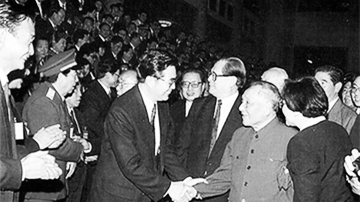
In terms of reform and opening-up, Jiang Zemin made little mark, falling far behind predecessors like Hu Yaobang and Zhao Ziyang. But in the art of political maneuvering, Jiang excelled, surpassing both. After ascending to power, he orchestrated a comprehensive reshuffle of personnel, filling Zhongnanhai with his Shanghai associates and consolidating what became the powerful “Shanghai faction,” positioning himself as its de facto leader. Key figures in the faction included Zeng Qinghong, Wu Bangguo, Huang Ju, Chen Liangyu, Chen Zhili, and the retired yet influential Wang Daohan, whom Jiang treated as a mentor.
Zhu Rongji, also from Shanghai but directly promoted by Deng Xiaoping, was not aligned with Jiang, creating subtle tensions. The Shanghai faction’s dominance in the Politburo was such that a joke circulated: after a meeting, someone asked former Premier Li Peng, “What was discussed?” He reportedly replied, “I didn’t understand anything—they all spoke Shanghainese.”
Under Jiang, factional or “clique politics” reached unprecedented heights. This trend extended downward, encouraging localism and regional cliques across the country, spawning labels such as the Beijing faction, Guangdong faction, and Fujian faction. One of Jiang’s major political maneuvers was the ousting of the “Yang family clique.”
In the spring of 1992, Deng Xiaoping’s southern tour revealed his dissatisfaction with Jiang, hinting at a possible replacement. Jiang publicly offered a contrite self-critique but simultaneously denounced the Yang brothers—Yang Shangkun and Yang Baibing—for controlling military power with questionable intentions. Of particular concern to Deng was the Yangs’ alleged desire to reverse the 1989 Tiananmen verdict. Faced with two risks, Deng judged Jiang’s leftist tendencies less dangerous than the Yangs’ rightist ambitions and potential for political rehabilitation.
By autumn 1992, just before the 14th National Congress, Deng decisively curtailed the Yangs’ military authority. The Yang family clique was removed from power, while Jiang turned a precarious situation into a triumph, solidifying his position and emerging stronger than before.
Success
You are now signed up for our newsletter
Success
Check your email to complete sign up
Jiang Zemin’s era: Luck, legacy, and diplomatic spectacle
During his tenure, Jiang Zemin benefited from a peculiar stroke of fortune: a succession of senior Communist Party elders—including Deng Xiaoping, Chen Yun, Deng Yingchao, Peng Zhen, and Yang Shangkun—passed away, leaving Jiang to ceremoniously “see them off” with feigned solemnity, privately feeling a mix of relief and satisfaction. Over time, Jiang’s era gradually took shape, with him firmly at the helm.
After retiring, in July 2006 the Party published Records of Jiang Zemin’s Overseas Visits, followed in August by Selected Works of Jiang Zemin. Observers speculated: was Jiang staging a comeback? The answer soon became clear: Jiang and Hu Jintao had reached a tacit agreement. Hu’s publication of Jiang’s works elevated Jiang’s historical standing, while Jiang tacitly allowed Hu to handle Jiang’s protégé Chen Liangyu, consolidating Hu’s authority.
Shortly thereafter, Hu abruptly ordered the arrest of Chen Liangyu, a key Shanghai faction figure. The publications coincided with Jiang’s 80th birthday on Aug. 17, signaling both homage and an attempt to “close the book” on Jiang’s era. Hu’s high-profile promotion of “studying Jiang’s works” from Zhongnanhai carried a subtle message: Jiang, you’ve had your time; step back and let the fourth generation take the stage.
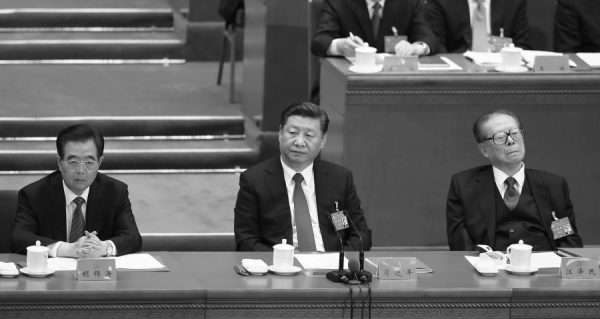
In other words, Hu intended to use the books to formally draw a line under Jiang’s tenure. Yet, the 17th Party Congress the following year showed Hu’s efforts were only partially successful. During the years when Jiang, Li Peng, and Zhu Rongji appeared together, commentators wryly dubbed them “the actor, the madman, and the fool.” Jiang, the “actor,” dominated the diplomatic stage, showcasing both flair and occasional absurdity.
Records of Jiang Zemin’s Overseas Visits ostensibly chronicled Jiang’s diplomacy but also highlighted his slick, sometimes superficial persona. Some of the portrayal may have been colored by Hu’s subtle flattery, which inadvertently exposed Jiang’s foibles.
Former U.S. First Lady Hillary Clinton recalled that Jiang slammed the table in anger when Tibet was mentioned, displaying crude and impolite behavior. Former Secretary of State Madeleine Albright described Jiang as a “grinning cat” who frequently bared his teeth and enjoyed showing off, occasionally mixing in broken English, leaving U.S. interpreters perplexed.
During a visit to Russia, Jiang insisted on delivering a two-hour speech in Russian before the national parliament, reading almost verbatim from his notes. Lawmakers and ministers were visibly uncomfortable, whispering among themselves. One member reportedly exclaimed in exasperation, “God, what on earth is he mumbling?” At the conclusion, another sighed in relief: “Thank heavens it’s finally over.”
Jiang Zemin: Retired but ever-present in China’s power struggle
Jiang Zemin’s tenure and retirement reveal a calculated blend of opportunism, influence, and performative diplomacy. During his rule, Jiang benefited from the passing of senior Communist elders—Deng Xiaoping, Chen Yun, Deng Yingchao, Peng Zhen, Yang Shangkun—allowing him to quietly consolidate power while feigning solemnity. Over time, the Shanghai faction under his leadership became entrenched, forming the backbone of his political legacy.
Even after retirement, Jiang remained actively involved in political affairs. In 2006, the Party published Records of Jiang Zemin’s Overseas Visits and Selected Works of Jiang Zemin, seemingly to cement his historical status. In practice, these publications were part of a tacit arrangement with Hu Jintao: Hu elevated Jiang’s image, while Jiang tacitly allowed Hu to handle Jiang’s protégé Chen Liangyu. Soon after, Chen Liangyu was arrested, signaling both a consolidation of Hu’s authority and a symbolic closure to Jiang’s era, even as Jiang retained informal influence.
Jiang’s foreign appearances further reinforced his idiosyncratic style and controversial legacy. In Paris, he spontaneously pulled France’s President Chirac’s wife into a waltz while waiting for an elevator; in Madrid, he comically combed his hair in front of Spain’s king and international dignitaries; in Ankara, he preemptively pinned a controversial medal around his own neck before the Turkish president could do so. These spectacles, often leaving observers baffled, became emblematic of his theatrical approach to diplomacy. Former U.S. officials recalled his volatile and showy behavior: Hillary Clinton noted Jiang’s outburst over Tibet, while Madeleine Albright described him as a “grinning cat” prone to flaunting his limited English. In Russia, his two-hour scripted speech in the national parliament left lawmakers visibly perplexed, whispering among themselves and relieved when it ended.
Domestically, Jiang’s rule was marked by ruthless suppression and human rights violations. His most notorious acts include orchestrating the brutal crackdown on Falun Gong, resulting in thousands of deaths and hundreds of thousands imprisoned or tortured. His Selected Works reveal his direct role in silencing political dissent, including Zhao Ziyang, and his complicity in maintaining the cover-up of the 1989 Tiananmen massacre. Jiang’s self-perception and determination allowed him to consolidate power and neutralize rivals, consistent with the principles outlined in Li Zongwu’s “Thick Black Theory”: success often goes to those who combine audacity with political cunning. Jiang’s handling of the Yang family clique, Qiao Shi, and Li Ruihuan illustrates his mastery in defeating opponents both technically and strategically.
The 16th Party Congress, orchestrated under Jiang’s guidance, expanded the Politburo Standing Committee to nine members and the Central Military Commission to eleven, securing key positions for his allies. Although Hu Jintao formally assumed top Party and state positions, Jiang’s influence diluted Hu’s real power, leaving him largely constrained.
Even by the 17th Party Congress, the delicate interplay between Jiang and Hu remained a central point of intrigue. Hu’s promotion of the “Scientific Outlook on Development” was in practice a subtle counterpoint to Jiang’s “Three Represents,” yet both ideologies served more as symbolic banners than substantive guides. Party insiders noted that the intense jockeying over leadership positions before the congress, including a half-hour delay in the Standing Committee’s public reveal, underscored ongoing factional tensions between Jiang’s allies and Hu’s camp.
Jiang’s post-retirement interventions drew repeated international attention. From 2002 to 2003, as China’s media speculated on the orderly handover of supreme power, Jiang retained the chairmanship of the Central Military Commission, emulating Deng Xiaoping. Even after relinquishing that post in 2004, he continued to exercise influence through the Shanghai faction, effectively checking Hu Jintao.
On Oct. 1, 2009, during the 60th anniversary of the People’s Republic of China, Jiang appeared prominently at Tiananmen Square, occupying the second-most visible position among Party and state leaders. Amid parades, military displays, and celebrations, it was Jiang—not Hu or Premier Wen Jiabao—who dominated the stage, highlighting the enduring strength of his political persona and the subtle sidelining of other leaders.
Jiang’s career illustrates the intricate blend of opportunism, theatrical diplomacy, and enduring factional influence that characterized his era—an era in which formal titles often belied the true balance of power within the Party.