By Yin Hua, Vision Times
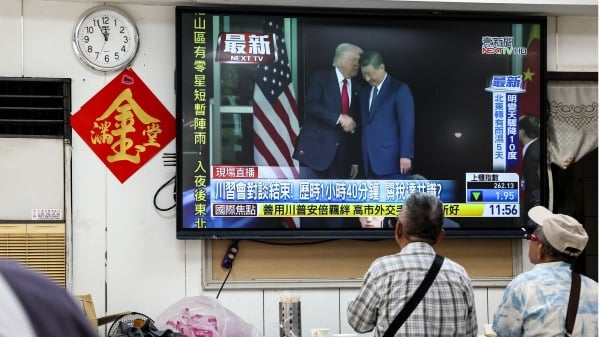
On Oct. 30, U.S. President Donald Trump and Chinese leader Xi Jinping held their first face-to-face meeting since Trump’s return to the White House. The two world leaders last met in 2019. The talks, which lasted around one hour and forty minutes at Busan’s Gimhae International Airport, touched on key issues including trade tariffs, rare earth exports, the fentanyl crisis, and Taiwan.
While state media framed the summit as a “positive breakthrough,” analysts say it exposed Beijing’s growing vulnerability — and Xi’s increasingly defensive posture. “This so-called ‘fight without breaking’ strategy has failed,” noted political commentator Du Wen, describing Xi’s concessions as “a thinly-veiled surrender.”
MORE ON THIS: Inside Trump’s ‘12 Out of 10’ Summit With Xi: Tariff Cuts, Rare Earth Deal, and Soybean Purchases
‘A thinly-veiled surrender’
Trump’s high-profile Asia trip, spanning Malaysia, Japan, and South Korea, marked a decisive bid to reclaim America’s strategic influence in the region. Beginning with mediating the Thailand–Cambodia border conflict, Trump’s whirlwind diplomacy delivered a series of economic victories — securing more than $70 billion in new investments from ASEAN nations, while reinforcing U.S.-aligned supply chains that exclude China.
Success
You are now signed up for our newsletter
Success
Check your email to complete sign up
In Malaysia and Thailand, Trump leveraged his “reciprocal tariff” policy, warning that countries resisting U.S. trade deals could face tariffs between 10 and 40 percent. By contrast, countries signing on, including Malaysia, Thailand, and Vietnam, would receive market access and investment benefits.
Commentator Jiang Feng described the results as “a masterstroke of economic statecraft,” noting that ASEAN nations are shifting away from dependence on Chinese supply chains and aligning instead with American-led markets. “The message is clear,” Jiang said. “While Beijing’s rhetoric hardens, its leverage evaporates.”
Xi’s concessions
Observers noted that the Trump–Xi meeting in Busan featured three major concessions from Beijing, signaling both domestic political pressure and international weakness, including:
- Rare Earths: Beijing agreed to delay its rare earth export ban by at least one year — a striking reversal after months of nationalist posturing.
- Fentanyl: China promised to “strengthen enforcement” on precursor chemical exports, in exchange for Washington halving tariffs on related imports.
- Agricultural imports: China pledged to restart large-scale U.S. soybean purchases, reportedly committing to $500 billion in American goods over the next three years.
“These moves are not diplomacy — they’re submission,” said commentator Du Wen, adding, “Xi lifted the rare earth card high, only to drop it softly. He’s been slapped into compliance.”
Analyst Jiang Feng went further, arguing that the concessions reflected an internal power shift: “The so-called ‘Hu faction’ — pragmatic veterans tied to former leader Hu Jintao — have reasserted control. Xi merely signed the surrender note they drafted.”
An economic mirage
Xi arrived in South Korea touting a 5.3 percent GDP growth rate, claiming that China’s economy was “stable and resilient.” But independent observers dismissed the figures as grossly inflated. Du Wen described it as “a systematic fraud,” explaining that Beijing’s local governments artificially inflate production figures by marking up invoices, refunding kickbacks, and counting losses as revenue.
“The reality is grim,” Du said. “Retail sales have fallen for six straight months, real estate investment has collapsed 41 percent, and manufacturing PMI has slipped below 50. These aren’t the numbers of a healthy economy — they’re signs of an economy on life support.”
In recent years, China has grappled with a cascading economic slowdown fueled by a property market in freefall, mounting local government debt, and shrinking consumer confidence. Once the backbone of its growth, the real estate sector now sits at the center of the crisis, with unfinished housing projects, bankrupt developers, and millions of citizens refusing to pay mortgages on stalled homes. The collapse of giants like Evergrande and Country Garden has sent shockwaves through China’s financial system, eroding public trust while drying up liquidity.
Economist Lao Deng added that the collapse of local debt, housing markets, and overcapacity has left China’s financial system “rotting from within.” “It’s like a cancer patient with AIDS,” he said bluntly. “Every system is failing, but Xi still insists the patient is in great health.”
Control vs. innovation
Among Trump’s key demands during the summit was internet liberalization — a long-standing U.S. goal tied to market access for major American tech firms. According to analysts, internal divisions within the CCP have intensified over whether to open the web.
RELATED: Xi’s Military Purge Intensifies: Zhong Shaojun’s Mother Detained, Air Force Chief Ma Xiaotian Probed
The reformist camp argues that tight censorship is crippling China’s innovation and foreign trade competitiveness, while the hardliners insist that digital openness threatens regime survival. “There are roughly 200 million Chinese who regularly use VPNs,” Du noted. “The wall is already cracked — it’s just a matter of when it collapses.”
Lao Deng warned, however, that Xi remains aligned with the conservative faction, favoring partial “sandbox openness” for select sectors under heavy surveillance. “The leadership believes that security comes before growth,” he said, “but in doing so, they’re sacrificing both.”
The CCP’s growing fractures
Despite exchanging pleasantries like smiles, photo-ops, and handshakes, insiders say the Trump–Xi summit was less so a diplomatic meeting and more a political test of Xi’s dwindling authority. “This wasn’t a U.S.–China negotiation,” Jiang Feng asserted. “It was a Hu Jintao–era correction session. Xi was just turning in homework written by someone else.”
RELATED: ‘Hit the Nail on the Head’: Video of Japanese Lawmaker Criticizing Xi Jinping Goes Viral
Analysts agree that the so-called détente merely masks a deeper fracture within the CCP. As pragmatic factions push for economic realism and foreign reconciliation, Xi’s ideological rigidity and autocratic control have left him isolated.
“The Busan kneel,” Jiang noted pointedly, “marks the moment when Xi’s supremacy cracked. The façade of unity is gone — and China’s future is now being rewritten behind closed doors.”
A new phase in US–China relations?
For now, Washington and Beijing appear to have resumed a “fight without breaking” dynamic — cooperation wrapped in confrontation. But experts warn that the underlying tensions are only growing.
Trump’s assertive Indo-Pacific strategy, combined with the realignment of ASEAN and renewed Japanese and Korean partnerships, leaves Beijing cornered both economically and diplomatically.
“The CCP’s house is divided,” Lao Deng concluded. “Xi’s legitimacy is eroding, the economy is weakening, and the military is in turmoil. The real question isn’t whether China will change — it’s who will be in charge when it does.”
Editorial note: Views expressed in this article are the opinions of the author and do not necessarily reflect the views of Vision Times.