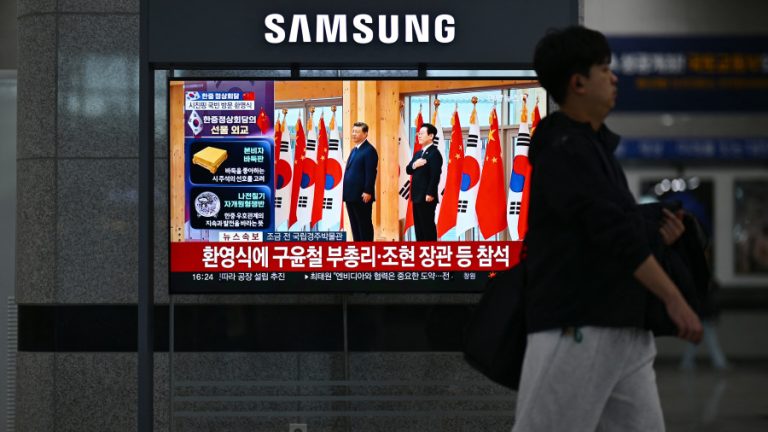
Before leaving South Korea after the APEC Summit, Chinese President Xi Jinping met with South Korean President Lee Jae-myung for a brief bilateral exchange and gift ceremony.
According to JoongAng Ilbo, the two leaders exchanged presents before their formal meeting began.
Lee offered LG Household & Health Care cosmetics for Xi’s wife Peng Liyuan, along with a white porcelain tea set, a go board made from Korean torreya wood, and a mother-of-pearl lacquer tray.
Xi, in return, presented Lee with two Xiaomi flagship smartphones, a traditional Chinese tea set, a jade-handled calligraphy brush, and inkstone from Zhaoqing’s historic Duanzhou region.
Xi reportedly remarked that the tea set was perfect for Chinese kung fu tea. After hearing the translation, Lee responded with a smile, saying it would also suit Pu’er tea.
Success
You are now signed up for our newsletter
Success
Check your email to complete sign up
Chinese officials accompanying Xi proudly noted that the curved screens on the Xiaomi phones were made in South Korea.
Lee then reportedly asked, “How about communication security?” — prompting laughter in the room.
When the translation reached Xi, he was quoted as replying with a grin, “You can check whether there’s a backdoor.”
Lee burst out laughing and clapped his hands, turning what began as a polite gesture into an unexpectedly comic moment.
The exchange quickly drew attention from both South Korean and international commentators.
In recent years, concerns over espionage and surveillance via mobile devices have made phone gifts between heads of state a delicate matter.
China’s Xiaomi phones, while popular worldwide, have repeatedly faced allegations of built-in monitoring software.
Many foreign governments remain wary of potential data collection linked to Chinese tech firms, particularly amid rising geopolitical tensions.
Lithuania’s cybersecurity report: A precedent for concern
According to a 2021 report from Lithuania’s National Cyber Security Centre, Xiaomi’s flagship smartphones sold in Europe contained code capable of detecting and censoring sensitive political terms such as “Free Tibet,” “Long live Taiwan independence,” and “democracy movement.”
The report also found that Xiaomi’s system applications — including the default web browser — maintained a continually updated blacklist of 449 Chinese phrases, with the ability to reactivate censorship functions remotely even if disabled in the EU region.
Lithuanian Deputy Defense Minister Margiris Abukevicius urged citizens to “avoid buying Chinese phones and dispose of existing ones where possible.”
The same report noted that Xiaomi devices sent encrypted user data to servers in Singapore, while Huawei’s P40 5G contained separate security vulnerabilities. Devices from OnePlus, by contrast, showed no such issues.