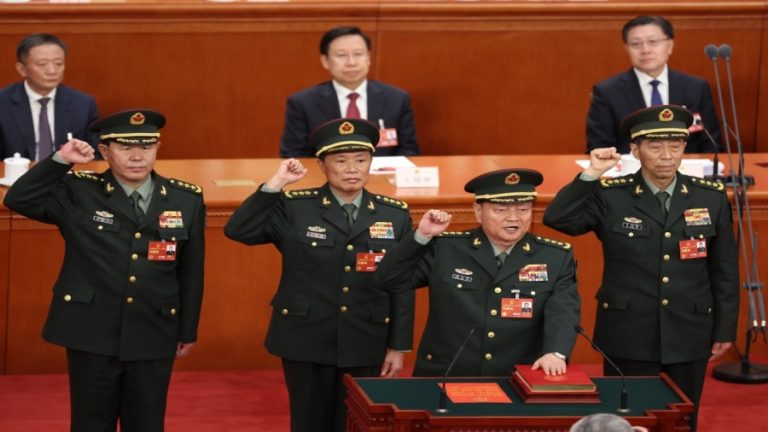
A mysterious mainland social media account called Wind Direction Observer recently published a detailed exposé alleging massive corruption and classified leaks involving former defense ministers Wei Fenghe and Li Shangfu, along with multiple senior officers in the PLA Rocket Force.
The report, which appeared to cite unreleased military prosecution and court documents, was quickly censored after publication — but not before screenshots circulated widely across Chinese and overseas platforms.
According to the post, the timing of the leak—just as nine senior generals were officially dismissed—was “unusually deliberate.”
The article named several top commanders and described in detail how contracts and defense funds were diverted for personal gain.
- Lt. Gen. Wang Hongyao, dubbed the “first tiger” of the Rocket Force, allegedly manipulated procurement contracts by designating fake bidders. He reportedly inflated the unit price of a missile transporter’s tires from 180,000 to 380,000 yuan, laundering the difference through a Hong Kong shell company controlled by relatives.
- Lt. Gen. Zhang Zhen, who oversaw chip contracts for the DF-26 missile, allegedly granted a contract directly to a Beijing-based firm backed by a U.S. investment fund, accepting 117 million yuan in bribes and an $8.5 million Manhattan apartment.
- The report further claimed that in October 2022, the U.S. Congressional Research Service submitted to the Senate Intelligence Committee a 225-page document titled “Order of Battle: People’s Liberation Army Rocket Force.”
Beijing was reportedly “shocked” to discover that the report’s data on missile bases and unit structures matched internal PLA records with 97 percent accuracy.
Success
You are now signed up for our newsletter
Success
Check your email to complete sign up
The leaked appendix allegedly listed eight Chinese military figures collaborating with U.S. intermediaries, labeled R1 through R8 — with “R3” and “R5” purportedly corresponding to Zhang Zhen and Wei Fenghe.
It further alleged that Zhang’s wife received $12 million in “consulting fees” via a Hong Kong middleman.
Gold bars, luxury villas, and secret files
The same post accused former Rocket Force Commander Zhou Yanning, arrested in December 2023, of hiding 328 kilograms of gold, 78 crates of vintage Maotai liquor, and 59 classified operational plans in a private storage room.
According to the alleged court document, Zhou confessed that the gold “belonged to the Americans, to be kept for my grandson’s education in the U.S.”
The supposed judgment excerpt—“This statement was recorded on page 9 of the verdict”—has fueled speculation that the materials came from classified judicial archives.
The same dossier allegedly included a military indictment against Wei Fenghe, who, through his brother-in-law, divided a DF-31AG missile simulator project into twelve subcontracted deals and awarded them to a subcontractor affiliated with Lockheed Martin.
He reportedly received 274 million yuan in bribes and a villa in Los Angeles.
One detail in particular captured online attention: the report claimed that Wei’s son sent him a WeChat voice message saying, “Dad, the house is ours — should we send out the original code for the training software?”
The audio, allegedly intercepted by the FBI and shared with Beijing, was said to have been played in court as key evidence.
Xi’s counterattack against Zhang Youxia?
Observers say the scandal may explain why the DF-31AG intercontinental missile was missing from this year’s September 3 military parade, replaced by a newly designated DF-31BJ.
Commentator Jiang Feng suggested that “it’s not about technical failure — it’s about fear. When the PLA’s own missile simulation software was written by a U.S. contractor, how could Beijing dare to showcase it?”
Analysts believe only those with top-level clearance could have obtained and leaked such documents.
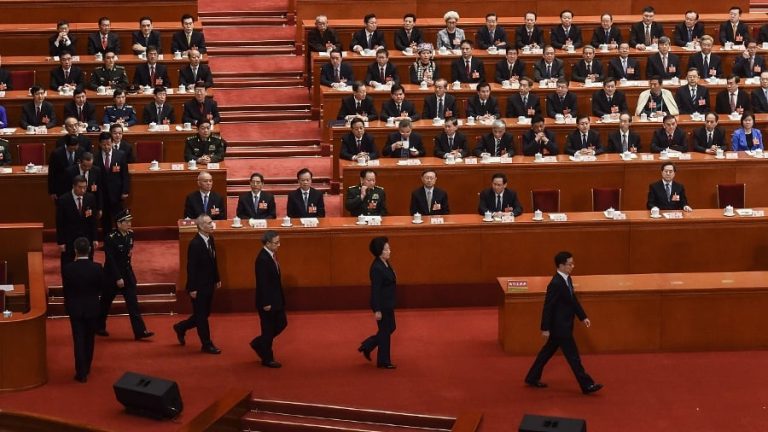
Just weeks before the Fourth Plenum, the Ministry of Defense announced disciplinary actions against nine generals — including He Weidong and Miao Hua — moves interpreted by some as Zhang Youxia’s attempt to pressure Xi.
The sudden exposure of Rocket Force scandals, therefore, may represent Xi Jinping’s counterstrike.
Former PLA Navy officer Yao Cheng told Vision Times: “If the evidence is real, Zhang Youxia will be formally investigated — and that would be the end for him. It’s a life-and-death struggle now. Xi and Zhang are locked in a mortal contest, and no one knows who will fall first.”
In reality, corruption and leakage within the Rocket Force have been widely discussed since the 2022–2023 intelligence breaches.
In October 2022, the U.S. released a 255-page dossier revealing the PLA’s full organizational structure — from headquarters down to individual bases, hospitals, and even kindergartens.
By early 2023, the Pentagon’s leaked documents confirmed that U.S. intelligence had mapped China’s Rocket Force installations with near-complete precision.
U.S.-based China analyst Cheng Xiaonong told The Frontline of Politics and Economics that internal purges and the massive turnover of Central Committee members — 61 absent from the Fourth Plenum — indicate a profound internal crisis.
“After more than a decade of anti-corruption drives, few dare to take bribes,” Cheng said. “The problem now is disobedience — especially in the military.”
He noted that over 30 generals have been removed, not merely for corruption but because many refuse to fight for Xi’s “war preparations.”
“Xi keeps shouting about readiness and confrontation with America,” Cheng said, “but his military only wants money — not war.”
Deliberate leaks as self-preservation
Cheng argued that the Rocket Force’s massive data breach may have been intentional, designed to force Xi to redeploy units and defuse internal purges.
“Once their base coordinates are exposed, they’re useless,” he explained. “By leaking the data, officers protect themselves — Xi can’t purge what he must rebuild.”
Commentator Zhang Tianliang said the Rocket Force scandal underscores the PLA’s systemic rot.
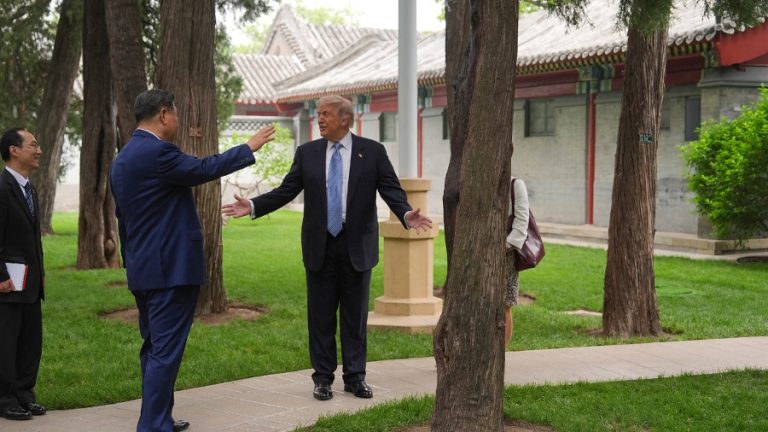
“Trump didn’t even bring up Taiwan in his talks with Xi, likely because he knows Xi can’t launch a war anytime soon,” Zhang noted. “With so many generals purged, no one can tell how many U.S. assets remain embedded in the PLA.”
He added that the newly promoted generals will need years of coordination across services.
“At least three to four years,” Zhang said, “before they can function as a cohesive force. That means Taiwan is relatively safe — for now.”