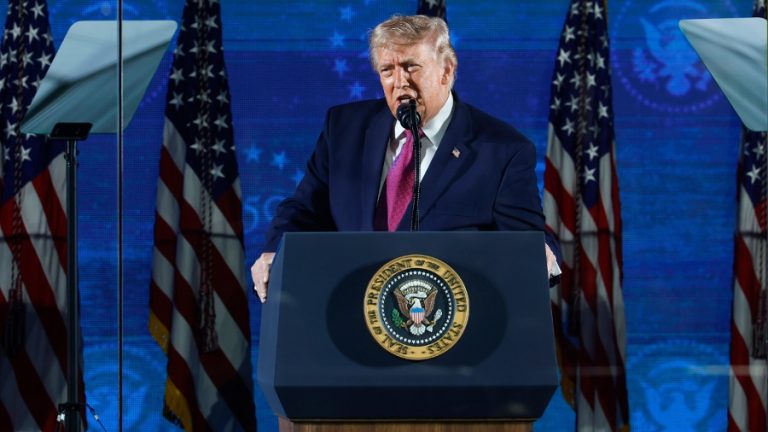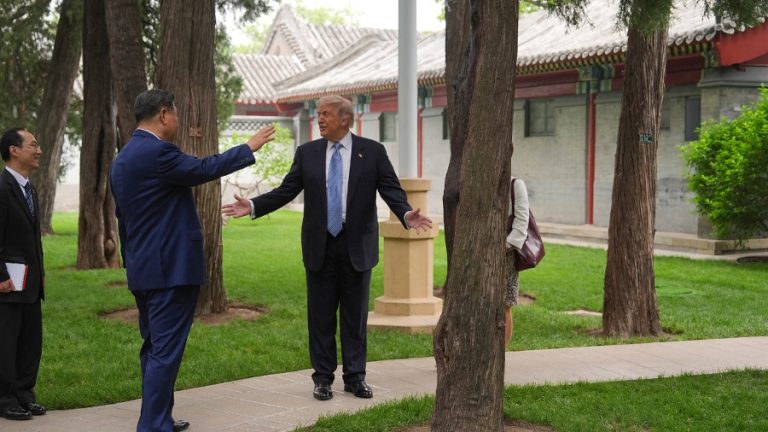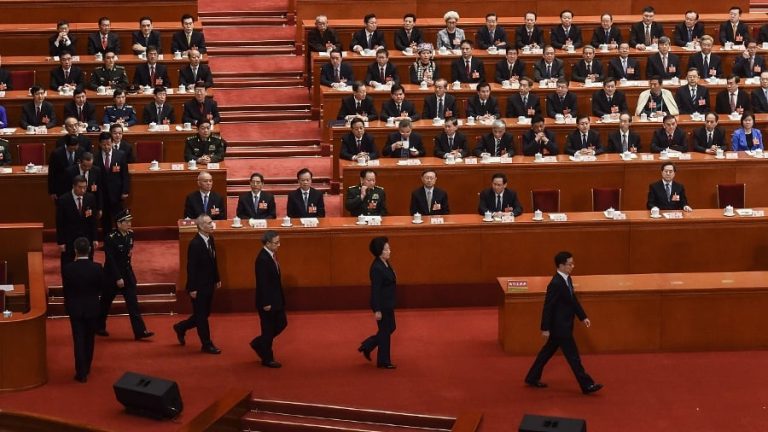
On July 1, 2026 Xi Jinping marked the Party’s 105th anniversary with a roughly forty-minute address at the Great Hall of the People, the Party’s ceremonial hall on the edge of Tiananmen Square in Beijing. State media cast it as a triumphant review of the Party’s history, but overseas critics drew a sharper conclusion: In the speech, Xi sorted more than a century of Communist Party rule into four eras and reserved the newest for himself, a framing they say is meant to rank him alongside Mao Zedong as the founder of a historical epoch. The same address, they argue, revealed a ruler who now governs by permanent struggle, whose anti-corruption campaign keeps devouring his own lieutenants, and who can no longer count on the “absolute loyalty” he demands.
In the speech, Xi Jinping traced more than a hundred years of Chinese Communist Party history and, in a single sentence, split it into four eras. He spoke for roughly forty minutes at the anniversary gathering, according to the Party’s official news agency, Xinhua, running through the Party’s self-proclaimed “achievements” since its 1921 founding. The sentence that drew notice abroad invoked the “great practice” of revolution, construction, reform, and what the Party calls the “new era.” Through all of it, Xi said, “the Party led the people through untold hardships and successfully opened up and held to the path of socialism with Chinese characteristics.”
U.S.-based independent political commentator Cai Shenkun, writing on X, argued that the sentence did far more than summarize. On the surface it read as a tidy recap of Party history. In substance, Cai wrote, it carried out a politically loaded division of that history into distinct eras.
By Xi’s framing, Cai noted, Communist Party history breaks into four periods: a revolutionary era from 1921 to 1949, when the Party seized power; a construction era from 1949 to 1978, devoted to building socialism; a reform era from 1978 to 2012, the decades of “reform and opening,” when Deng Xiaoping steered China toward a market economy after Mao’s death; and a “new era” from 2012 to the present, which the Party labels the age of Xi himself.
In Xi’s scheme, reform is a closed chapter of history and its work is complete. From 2012 onward, in this telling, China entered an entirely new phase, the “Xi Jinping New Era.”
Success
You are now signed up for our newsletter
Success
Check your email to complete sign up
That reordering, Cai wrote, also rearranges the standing of the Party’s leaders. Mao Zedong owns the revolutionary era and, in large part, the construction era that followed. Deng Xiaoping opened the reform era, which Jiang Zemin and Hu Jintao, the two men who led China in the decades before Xi, then carried forward. The “new era” belongs to Xi alone.
The result compresses a century of Party history into three defining figures. Mao stands for revolution and construction, Deng for reform, and Xi for the new era. Two of the Party’s four self-declared epochs are assigned to Mao; the newest is claimed wholly by Xi. In effect, Cai argued, Xi is presenting himself as the second man after Mao to open a historical era of his own.

Xi Jinping uses the ‘new era’ label to reverse his predecessors’ reforms
Xi Jinping’s insistence that his “new era” stands apart from the decades of “reform and opening” amounts to a signal that he intends to roll back the market-oriented course his predecessors set, overseas analysts say. US-based commentator Li Muyang, who hosts a current-affairs program, read the speech as Xi finally getting what he has long wanted, a position above Deng, Jiang, and Hu and level with Mao. By insisting that the “new era” stands apart from “reform,” Li said, Xi is signaling that he intends to “correct” the reform path his three predecessors built and to restore a model in which the Party controls everything. In measuring himself against Mao, Xi is also making a forceful claim that he, like Mao, founds eras, and that he alone gets to define the “correct line” of history.
The speech, Li added, points to Xi’s plan to keep his post at the 21st Party Congress, the leadership meeting expected next year, and to his refusal to allow anyone to contest his authority.
Xi Jinping’s politics of permanent struggle turns every problem into an enemy
Xi Jinping’s address was saturated from start to finish with the language of struggle, a framing critics say turns ordinary economic and social problems into political enemies and locks Chinese society into permanent mobilization. In the speech, Xi described the present as “a period in which strategic opportunities coexist with risks and challenges, and in which uncertain and hard-to-predict factors are multiplying.” He called on the whole Party to sharpen its “sense of adversity” and its “capacity for struggle,” warned that it must “stand ready at all times to withstand major tests of high winds, rough seas, and even perilous storms,” and vowed to press what the Party calls a tough, protracted, all-out battle against corruption.
Cai Shenkun wrote on X that official language dresses this up as political mobilization against risk. At a deeper level, he argued, the constant “discourse of struggle” reveals how badly Xi misjudges the way modern societies function, the way the international order is shifting, and what ordinary people want out of daily life.
A country that keeps a sense of risk is unremarkable, Cai wrote. The danger comes when that sense hardens into a society-wide “philosophy of struggle” that pushes an entire population into permanent tension and mobilization. Where ordinary states meet a crisis with institutional flexibility, legal process, professional administration, and cooperation abroad, Xi’s political vocabulary reaches first for enemies, battlefields, willpower, and the tally of who wins and who loses. Economic decline then gets blamed on foreign encirclement, public discontent is read as infiltration by hostile forces, and reasoned criticism is branded ideological warfare. Every real problem is dragged onto political ground, every governing failure is recast in terms of friend and enemy, and the space to fix anything drains away.
More dangerous still, Cai argued, struggle has hardened from slogan into a working system of rewards. Officials go hunting for “targets of struggle” to show their loyalty, the propaganda apparatus inflates a “narrative of crisis” to keep the “situation grave,” and the security services keep widening the definition of “enemy” to expand their own reach. This inward-turning logic is corroding trust across Chinese society. People wall themselves off from one another and trade in suspicion, each as jumpy as a bird flushed by a bowstring, never sure when or over what they might be cast aside or purged. Xi extracts near-total power by manufacturing enemies, Cai wrote, and the vitality of Chinese society drains away in the process.
Xi’s speech, Cai continued, forcibly ties struggle to national rejuvenation, the Party’s signature promise to restore China to national greatness, as well as to the Party’s leadership and to Xi’s own place in history. The official formula holds that “no matter how powerful the enemy or how treacherous the road, we will never retreat.” Behind that mobilization sits a deep political hazard. Once Xi declares the “direction correct,” any cost can be repackaged as “necessary sacrifice,” and once someone speaks in the Party’s name, any doubt can be branded treason. The boundary between friend and enemy, the test of victory and defeat, and the very meaning of “loyalty” all rest in the hands of one man. None of that sits easily with the pluralism, bargaining, and self-correction that modern governance requires.
A mature national leader, Cai wrote, should lead a society out of fear instead of endlessly generating it, and should give people ordinary lives free of struggle instead of dragging everyone into smoke-choked trenches. A modern country, in his account, is defined by dignity for every person, oversight of the ruling party, a society that governs itself, limits on power, and the rule of law. It is not produced by forcing an entire population into one mind, one step, and one slogan.
Some online commenters said Cai’s remarks capture how a Party leader steeped in the culture of struggle uses the regime’s engineered hatred and fear to deform and destroy the ordinary lives and thoughts of Chinese people.

Xi Jinping’s ‘anti-corruption’ drive keeps toppling his own appointees
Despite more than thirteen years of Xi Jinping’s signature “anti-corruption” campaign, the drive keeps toppling his own appointees. In the first half of 2026 alone, at least 36 centrally administered officials were brought down, according to the Chinese Communist Party’s internal disciplinary body, the Central Commission for Discipline Inspection. They included Ma Xingrui, one of the roughly two dozen members of the Party’s ruling Politburo, along with seven officials of full ministerial rank. Two of Xi’s own military favorites, He Weidong, a vice chairman of the Central Military Commission that commands China’s armed forces, and Miao Hua, the admiral who ran that commission’s political work department, have likewise been implicated in corruption. Xi again promised in this July 1 speech to press a hard “battle against corruption,” yet the bulletins show that campaign consuming the very loyalists he installed.
In mid-June 2026, an X user posting under the handle “Xin Gaodi” argued that Xi’s rule has hit a dead end. In recent disciplinary bulletins, the user wrote, officials at every level of the Party are not merely corrupt across the board but are also mired in what the Party calls “feudal superstition,” meaning religious or spiritual belief, along with factional cliques, half-hearted enforcement of the Party’s (that is, Xi’s) directives, and disloyalty to the Party and to Xi. So Xi has begun to shift his next set of targets.
What Xi fails to see, the user continued, is that once belief in communism collapsed, the Party’s system of factional “mountaintops,” the personal power bases that officials cluster around, meant that every promotion depends on a patron at the top. Without a “boss” to pull him upward, an official can work himself to death and never rise. In that environment, personal fortunes, connections, and a talent for pleasing everyone become decisive, and Xi himself climbed by exactly these means. This is the long-hardened ecology of Party officialdom. Xi now wants to smash that entrenched system, the user wrote, yet he offers no workable structure to replace it. More absurd still, he tries to substitute a cult of personality, though everyone inside the Party knows precisely what Xi is worth. Does Xi himself not indulge in feudal superstition, the user asked. Does he not build factions? Does he fully carry out the Party’s directives? Is he loyal to the Party? If a man is himself this compromised, how can he demand better of anyone else?
Another X user responded that the episode points to a deeper problem. When promotion, responsibility, and personal safety all hinge on a patron’s favor, the bureaucracy stops functioning as a system of institutions and turns into a system of personal dependency. Such dependency can enforce short-term obedience, the user wrote, but it cannot deliver stable governance, because everyone spends their energy reading the political winds, hunting for a protector, and dodging accountability instead of solving problems. The fix, the user argued, using the term “civic order-ism,” is to shift power away from loyalty to individuals and toward adherence to process, so that responsibility can be traced, problems can be raised, power runs up against limits, officials no longer survive by attaching themselves to a patron, and society is no longer hostage to the politics of personal connection.
READ MORE:
- Trump Jokes, ‘I’m the Boss’ but Xi Jinping Dreams of Becoming the Global ‘Supreme Leader’
- Xi Jinping’s Manufacturing Obsession Is About Saving the Party, Not Helping Ordinary Chinese
Why party officials increasingly withhold the ‘absolute loyalty’ Xi Jinping demands
Xi Jinping’s demand for “absolute loyalty” is increasingly going unmet, and the resentment inside the Party predates this year’s anniversary speech. In November 2025, Australia-based Chinese legal scholar Yuan Hongbing told Vision Times that since the Party’s 20th Congress in 2022, the gathering that handed Xi a norm-breaking third term, his mass purges and “rectifications,” the Party’s term for disciplinary campaigns that force officials back into line, have been running at high speed with what Yuan called an “end-times madness.” Senior officials, he said, now fear for themselves, unable to eat or sleep, never knowing when disaster will fall. Yuan relayed an assessment he attributed to conscience-driven insiders within the Party. As they see it, the root of everything is a demon in Xi’s own mind, a man who has sunk into the psychological pathology of paranoid delusion.
What frightens Xi most now, in Yuan’s account, is what Xi perceives as the treachery of the people around him, a fear that runs deeper than any worry about being overthrown. Xi has come to believe that his closest aides and confidants are all “two-faced,” fawning to his face while privately mocking and despising him and stopping at nothing. Some, he suspects, even regard him as an enemy. Yet Xi lacks the intelligence or the capacity, Yuan said, to grasp a basic fact. The treacherous predicament he finds himself in is the product of his own foolishness.
The overwhelming majority of Party officials, Yuan argued, will happily pledge their so-called “absolute loyalty” to power, money, and lust. To Xi himself, they will not. In the eyes of most officials, Yuan said, Xi’s competence at the actual work of governing has fallen toward negative numbers, while in the arena of raw power struggle he comes across as devious, brutal, and vicious. “How could anyone willingly hand ‘absolute loyalty’ to a two-handed monster as dull as a pig and as cunning and venomous as a scorpion?” Yuan asked.
By Li Deyan