China is facing an unprecedented convergence of political and economic turmoil.
According to Chinese entrepreneur Hu Liren, host of the YouTube program Real China, Xi Jinping’s rule is steering the nation into what he calls a “Great Calamity Era.”
Hu argues that Xi’s personalized power structure and loyalty-first governance have hollowed out the state’s administrative capacity.
Economist Cheng Xiaonong offers a complementary diagnosis: the collapse of China’s real estate bubble, the erosion of household wealth, and the flight of foreign capital have shattered the myth that China could one day surpass the United States.
The Collapse of Governance: When loyalty replaces competence
1. Power centralized, the State Council paralyzed
Hu notes that under Xi’s 13-year rule, China’s political system has regressed dramatically.
Success
You are now signed up for our newsletter
Success
Check your email to complete sign up
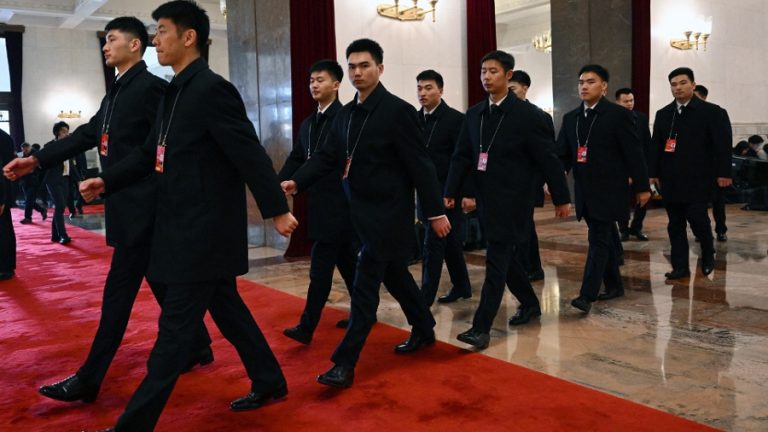
The State Council, once the country’s top administrative body, has been reduced to a mere “document-signing machine.” Real power now lies with Xi’s central leading groups, while Premier Li Qiang and other senior officials act only as messengers.
Such hyper-personalization of power, Hu argues, has replaced professional governance with political loyalty.
Li Qiang’s rapid ascent—from Zhejiang to Shanghai to Beijing—owed not to his technocratic skill but to his unwavering loyalty to Xi.
Likewise, Cai Qi and Ding Xuexiang, both from propaganda or secretarial backgrounds, lack real administrative experience.
Mao’s ‘old cadres’ once ruled because of their revolutionary pedigree,” Hu observed. “Xi’s loyalists rule because they make him feel safe.”
2. The ‘invisible Cultural Revolution’
Today’s China, Hu warns, is living through an “invisible Cultural Revolution.” Where Mao mobilized mobs, Xi relies on institutionalized fear and bureaucratic control.
The label “politically unreliable” has replaced “rightist.” Public struggle sessions have been rebranded as internal briefings.
And the CCDI and inspection teams now play the role once held by the Red Guards. Academics self-censor, media outlets preemptively delete, and entrepreneurs flee abroad.
It is a quiet terror—psychological, not physical—sustained by fear and reinforced through paperwork. Truth is smothered beneath performance; China’s information ecosystem has become an engineered black hole.
3. Xi’s power anxiety
Hu traces Xi’s obsession with control to a deep-seated fear of insecurity.
Born a “red second-generation” princeling whose father was later purged, Xi grew up in exile and hardship.
In Liangjiahe, he learned that survival meant submission to power; control became his shield against chaos.
“The less Xi trusts others, the more he demands loyalty,” Hu said. “The more he fears losing control, the more he seeks to control everything.”
Under such a mindset, governance has devolved into political ritual: discussion gives way to praise, research to slogans. The machinery of the state remains in motion—but empty of meaning.
4. A cultural and spiritual void
At the root of China’s political decay, Hu argues, lies a spiritual crisis. Mao’s campaign to “conquer nature” destroyed the moral sense of humility and faith.
Xi continues this legacy, upholding the belief that power itself defines truth.
By contrast, Hu notes, the West’s institutional resilience rests on a moral reverence for truth and order, drawn from Judeo-Christian ethics.
China’s “struggle with heaven” mentality, by comparison, has bred arrogance without purpose. Officials now serve power rather than principle; citizens stay silent to survive.
Without a moral foundation, Hu warns, reform from within is impossible.
Economic breakdown: From ‘China boom’ to ‘farewell banquet’
1. The real estate collapse
Cheng Xiaonong cites The Wall Street Journal in describing the historic scope of the current downturn.
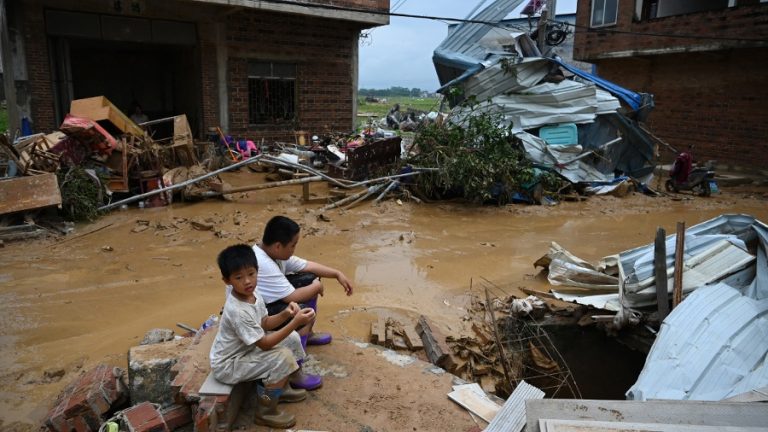
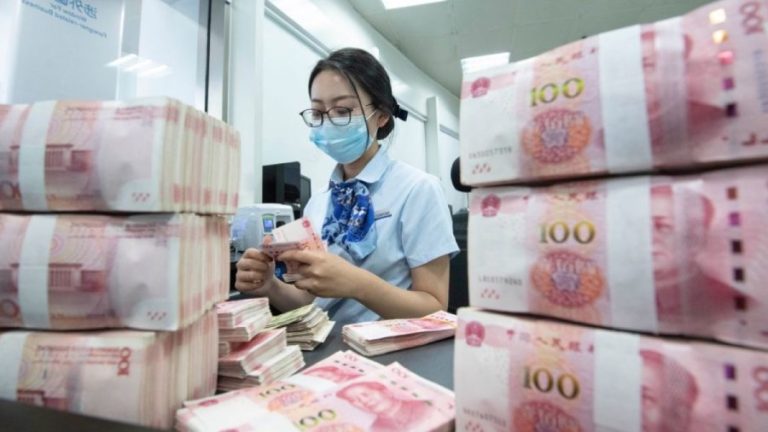
China’s property crash has wiped out roughly US$90,000 in home value per urban household— a total loss of US$18 trillion, or 1.5 times China’s annual GDP.
The shock, he notes, is even greater than America’s 2008 subprime crisis.
With 80 million vacant homes, twice the housing stock of the United States, prices will continue to fall. And with total debt—public, corporate, and household—now three times GDP, recovery looks increasingly out of reach.
2. The flight of capital and the end of the ‘China boom’
Foreign investment, once a cornerstone of China’s rise, is rapidly retreating.
As The Wall Street Journal reported, global companies no longer see China as “a land of opportunity. Even U.S. firms—especially under Trump’s second term—have downgraded China’s strategic importance.
Cheng warns that Taiwan must also reduce its dependence on the mainland market. The long-running slogan “China will surpass the U.S.” was, he says, a propaganda myth.
In 2025, the Journal described China’s economy as hosting a “farewell banquet for the China boom”—a turning point when optimism finally gave way to risk aversion.
3. The ‘Ostrich Effect’
Cheng also highlights a widespread psychological retreat.
China’s youth, faced with shrinking prospects, choose withdrawal over resistance—what the internet calls “lying flat.” Many in their 30s still depend on parents, escaping into short videos for fleeting comfort.
It is, Cheng says, an “ostrich effect”: a generation burying its head in the sand rather than confronting collapse. Such passivity, he warns, makes democratic awakening unlikely in the short term.
4. From partner to risk factor
China’s global image, Cheng concludes, has turned from partner to potential risk.
Once admired for growth, it is now viewed with caution for its instability and repression. That shift, he says, may redefine China’s international standing for years to come.
History repeating itself
Hu Liren argues that Xi’s governance mirrors Mao’s. He rules not through law or reason, but through fear and survival.”
Mao’s political virus—struggle as faith, power as truth—still courses through the system. Silence and obedience have replaced intellect and conscience.
“Xi may believe he is history’s choice,” Hu said, “but he is merely its repetition.”
By substituting loyalty for competence, control for trust, and fear for stability, Xi has driven China into self-destruction.
“The more he seeks to prove greatness, the more fragile he appears. The more he tries to control everything, the more he loses everything.”
Hu contends that China’s only escape lies in abandoning loyalty politics and rebuilding transparency and moral culture.
Yet he concedes that genuine reform within the CCP is nearly impossible.
From the global perspective, Cheng Xiaonong offers three cautions:
- Governments should reassess their engagement with China’s faltering system.
- Taiwan must diversify its economy away from the mainland.
- The West should temper expectations for democratic change and adopt a pragmatic posture instead.