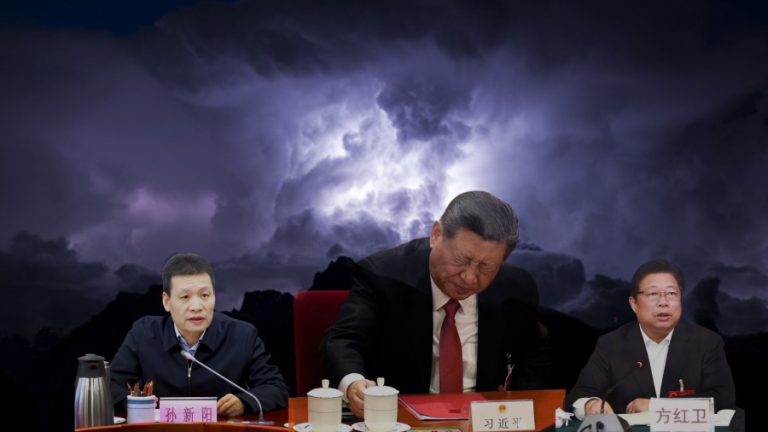
According to multiple online accounts, Xi’an Party Secretary Fang Hongwei was reportedly taken away by personnel dispatched under the direction of Sun Xinyang, Deputy Secretary of the Central Commission for Discipline Inspection (CCDI), on Nov. 5 while conducting an inspection in Chang’an District.
Eyewitnesses claimed that Fang appeared “visibly pale and trembling,” describing a scene of extreme distress as he was escorted away. The incident, still unconfirmed by official channels, has quickly circulated through Chinese social media.
Observers noted that Fang’s failure to be promoted from alternate to full Central Committee member at the recently concluded Fourth Plenary Session may have been an early sign of his political downfall.
Fang Hongwei, a native of Shaanxi province and a Tsinghua University alumnus, has long been viewed as part of Xi Jinping’s extended “hometown network.” Known for his rapid rise through positions such as chairman of Shaanxi Automobile Holding Group and later Party Secretary of Hanzhong and Xi’an, Fang was seen as a loyal local ally within Xi’s political base.
However, his apparent fall marks another setback for Xi’s Shaanxi faction. The article argues that Fang’s demotion—and possible detention—suggests growing instability within Xi’s inner circle following the Fourth Plenum.
Sun Xinyang: From Hainan to the CCDI
Success
You are now signed up for our newsletter
Success
Check your email to complete sign up
The same report highlights the career of Sun Xinyang, a fellow Shaanxi native who once worked in Hainan and Jiangxi before rising to become Deputy Secretary of the CCDI. The author describes Sun as a “political insider” placed within the top disciplinary body to safeguard Xi’s interests — a claim that cannot be independently confirmed.
Sun was reportedly mentored by Xi’s half-brother Xi Zhengning (born Xi Fuping), who served in the Shaanxi Provincial Organization Department before passing away in 1998 at age 57. According to the commentary, Xi Zhengning played a formative role in cultivating local cadres later aligned with Xi’s national rise.
The article further explores Xi Jinping’s reported fascination with the notion of “dragon veins” — geomantic alignments traditionally associated with dynastic legitimacy. It claims that Xi’s visits to Qinling Mountain in 2020 were intended to “secure ancestral roots,” following repeated embarrassments over illegal villa developments in the same region.
In May 2025, Xi reportedly renamed the Xi Zhongxun Memorial Hall in Fuping as the “Guanzhong Revolutionary Memorial Hall,” interpreted by some observers as an effort to project collective leadership amid growing internal pressure.
According to the author, Xi’s belief in symbolic “ancestral energy” underscores a deeper sense of insecurity within his rule: “He has sought a spiritual foundation for authority, but found only ghosts of the Party’s past.”
The broader context: Faltering faith and the Tuidang movement
The article connects Fang’s downfall with broader disillusionment inside the Party. Citing data from the Global Service Center for Quitting the CCP, it notes that between September and October 2025, the number of Chinese citizens publicly renouncing their Communist Party, Youth League, or Young Pioneer memberships (Tuidang declarations) surged by more than 410,000, bringing the total to over 450 million.
One declaration reportedly read: “He [Yu Menglong] was kind-hearted yet destroyed by the regime’s corruption. I am quitting the CCP in his name.”
According to the same organization, the late actor Yu Menglong was posthumously registered for a Tuidang (Quit the CCP) declaration. These figures cannot be independently verified, but they illustrate the moral and ideological fracture within China’s society and elite.
The author concludes that Xi’s political base — once reinforced by loyal figures in Shaanxi and among his Tsinghua peers — is steadily eroding. Fang Hongwei’s reported detention and Sun Xinyang’s rumored distress signal turbulence within the very circle that once embodied Xi’s confidence.
“Those who protected Xi’s roots are now being uprooted themselves,” the commentary observes.
The scene of Fang’s breakdown is described as emblematic of an era nearing its end—when heaven and earth tremble, and the crisis of survival arrives in an instant.
By Jin Tao Pai’an