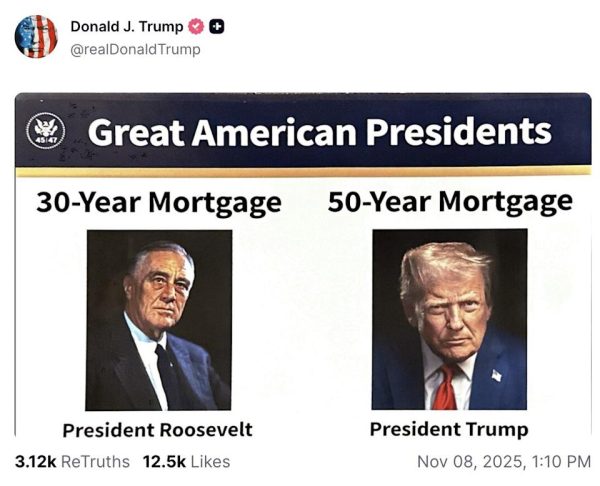
On Saturday, Nov. 8, U.S. President Donald Trump posted to his social media platform, Truth Social, floating the idea of introducing 50-year mortgage terms as a way to address the nation’s growing housing affordability crisis. The proposal, still informal, has sparked debate over whether such ultra-long loans could ease financial pressure on homebuyers or simply extend debt across generations.
Bill Pulte, the director of the Federal Housing Finance Agency responded to the post saying, “Thanks to President Trump, we are indeed working on The 50 year Mortgage – a complete game changer,” appearing to acknowledge that work is already underway on the proposal.
Meanwhile, according to Realtor.com® a White House official said, “President Trump is always exploring new ways to improve housing affordability for everyday Americans. Any official policy changes will be announced by the White House.”
A 50-year mortgage would result in lower monthly payments for homebuyers, however the total interest paid over the life of the mortgage would be significantly higher and owners would gain equity at a slower pace.
Critics call it a bad deal for homebuyers that only benefits lenders while supporters argue it gives owners more financing options and flexibility.
Success
You are now signed up for our newsletter
Success
Check your email to complete sign up
Joel Berner, Senior Economist with Realtor.com® said, “The appeal of the 50-year mortgage is to offer monthly payments to homebuyers and break up the logjam of the current housing market. The drawbacks are that a 50-year mortgage results in almost double the interest payments of a 30-year mortgage and a longer path to meaningful home equity.”
Berner also warned that “subsidizing home demand without increasing home supply,” could result in higher home prices which could negate any potential monthly savings homebuyers could enjoy.
How your payments could change
With a 50-year mortgage, the average interest rate would undoubtedly be higher, similar to how 30-year rates are higher than rates on a 15-year mortgage.
“The longer the life of the loan, the more compensation the lender will demand,” Berner explained.
For instance, according to Freddie Mac, last week rates on a 15-year mortgage averaged around 5.5 percent, while the interest rate on a 30-year mortgage sat at around 6.22 percent.
It remains unclear what a mortgage rate would look like on a 50-year mortgage.
“Assuming for the sake of argument that mortgage rates were equal across both products, a 50-year mortgage would lower mortgage payments by about $250 per month on a $400,000 home, assuming 10 percent down and a 6.25 percent mortgage rate,” Realtor.com® reported.
Under this scenario, a homebuyer would pay $816,396 in interest over the 50-year loan term, compared to just $438,156 on a 30-year loan, a difference of $378,240. Therefore, a homebuyer would pay 86 percent more interest over the life of a 50-year loan compared to a 30-year loan term.
In addition, Berner reiterated, “The ‘savings’ from 50-year mortgages may be totally negated by rising home prices.”
“The design of this proposal is to boost homebuyer demand, which has been subdued for the last several years as mortgage rates have been stuck above 6 percent,” says Berner. “More flexible financing is essentially a subsidy for housing demand, which will add to the pool and buying power of homebuyers without increasing the supply of homes, which will drive home prices up.”