By Li Jingyao, Vision Times
Following the Chinese Communist Party’s (CCP) 20th Fourth Plenum on Oct. 24, a wave of sudden purges, investigations, and unexplained deaths among senior officials has gripped the mainland’s political landscape. Among the most notable developments: Three longtime subordinates of former Xinjiang Party Secretary Ma Xingrui have been taken down, with one of them suddenly dying under strange circumstances.
Analysts say the pattern reflects two rival factions inside Zhongnanhai — the Xi faction and the anti-Xi faction — intertwining in a tightening political noose. As the pressure grows, they warn that Ma Xingrui is edging dangerously close to Qincheng Prison, and Peng Liyuan (Xi Jinping’s wife and China’s first lady), who has long been linked to Ma through personal and political ties, is also “in an increasingly unfavorable position.”
RELATED: Why Zhang Youxia’s ‘Loyalty Essay’ Speaks to the CCP’s Silent Power Realignment
Urumqi’s politics chief Ma Zhijun under investigation
On Nov. 10, the CCP’s Central Commission for Discipline Inspection (CCDI) announced that Ma Zhijun, deputy Party secretary of Urumqi and head of the city’s powerful Political and Legal Affairs Commission, was under investigation for “serious violations of discipline and law.”
Success
You are now signed up for our newsletter
Success
Check your email to complete sign up
The 54-year-old official spent his entire career in Xinjiang and rose rapidly under Ma Xingrui’s tenure — including his 2021 promotion to Urumqi political-legal chief and his 2022 elevation to deputy Party secretary.
Observers note that his climb “exactly overlapped the period when Ma Xingrui served as Xinjiang Party secretary,” making his downfall a direct blow to Ma.
Jiang Xinjun’s abrupt death
On Nov. 5, state media reported that Jiang Xinjun — a 20th Central Commission for Discipline Inspection member, deputy political commissar of the Xinjiang Production and Construction Corps (XPCC), and head of its discipline commission — “died suddenly of illness while on duty” on Nov. 3. He was only 56.
Jiang was appointed to the XPCC after Ma Xingrui took over Xinjiang, and Ma himself held the top political role inside the Corps. Jiang’s sudden death immediately sparked speculation that the political storm surrounding Ma had begun to claim casualties.
On Nov. 1, CCDI announced that Jin Zhizhen, vice chairman of the Xinjiang CPPCC, was also under investigation. Jin held numerous posts across Xinjiang’s state-owned enterprises, the XPCC, and regional governments, again placing him squarely within the network of officials elevated during Ma Xingrui’s leadership.
Under probe
U.S.-based commentator Chen Pokong said, “One after another, Ma Xingrui’s subordinates are falling. The anti-corruption storm has reached Xinjiang. The noose around Ma Xingrui is tightening — he is now at very high risk, not far from Qincheng Prison.”
According to Chen, Beijing has dispatched two powerful factions to tighten the pressure: Shi Taifeng, a Hu Jintao protégé and Politburo member who now controls the Party’s personnel system as head of the Organization Department. Chen Xiaojiang, the new Xinjiang Party secretary and a longtime ally of Wang Qishan, reportedly also has deep roots in the CCDI.
“These two lines have converged in Xinjiang,” Chen said. “Ma Xingrui is now in a state of extreme anxiety.”
Ma Xingrui’s fall signals trouble for Peng Liyuan
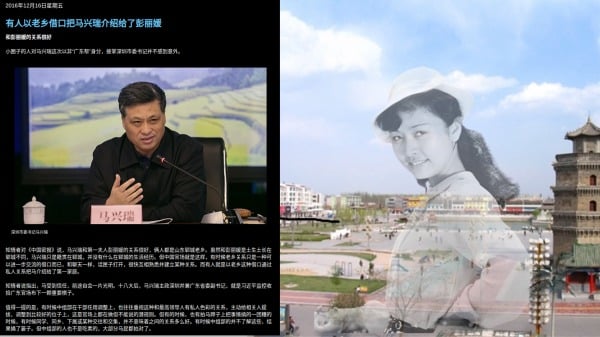
Ma Xingrui is widely regarded as a longtime Xi loyalist — but he is also linked personally to Peng Liyuan, with the “Financial Times” reporting that the two families share longstanding connections. A dissident blogger revealed in July that: “Ma Xingrui’s wife, Rong Li, was taken away by the CCDI for investigation on July 5, 2025.”
The blogger claimed she enriched herself for years by invoking Peng Liyuan’s name and had transferred over 7 billion RMB to family accounts abroad. If Ma falls, analysts say Peng Liyuan will inevitably be dragged into the storm.
Indeed, negative rumors surrounding her have circulated for months, including the abrupt cancellation of her planned visit to South Korea. Chen Pokong speculates she may be required to “cooperate with the investigation” into Ma’s case.
Peng has also been involved in military personnel decisions. In 2024, she appeared in uniform at a military research event as a full-time member of the CMC Cadre Evaluation Committee, prompting speculation that she influenced the promotions of top generals.
Chen noted, “Many generals, especially from Shandong, are said to require Peng Liyuan’s approval before being promoted.”
Xi forced to yield
After reports that Xi collapsed during the Third Plenum and Zhang Youxia seized de facto military authority, analysts say China’s political landscape shifted significantly. One major change: The sudden reshuffling of the Party’s personnel chief, a key power center.
Journalist Guo Jun argues that “after the Fourth Plenum, signs that Xi has lost Party power are increasingly obvious.” Guo says Xi has reportedly already:
- Lost influence over the aerospace system,
- Seen the purge of Peng Liyuan’s Shandong network,
- Watched his Tsinghua faction suffer major setbacks.
Producer Li Jun adds, “Xi’s loyalists are falling one after another — and none of the newly promoted officials are his people.” Meanwhile, Shi Taifeng — a staunch Hu Jintao ally — now controls the Party’s personnel system and has extended influence over CCP discipline organs.
Chen Pokong notes, “The anti-Xi faction and Xi’s faction are now intertwined. Xi has been forced to retreat.” Li Jun was even more direct, “Xi is increasingly resembling a second Hua Guofeng. In negotiations with Trump, he didn’t act like a decision-maker at all — just read from a script.”
The downfall of Ma Xingrui’s circle, the sudden death of senior Xinjiang officials, and the pressure surrounding Peng Liyuan all point to an accelerating power realignment inside the CCP. What appears on the surface as anti-corruption is, analysts argue, a deep political struggle now turning inward and upward, with Xi Jinping himself increasingly constrained by rival power centers.
Editorial note: Views expressed in this article are the opinions of the author and do not necessarily reflect the views of Vision Times.