By Li Jingyao, Vision Times
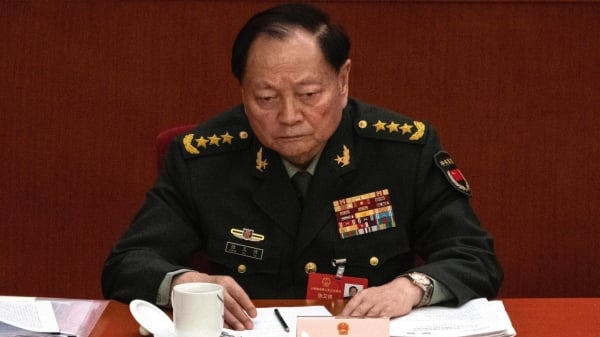
Following the conclusion of the Fourth Plenum on Oct. 24, Beijing’s political atmosphere has grown increasingly abnormal, with the Party’s messaging system showing unmistakable signs of recalibration. On Nov. 12, Central Military Commission (CMC) vice chairman Zhang Youxia published a lengthy signed essay through state mouthpiece “Xinhua News” titled: “Zhang Youxia: High-Quality Advancement of National Defense and Military Modernization.”
Though framed as a statement of loyalty to leader Xi Jinping, analysts say the piece exposed deep cracks inside the Party and revealed the very “secret” Beijing is most desperate to conceal: The CCP is quietly reverting to collective leadership — and the military is now the dominant force spearheading the transition.
RELATED: Beijing Pushes Loan-Driven Consumption: How Xi Jinping Is Undermining China’s Economy
Growing signs of a fracture
Zhang’s article mentioned Xi Jinping at least 20 times, declaring the need to “comprehensively strengthen the military,” “thoroughly implement Xi Jinping’s thought on strengthening the armed forces,” and “resolutely prevent being ‘two-faced people’ or showing false loyalty.”
Success
You are now signed up for our newsletter
Success
Check your email to complete sign up
He also stressed embedding “upholding the core and following the Party’s command” into the minds of all officers and troops, while invoking sensitive phrases such as “winning local wars.”
Under normal circumstances, analysts say, Zhang — a career military figure who rarely publishes personal essays — would not issue such a long political treatise. But the timing is telling.
The piece follows a wave of speculation that Zhang and Xi have fallen out, especially after Zhang was absent from Xi’s Nov. 5 commissioning ceremony for the Fujian aircraft carrier while fellow CMC vice chairman Zhang Shengmin replaced him. A later group photo in Guangzhou on Nov. 9 showed Zhang standing far from Xi, fueling rumors that their relationship has deteriorated.
Zhang and Xi clash over Taiwan
Multiple individuals with ties to the PLA say Zhang Youxia and Xi Jinping engaged in intense disputes over Beijing’s Taiwan policy. According to these accounts:
- Zhang opposed launching a military conflict, warning that China’s economic slowdown and growing diplomatic isolation made war too risky.
- But Xi reportedly viewed this as “shaking military morale.”
These disputes, insiders say, triggered a wave of purges among senior generals and widened a rift that Party propaganda is now scrambling to conceal.
A return to ‘collective leadership’
Former Wen Wei Po Northeast bureau director Jiang Weiping called Zhang’s publication “extraordinary,” noting that he almost never writes under his own name.
He argues the flood of signed essays from top Party figures since the Fourth Plenum — including Li Qiang, Wang Huning, Hu Chunhua, Cai Qi, Ding Xuexiang, and now Zhang — reflects a major institutional shift. “This means that after the Third Plenum, the Party elders and military chiefs have jointly taken back authority,” said Jiang.
According to him, once collective leadership was restored, every core figure — especially those controlling military power — was ordered to publish an official piece. He added, “This reveals three succession contenders supported by two major factions: Ding Xuexiang, Hu Chunhua, and Li Qiang. Their camps have already reached a tacit understanding.”
An essay meant to quell rumors backfires
Jiang Weiping says the article was itself a response to growing overseas commentary that Zhang Youxia had split from Xi or was “pretending obedience.”
“The military and Xi himself clearly felt the pressure of international opinion,” he said. But on the contrary, Zhang’s article, was designed to publicly deny tensions, notes Jiang. The text inadvertently exposed what Beijing was trying to hide. Most notably:
- It mentions the Party and Xi Jinping, but
- Carefully avoids the core loyalty slogans “Two Establishes” and “Two Upholds.”
- It also does not use the newer signals “deeply comprehend” or “resolutely achieve.”
This linguistic omission, Jiang says, “makes the contradiction unmistakable.”
“The article attempts to rebut claims of Party division but deliberately avoids the sore points — revealing their differences instead.”
Political posturing gone wrong
Commentator Li Linyi likewise believes the essay was crafted to “protect the regime and quash rumors,” noting that it may be Zhang’s most intense public praise of Xi to date. He also notes that the same essay was quietly published nine days earlier — another sign something abnormal is occurring behind the scenes.
“This could mean Zhang reached a temporary compromise with Xi to stabilize the regime. Or it could be pure political theater under internal pressure.”
Li argues the repeated warnings against “two-faced people” and “false loyalty” appear aimed at purged military leaders like He Weidong and Miao Hua — but ironically underscore a deeper truth: “The CCP system itself manufactures two-faced people.”
He cites past cases, including
- He Weidong praising Xi shortly before his downfall,
- Lin Biao famously professing loyalty before fleeing and dying in a plane crash.
Thus, Li notes, “Zhang Youxia’s political statements won’t count when the critical moment comes. Whether Xi discards him or he turns against Xi — both outcomes are possible.”
Zhang Youxia on the PLA’s unchecked power
Official media recently touted Zhang’s and Zhang Shengmin’s speeches at the PLA’s Nov. 3 Fourth Plenum propaganda session, both of which were filled with ritualized slogans praising Xi.
Some analysts interpret this as evidence Xi’s authority remains intact. But others argue the opposite: Excessive praise often signals weakness, not strength. Independent commentator Du Zheng writes in “Up Media” that Zhang’s dominance within the military has reached an unprecedented level:
- Zhang Shengmin did not enter the Politburo (China’s top ruling body)
- Zhang Youxia is the only military member in the Politburo
- This makes him the sole power center in the PLA
Compared with his role after the Third Plenum, Du argues, Zhang’s authority now resembles “a king within the military.” This structure, Du warns, risks sidelining Xi entirely, “If Zhang truly has ambition, he becomes a Lin Biao-type figure — the gun commanding the Party, the gun no longer protecting Xi.”
Even if Zhang’s intentions are to address corruption in the PLA, Du adds: “Everyone knows the institution is rotten to the core — Xi’s decade of anti-corruption has only made things worse.”
The downfall of generals like He Weidong and Miao Hua — both personally elevated by Xi — has greatly damaged Xi’s legitimacy: “Xi appointed these tigers himself. He now loses authority beyond repair.”
‘A king within the military’
Commentator Zhang Tianliang, however, disagrees that Xi’s grip has weakened. He points to a “Wall Street Journal” report by senior correspondent Lingling Wei, claiming that “Xi’s authority and position are unshakable.” Wei, citing sources inside Zhongnanhai, outlined three conclusions:
- Xi’s political status remains secure
- Beijing is determined to win its technological competition with the U.S.
- Xi’s anti-corruption drive will continue
This view remains contested, but it reflects ongoing debate within elite circles.
A new military troika — and the marginalization of Xi
Commentator Jiang Feng argues the Fourth Plenum has already finalized the PLA’s new power structure: “A military iron triangle has formed — Zhang Youxia at the center, with Zhang Shengmin holding the Party discipline apparatus and Liu Zhenli controlling the military command.”
He adds, “In this three-against-one configuration, Xi’s authority over the military has completely slipped away.” In essence, Zhang Youxia’s essay was meant to project unity and loyalty. Yet its omissions, timing, and political subtext suggest the opposite, analyst say:
- The Party is shifting back to collective leadership
- The military is asserting unprecedented influence
- Xi’s personal authority is being quietly downgraded
- The system is working overtime to hide deep fractures
The CCP’s power apparatus may be attempting to present a seamless front to the outside world. But, as analysts warn, the signs of internal realignment are too visible — and too deliberate — to ignore.
Editorial note: Views expressed in this article are the opinions of the author and do not necessarily reflect the views of Vision Times.