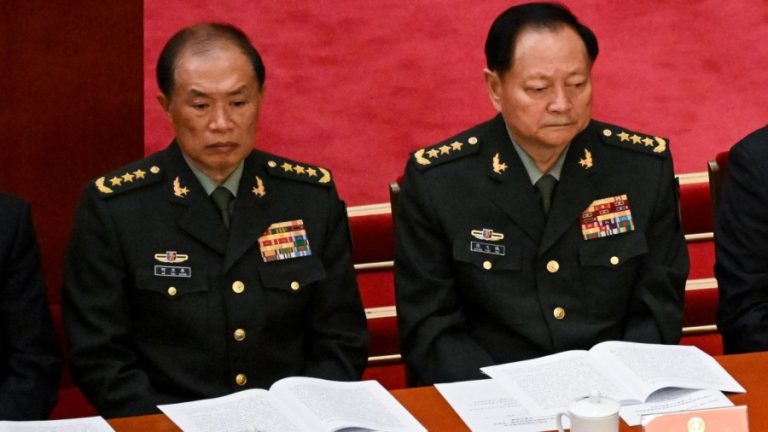
Amid ongoing military turmoil, including the sweeping purge of Xi Jinping’s loyalists and accusations that Zhang Youxia was “acting like a king in the army,” China’s official military newspaper addressed “political military building,” citing the corruption cases of He Weidong and Miao Hua. The report unusually mentioned the sensitive term “gunfire,” fueling speculation abroad that it may allude to past mutinies or internal conflicts within the PLA.
On Nov. 13, the People’s Liberation Army (PLA) Daily published a commentary titled “The More Thorough the Anti-Corruption Struggle, the More Solid the Century-Long Campaign—Continuously Deepening Political Training and Advancing Anti-Corruption Measures Series ②.” The article stated that it is crucial to recognize that investigating major corruption cases involving figures such as He Weidong and Miao Hua is a resolute fight to defend the Party’s absolute leadership over the military’s political foundation and a necessary step to eradicate the conditions that allow corruption to flourish.
The article emphasized that the more thoroughly hidden dangers are eliminated, the more achievable the century-long campaign becomes. “If the bad apples are not completely removed before the gunfire, it will leave major political security risks, and the consequences at a critical moment would be unimaginable.”
Someone rebelled—almost a shootout?
Commentator Xiaoshuojia analyzed on social media that within the Chinese propaganda system, “gunfire” is not a term used lightly. “This is a highly sensitive word with strong political implications,” he said. In reality, he argued, the PLA has already entered an extremely unstable and dangerous phase, and the delicate balance between Xi and Zhang Youxia is gradually unraveling.
Xiaoshuojia noted that the military’s wording—“If the bad apples are not completely removed before gunfire, it will leave major political risks”—can be literally understood as “problems must be resolved before anyone opens fire.” But what does “gunfire” mean in the military context? It is not an accidental discharge or a training exercise; it means someone is ready to take action, someone is preparing to rebel, someone is ready for armed conflict.
Success
You are now signed up for our newsletter
Success
Check your email to complete sign up
He argued that publishing such words in the PLA’s most authoritative official mouthpiece is not casual. “For this to pass censorship, there must be a political-military intention behind it. The signal it sends externally is clear: the cases of He Weidong and Miao Hua are not just anti-corruption—they aim to prevent a possible armed rebellion, internal conflict, or military coup.”
Political commentator Li Linyi also pointed out that while the PLA discussing anti-corruption is normal, emphasizing “major political risks” and “removing the bad apples completely before gunfire” evokes thoughts of military coups or armed rebellion, meaning that the targets had plans to act but were apprehended before taking action—“almost a shootout.”
Earlier, the communiqué of the 20th Central Committee’s Fourth Plenary Session on Oct. 23 confirmed that He Weidong, Miao Hua, and several others had been expelled from the Communist Party for “losing loyalty” and “severely undermining the principle of Party command over the gun and the Military Commission chairman responsibility system.” The PLA Daily editorial the next day stated that the thorough investigation of He Weidong and Miao Hua “effectively eliminated major political risks.”
Ming Juzheng, emeritus professor of political science at National Taiwan University, analyzed on the program Political and Economic Frontline that the PLA Daily’s use of terms like “losing loyalty” and “severely undermining the principle of Party command over the gun and the Military Commission chairman responsibility system” is far harsher than mere corruption accusations. It could involve disloyalty to the top leadership or even more serious political conspiracy.
Version 1: Xi investigates He Weidong and Miao Hua
There are currently two versions circulating regarding the background of the He Weidong and Miao Hua cases.
Independent commentator Du Zheng, writing for Shangbao, suggested one version: Xi Jinping first unusually promoted his loyalist Miao Hua to oversee the military’s personnel system, then exceptionally elevated another loyalist, He Weidong, directly to Politburo member and vice chairman of the Central Military Commission (CMC). Xi’s lavish appointments and apparent “ignorance” of their misdeeds objectively created a disorderly pattern of “promotion despite flaws.”
After assuming office, He Weidong became ambitious, investigating Zhang Youxia’s military procurement and disciplining a number of generals. During the 2024 Two Sessions, He Weidong reportedly stated at a military delegation meeting that he would crack down on “fake combat capabilities” within the PLA. Analysts believe He was targeting flaws in equipment under Zhang Youxia’s supervision and deceptive practices within the troops during training.
Du Zheng explained that Zhang Youxia then counterattacked, reporting Miao Hua for selling positions, forcing Xi to approve the investigation. Shortly after Miao Hua was “suspended and investigated,” He Weidong suddenly “disappeared.” Being of civilian origin, He Weidong could not compete with the powerful “princeling” faction led by Zhang Youxia.
Version 2: Zhang Youxia strikes back
Another version, proposed by former Central Party School professor Cai Xia on the program Fangfei Time, suggests that this purge was not entirely orchestrated by Xi, but was a preemptive political counterstrike by Zhang Youxia. When large-scale corruption cases emerged in military procurement and the Rocket Force, Zhang did not remain passive but acted first. She argued that the successive downfalls of He Weidong, Miao Hua, and nine other generals may have been Zhang Youxia’s countermeasures.
US-based political commentator Chen Pokong stated that He Weidong, Miao Hua, Lin Xiangyang, and others were all from the 31st Group Army, and their purge was orchestrated by Zhang Youxia, vice chairman of the CMC, to eliminate Xi’s influence in the military.
Zhang Shengmin, who was promoted to vice chairman at the Fourth Plenary, is believed to align with Zhang Youxia. Du Zheng revealed that Zhang Shengmin, then the Rocket Force political commissar and secretary of the CMC Discipline Inspection Commission, subtly monitored He Weidong and collected evidence, ultimately assisting Zhang Youxia. Chen Pokong noted that in the context of the Rocket Force’s leadership being purged, Zhang Shengmin could not act independently and chose to side with Zhang Youxia.
Zhang Youxia reporting to the elder group?
Veteran media analyst Guo Jun, on the program Elite Forum, analyzed that while Zhang Youxia repeatedly emphasized resolutely supporting Xi at the Second and Third Plenary Sessions of the 20th Party Congress, after the Fourth Plenary, his statements shifted to emphasizing following the CMC’s central decisions, effectively downgrading Xi’s personal authority. This signals a power reshuffle: the military is now under Zhang Youxia’s control rather than Xi.
Guo Jun added, “Many signs and leaks indicate Zhang Youxia now reports directly to the CCP’s elder coordination group,” a core decision-making circle led by Hu Jintao. Its members include Wen Jiabao and Zhang Youxia; others such as Hu Chunhua, Wang Yang, and Liu Yuan belong to the executive layer. Their logic is clear: maintain CCP stability while allowing Xi to nominally bear responsibility.
Over his 13 years in power, Xi has promoted many loyalists to key positions, consolidating the “Xi faction” in all major organs. However, statistics show that among the 79 generals Xi promoted, nearly half have been officially removed, dismissed, or implicated in scandal. In 2023, five generals including Li Shangfu were officially removed; in October 2025, nine generals including He Weidong were expelled from the Party and military.
At the 20th Central Committee Fourth Plenary, 27 military officials were absent, including 22 generals. Wang Wenquan, political commissar of the Southern Theater Command, attended the plenary but missed the Nov. 5 commissioning ceremony of the aircraft carrier Fujian, sparking speculation. Sources estimate that over a thousand officers at the rank of lieutenant general or major general may have been affected.
Li Jingyao