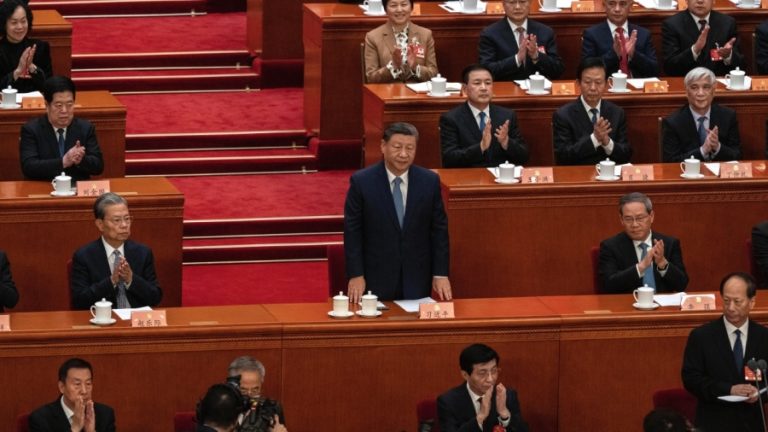
On Nov. 11, the Chinese Communist Party’s flagship newspaper People’s Daily published an editorial titled “Young Cadres Should ‘Seek Hardship.’” The piece praised Xi Jinping’s early years in rural Shaanxi, recalling how he “led villagers to build dams and biogas pits” and “made it his principle to seek hardship.”
It urged young officials to “do more, suffer more, and experience more challenges” to grow into “mature and capable” cadres. But midway through, the article shifted tone — criticizing those who “charge ahead blindly without looking up” and warning that such behavior “fails to improve their competence.”
Analysts noted that the phrase “seek hardship” in Chinese is nearly synonymous with “ask for trouble,” a saying often used to describe self-inflicted problems. Commentator Li Yanming observed that the piece’s contrast between Xi’s example and its criticism of reckless behavior could be read as subtle mockery.
Li argued that the phrase “work blindly without looking up” mirrors Xi’s governing style since 2017 — marked by aggressive crackdowns on private enterprise, tech firms, entertainers, and education sectors, as well as the costly COVID lockdowns that left China’s economy strained and public resentment high.
‘Let the capable rise’: A hint against one-man rule
The People’s Daily editorial concluded with a call to “ensure those who take initiative are given opportunities and positions,” which some analysts interpreted as an indirect message on leadership succession. Li noted that the line “let the capable rise” implicitly contrasts with Xi’s decision to abolish presidential term limits and avoid naming a successor.
Success
You are now signed up for our newsletter
Success
Check your email to complete sign up
He added that this rhetorical turn — invoking Xi’s slogans while questioning their results — fits a growing pattern of “high-level satire” in Party propaganda, where editors echo official themes but undercut them between the lines.
Signs of change have also appeared in state television. During coverage of China’s 15th National Games opening ceremony, Xi’s presence was notably downplayed. Unlike previous events, the stadium’s big screen did not display Xi’s image as he entered, and the camera lingered on him for only 28 seconds — less than half the duration of his appearance at the 2021 games.
There were no crowd shots, applause, or solo projection moments. Even First Lady Peng Liyuan’s screen time was cut from 15 seconds to about eight. Four years ago, both had received prominent close-ups, including an oversized portrait of Xi on the arena’s jumbotron.
Analysts said the new restraint appears deliberate — part of an effort to curb “personal idolization” and signal a return to collective leadership imagery.
Delayed coverage of Fujian carrier ceremony
Independent producer Li Jun pointed out another anomaly: Xi’s attendance at the commissioning ceremony of the aircraft carrier Fujian on Nov. 5 was not reported by state media until Nov. 7 — an unusual two-day delay. “That schedule clearly wasn’t set by [Propaganda chief] Cai Qi,” Li said on his Elite Forum program.
In a parallel development, retired PLA Navy staff officer Yao Cheng claimed on his social media channel that Xi had been “temporarily held by the military” during the event, citing sources inside China. Yao added that if CCTV’s Xinwen Lianbo evening news did not broadcast footage of Xi by Nov. 7, “it would mean he was truly detained by the army.”
While the rumor remains unverified, the subdued tone of official coverage added to speculation. The Xinhua dispatch on the event ran just over 1,000 words and mentioned only that Xi “has long been attentive to the development of China’s aircraft carriers.” It made no reference to “Xi Jinping Thought on Military Affairs” or the “Two Establishes,” slogans central to his personal authority.
Li Jun concluded, “This reads almost like an open signal that Xi no longer controls propaganda or the military narrative.”
By Li Jingyao