By Meng Hao, Vision Times
Just days before the 37th anniversary of the Tiananmen Square crackdown, the June 4th Memorial Museum in Los Angeles was vandalized in what organizers say was a politically-motivated act of intimidation. Local police have opened a hate crime investigation, while museum founder and former student leader Wang Dan condemned the incident as an example of ongoing “transnational repression” by the Chinese Communist Party (CCP).
The attack occurred in the early hours of May 31 at the museum in El Monte, California. According to Wang, unknown individuals unlawfully entered the facility and damaged portions of the exhibition, including key displays and interior walls.
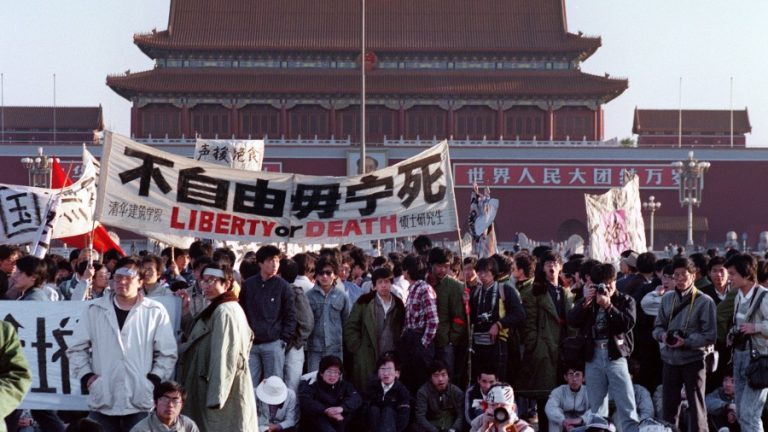
On June 4, 1989, the CCP deployed troops and tanks to crush a nationwide pro-democracy movement led largely by students. Though publicly-available information is scarce, the military assault ended weeks of peaceful demonstrations centered in Beijing’s Tiananmen Square and resulted in the deaths of hundreds, and according to some estimates, thousands of civilians.
RELATED: Thousands Gather in Toronto to Mark 37th Anniversary of Tiananmen Massacre
A targeted attack
Success
You are now signed up for our newsletter
Success
Check your email to complete sign up
“Unknown individuals illegally broke into the museum and damaged part of the exhibition,” Wang told Vision Times. “The main exhibition area was targeted, and some walls were defaced with spray paint, causing significant damage to museum property.”
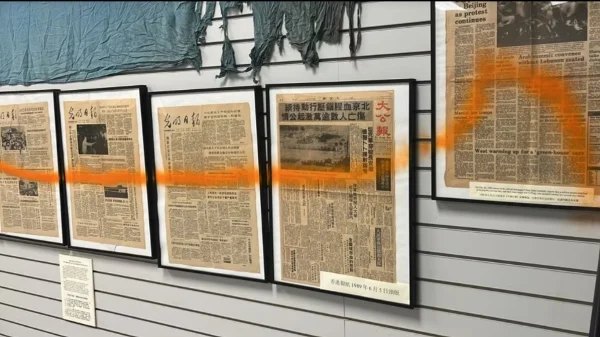
The incident took place only days before annual June 4 commemorations marking the 1989 Tiananmen Square crackdown, when Chinese authorities sent troops into Beijing to suppress pro-democracy demonstrations centered around Tiananmen Square. The military operation ended weeks of peaceful protests led largely by students and workers. The exact death toll remains unknown, but rights groups and witnesses estimate that hundreds, and possibly thousands, were killed.
In a statement released June 1, museum organizers strongly condemned both the perpetrators and any individuals who may have directed the attack. The statement described the vandalism as the latest example of efforts to intimidate overseas democracy activists. “We believe this is clearly a case of transnational repression and political intimidation,” Wang said.
‘We will not yield’
He argued that the timing of the attack left little doubt about its intended purpose. “This is a very obvious act of intimidation,” Wang said. “Its primary purpose is to threaten and frighten us in the hope that we will not organize large-scale June 4 commemorative activities.”
“The last thing the Chinese Communist Party wants is for people to continue remembering June 4,” he added. “But this kind of threat and intimidation will not work, and we will not yield.”
Wang also pointed to what he described as a broader pattern. From repeated vandalism targeting freedom-themed public art installations in Southern California to harassment directed at overseas dissidents, he said the incidents share common characteristics and should not be viewed as isolated events.
Following the attack, museum volunteers immediately reported the incident to the El Monte Police Department. Wang said security cameras at the site had also been damaged but were later restored, allowing investigators to recover portions of the surveillance footage.
Police open hate crime investigation
El Monte Police Department officials confirmed that the case has been opened as a hate crime investigation. Though authorities have obtained video evidence from the scene and are reviewing it, police said no information regarding suspects or investigative leads would be released while the investigation remains ongoing.
Wang said the museum has also informed the FBI and relevant congressional offices and intends to pursue all available legal remedies.
Human rights organizations have increasingly warned about efforts by authoritarian governments to intimidate critics and dissidents living abroad. Researchers have documented hundreds of alleged incidents involving surveillance, harassment, threats, and coercion directed at overseas activists, journalists, and political opponents.
Despite the damage, organizers say the attack has generated an outpouring of public support. The museum proceeded with its scheduled Second China Forum on the day of the incident. The event, which focused on cooperation among political opposition movements across generations, drew a full audience, with attendees lining up outside the venue.
Supporters turn out as museum presses forward
According to Wang, one supporter privately contacted him and offered an $800 donation to help repair damaged exhibits. “This was a very foolish move,” Wang said. “Instead of discouraging people, it has generated greater public outrage and drawn more attention to the museum and its mission.”
Some damaged exhibits will not be repaired immediately. Wang said portions of the vandalized displays will remain on public view. “We will preserve some of the damaged items as part of the exhibition,” he explained. “They represent the ongoing struggle between memory and forgetting.”
Items that cannot be fully restored will remain displayed in their damaged condition, serving both as evidence of the attack and as a reminder of the continuing importance of preserving the history of June 4.
Founded in Hong Kong in 2014, the June 4th Memorial Museum was created to document and preserve the history of the 1989 pro-democracy movement and its violent suppression. After being forced to close in Hong Kong in 2021, the museum reopened in New York in 2023 before relocating to Los Angeles in 2025.
For Wang, the attack ultimately reinforces the museum’s purpose. “The fact that this happened on the eve of the anniversary only underscores why preserving this memory remains so important,” he said. All planned June 4 commemorative events, organizers confirmed, will proceed as scheduled.