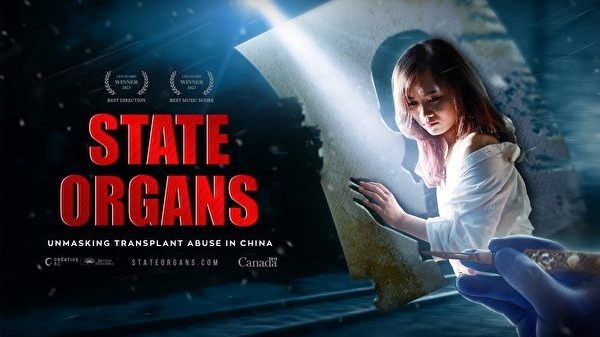
On the evening of Nov. 7, the award-winning documentary “State Organs” was screened at the University of Toronto, drawing a diverse audience of legal and medical professionals, students, and Chinese community members. The film, exposing the dark reality of forced organ harvesting in China with compelling evidence and deeply moving stories, profoundly shocked viewers and sparked intense discussions on human rights, ethics, and morality. Following the screening, the documentary’s protagonist and several audience members shared their personal experiences and reflections in interviews, emphasizing the urgent need to stop the Chinese Communist Party’s (CCP) crimes against humanity. They called for individuals to spread the truth and for governments to enact legislation to counter the CCP’s actions.
The screening concluded with applause in the theater. The event’s organizer, the University of Toronto’s “Choose Humanity” club, facilitated an online Q&A session with renowned international human rights lawyer David Matas and “State Organs” producer Cindy Song. The interactive session was lively and engaging, with audience members raising questions that deepened their understanding of China’s human rights issues, the persecution of Falun Gong, and forced organ harvesting.
Mainstream audience profoundly moved
Adam Pokorn, a physical education director and teacher at the Toronto French School Board, was deeply moved after watching “State Organs” for the first time. He described the documentary as both captivating and thought-provoking, fundamentally reshaping his worldview. “This documentary is incredibly moving. It not only held my attention but made me rethink my perspective on the world, revealing facts I was unaware of,” he told Vision Times. The film made him realize that this crime has persisted for decades, saying, “It’s heartbreaking because I wish I could have done something earlier to help them (Falun Gong practitioners).”
Adam called for international action to stop this crime against humanity, urging governments at municipal, provincial, federal, and international levels to enact legislation to drive change. “We need laws to enforce change for the greater good of the world,” he said. As a teacher, he pledged to spread awareness: “Not only can I educate my students formally, but I can also share the truth with friends, neighbors, and even strangers, inviting them to act. Change starts with education and doing the right thing. I hope China and the world can change.” He was encouraged to learn that Canada, Israel, and Taiwan have passed laws banning citizens from obtaining illegal organ transplants in China and urged more countries to follow suit: “This (going to China for organ transplant) must be made illegal. We must stop this crime at all costs.” Adam expressed heartfelt support for Falun Gong practitioners: “God bless you. Your courage and resilience are admirable. We are all brothers and sisters; no one should endure such abuse.”
Nadia Nali, a clinical pharmacist working on transplant programs at Toronto’s Hospital for Sick Children, was particularly interested in the organ transplant issue due to her profession. After receiving information about “State Organs” from her transplant center, she attended the screening to learn about China’s forced organ harvesting. “As someone in the transplant field for years, I’ve seen documentaries on transplant tourism and was deeply concerned. I wanted to learn more about state-sponsored organ harvesting,” she told Vision Times. The film’s revelation of systematic extermination targeting groups like Falun Gong shocked her. “This is a systematic slaughter of a group based on their cultural, religious, or spiritual beliefs. These are good people, detained and harvested for organs, violating every principle of voluntary living donation in medical ethics.” She stressed that organ donation must be voluntary, not obtained through killing: “We cannot take one life to save another.”
Success
You are now signed up for our newsletter
Success
Check your email to complete sign up
As a medical professional, Nadia urged Canadian medical institutions and transplant associations to raise awareness about forced organ harvesting and push for legislation to ban citizens from participating in illegal transplants. “Canada has passed federal laws, but we need more provincial measures, including mandatory reporting mechanisms where medical privacy laws allow, to deter Canadians from seeking illegal transplants in China,” she said in the interview. She plans to recommend the documentary to colleagues and encourage action from Canada’s transplant community. “We need more people to see this film, understand this crime is ongoing, and take legal and ethical steps.” Nadia noted the film’s disturbing content is critical for Canadians to grasp.
Katerina Claridge, an Australian law firm owner specializing in intellectual property and commercial law, attended the screening during an International Bar Association conference in Toronto. She was moved to tears, saying, “This story must be told. The production team showed immense courage.” She was pained by the film’s depiction of humanity’s failures: “How can humanity behave so cruelly? Where is our humanity? This worries me deeply.” Katerina emphasized that forced organ harvesting is a global issue, as many foreigners seek transplants in China unaware of the organs’ origins. “People don’t know where the organs come from; they just want to get healthy, but it’s at the cost of living human beings.” She encouraged more people to watch the documentary despite its unsettling content: “It raises profound questions about human behavior and morality that many may avoid, but we must face them.”
Katerina pledged to investigate whether Australia has legislation similar to Canada, Taiwan, and Israel banning illegal organ transplants in China. “If we don’t have it, we need to push for it,” she said, praising the filmmakers’ courage: “They spent seven years challenging a government. That bravery is admirable.” She highlighted the documentary’s value in awakening public conscience and driving global action.
An anonymous Western audience member had heard of Falun Gong’s persecution but was stunned by the extent of forced organ harvesting. “It’s horrifying, beyond imagination. I can’t believe this is happening,” he said, noting economic interests drive the crime: “People act for wealth, not morality. This isn’t just a communism issue; it’s a global one.” He strongly hoped for an immediate end to Falun Gong’s persecution: “Of course it must stop. I hope for a quick solution.” He expressed disappointment in Canadian Prime Minister Mark Carney’s meeting with Xi Jinping, criticizing its focus on trade over human rights. “This is a human rights issue. The federal government should do more,” he said, calling for stricter provincial laws to curb illegal transplants.
Canadian citizen Michelle Zhang’s personal tragedy: A moral choice for all
The story of Michelle Zhang, a Canadian citizen and one of the documentary’s protagonists, deeply moved the audience. She shared how her family was torn apart by persecution for their Falun Gong beliefs. Her brother-in-law, Zou Songtao, a 28-year-old master’s student at Qingdao Ocean University, was persecuted to death, and her sister’s whereabouts remain unknown, with Zhang suspecting she was a victim of forced organ harvesting. Her parents died of grief, leaving only an orphaned child. “This is an unhealable wound for our family, a lifelong blow,” she said. She attributed the CCP’s crimes to fear: “The CCP uses coercion and threats to silence people. We must expose these crimes, or they won’t stop.” Zhang noted that the CCP destroys human morality, turning people, including doctors, into “devils.” Investigations by the World Organization to Investigate the Persecution of Falun Gong reveal nearly 900 Chinese hospitals and 9,500 doctors implicated in organ harvesting. “The CCP aims to destroy human morality, turning people into parts of a killing machine to maintain its power. The CCP must fall, or justice will not prevail!”
Michelle called on the international community to recognize the CCP’s evil nature. “People need to know the truth about Falun Gong and how evil the CCP is. Good people will make the right choice.” While Canada, Israel, and Taiwan have banned illegal organ transplants in China, she noted too few countries have followed. “In today’s morally confused world, everyone faces a moral choice,” she said, urging global action through legislation, education, and accountability to end the crime.
Chinese audience: The CCP must be overthrown
Chinese audience member Zhang Ke said the film “shattered my soul.” It took her months to muster the courage to watch it, knowing the brutal truth of forced organ harvesting. “One million people go missing in China annually. Where do they go? Where do the donors for transplant centers come from?” She outlined three horrific aspects: first, organs are harvested from living, healthy people without anesthesia, surpassing Nazi atrocities; second, accepting a harvested organ means another life was taken, with victims including Falun Gong practitioners, dissidents, Uyghurs, Christians, and even students and infants—“Since 2023, the CCP banned foreigners from adopting Chinese orphans. Where are those children? There’s no record”; third, the crime challenges human morality: “If humanity loses its goodness, it deserves to perish.” She condemned the CCP’s state-sponsored “massacre,” noting its organ transplant technology, while advanced, is a “disgrace built on countless lives.” Referencing a public discussion on organ transplants and longevity between Xi Jinping and Putin at a 2015 parade, Zhang angrily said, “They have no shame, treating live transplants as trivial. We must overthrow the CCP and Xi Jinping. The world cannot allow such evil to persist!”
Chinese audience member Liu Yan, watching the film for the first time, said its immersive experience evoked strong empathy, particularly for Zhang Tianxiao’s search for her sister. “It’s unbelievable. The CCP completely violates law, ethics, and morality—a total devil!” He called for overthrowing the CCP and speaking out for victims.
Zheng Xueming, another Chinese viewer, said the film confirmed his long-held beliefs. In China, he heard rumors of children’s organs being used for wealthy or high-ranking officials’ transplants. “The CCP’s essence is evil. It acts without legal basis, doing whatever it needs unscrupulously,” he said, noting no group in China is safe under the CCP’s lack of moral limits. He praised Falun Gong’s “Truthfulness, Compassion, Forbearance” principles for revitalizing Chinese culture and countering CCP propaganda. “Every conscientious Chinese should speak for Falun Gong. I hope they can one day practice their faith freely.”
Li Liang, watching the film for the first time, expressed sympathy for Falun Gong practitioners. “It’s tragic they don’t live in a democratic era,” he said, noting the CCP’s system endangers everyone, even insiders. He cited frequent social media reports of missing children in China, reinforcing his belief in forced organ harvesting. “This shouldn’t happen in the 21st century. I’ll absolutely speak out for the victims because it’s so inhumane.”
Zhang Jian, a member of the Canadian Committee of the Chinese Democratic Party, told “China Watch” the film left her “devastated,” calling the CCP’s organ harvesting “too evil, too inhumane,” and a crime against humanity. “This is devilish behavior against good people,” she said, noting her own son could be a target. “In mainland China, no one is safe.” She vowed to raise awareness overseas about the severity of forced organ harvesting.
Awakening conscience and taking action
The audience unanimously agreed that stopping forced organ harvesting requires global cooperation, with more countries following Canada, Israel, and Taiwan in legislating against illegal organ transplants. Adam and Nadia emphasized the importance of education and legislation, suggesting public awareness campaigns and medical community action to reduce demand for illegal organs. They stressed that exposing the truth is the first step to ending the crime, and everyone must act.
As Michelle Zhang and audience members stated, silence is no longer an option. Exposing the truth and driving change is the responsibility of every conscientious person. The international community needs more action through legislation, education, and accountability to ensure such tragedies never recur, restoring justice and humanity to the world.
By Xiao Ran