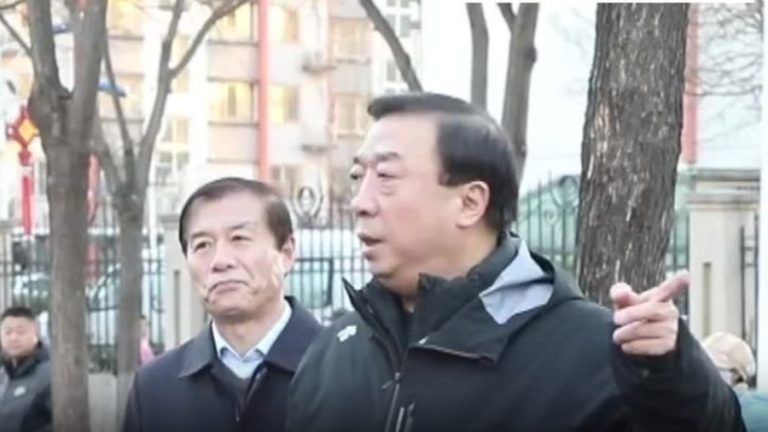
The political scene within the Chinese Communist Party (CCP) remains turbulent. Dong Yijun, Deputy Director of the Beijing Municipal Public Security Bureau and Director of the Traffic Management Division, recently died under mysterious circumstances. Authorities waited a full month before announcing his death. Analysts note that the timing, location, and manner of Dong’s death are highly unusual. He died the day after the Fourth Plenary Session, suggesting a possible internal power struggle. Some speculate that an “incident” may have occurred at Zhongnanhai or the Jingxi Hotel, and that Dong may have been killed during a confrontation.
Unusual timing, location, and announcement of death
On Nov.15, CCP state media reported that Dong Yijun, Deputy Director of the Beijing Public Security Bureau, Director of the Traffic Management Division, First-Class Police Commissioner, and First-Class Police Supervisor, suddenly fell ill while on duty. Despite medical treatment, he passed away on Oct. 21, 2025, at the age of 58.
Observers highlight five notable aspects of Dong Yijun’s death, all highly unusual.
1. Dong Yijun was Wang Xiaohong’s close aide
Commentator Li Yanming noted that Dong had served as Wang Xiaohong’s “chief steward.” When Wang Xiaohong was head of the Beijing Public Security Bureau, Dong was promoted in December 2017 to Secretary of the Party Committee and Director of the Bureau’s Office, effectively becoming Wang’s top aide.
After Qi Yanjun replaced Wang Xiaohong as Beijing Public Security Bureau Director in April 2020, Dong continued as Secretary and Director of the Bureau’s Office. In September 2021, he was promoted to Director of the Tongzhou Branch, and in May 2023, he became Deputy Director of the Beijing Public Security Bureau, serving as Qi’s deputy.
Success
You are now signed up for our newsletter
Success
Check your email to complete sign up
2. Sudden death coinciding with the Fourth Plenary Session
Dong died on Oct. 21, the second day of the Fourth Plenary Session.
Li Yanming pointed out that, as Deputy Director of the Beijing Public Security Bureau and head of the Traffic Management Division, Dong should have been responsible for key aspects of security around the plenary session. His sudden death at such a critical time has raised suspicions of underlying issues.
US-based political commentator Chen Pokong questioned why Dong’s death on Oct. 21 was only announced a month later, calling it a major mystery. Chen also noted, “The Fourth Plenary Session was held from Oct. 20 to 23. This man died on the 21st; the cause of death is extremely mysterious.”
3. CCP media urged learning from Dong Yijun
Chen Pokong said that the state media calling for people to “learn from Dong Yijun” is highly unusual. He compared this to other sudden deaths, such as the December 2024 death of Customs Director Yu Jianhua, who reportedly committed suicide, and Wang Shaojun, Director of the Central Guard Bureau, who died in April 2023 but whose death was only announced in July, with no call to “learn” from him.
An earlier case involved Zhang Xudong, briefly Commander of the Western Theater Command, who died suddenly in Beijing on Oct. 1, 2021, at age 58. The official announcement came 20 days later.
Chen argued, “Since state media is controlled by Xi Jinping and Cai Qi’s faction, calling on people to learn from Dong essentially makes him a model. This suggests Dong’s death is treated differently from others.”
4. Beijing police may be linked to the Yu Menglong case
Li Yanming noted that multiple locations related to the Yu Menglong case—Sunshine Shangdong community, 798 Art District, Bulgari Hotel—are all in Beijing’s Chaoyang District. Chinese “red descendants” activist Lin Beichuan had publicly accused the case’s central figure, Chaoyang District Police Chief Bi Bo, and even indirectly implicated Public Security Minister Wang Xiaohong.
Commentator Zhang Tianliang, however, believed that while Yu Menglong’s death may have deeper complexities, it is unlikely that a Beijing deputy police director would be silenced over it. He speculated that Dong’s death may instead have been triggered by the extreme pressure of Fourth Plenary Session security duties, possibly causing cardiovascular complications.
5. Sudden deaths among CCP police are frequent
Li Yanming stated that CCP police have become a high-risk group, with sudden deaths occurring often. Around the same time as Dong’s death, multiple young-to-middle-aged police officers, all Party members, also died suddenly.
Dong was a close associate of Wang Xiaohong. While serving as Director of the Tongzhou Branch, he participated in the persecution of Falun Gong practitioners, making him a target of international investigations.
Li concluded, “Whether Dong Yijun died due to internal power struggles or disease, it serves as a warning to CCP officials, especially police officers: committing evil can bring sudden retribution.”
Dong Yijun may have died due to internal power struggles
Chen Pokong suggested that the Fourth Plenary Session was marked by intense factional tension. Beijing was heavily secured inside and out, with Public Security, State Security, the Guard Bureau, and the Armed Police deployed, even with troops entering the city. “It is possible that just before or during the plenary session, an emergency occurred. Dong belonged to Xi Jinping’s faction and may have been killed in an internal struggle.”
He added that if Dong had truly died suddenly from illness at work, the announcement could have been immediate; the month-long delay points to intrigue. “Determining his cause of death likely involved high-level CCP negotiations.”
At the same time, authorities announced the dismissal of nine generals loyal to Xi, delivering a blow to him. Factional fighting was intense; Xi may have attempted to surround the plenary session or the Jingxi Hotel, only to be countered by Zhang Youxia’s faction.
Chen noted that anomalies during the plenary echo the 19th Fourth Plenary Session, when a Central Committee alternate member, Ren Xuefeng, jumped to his death at the Jingxi Hotel, prompting an emergency relocation of the session’s closing to the Great Hall of the People.
Chen speculated, “A confrontation may have occurred near Zhongnanhai or the Jingxi Hotel, with Dong Yijun killed by anti-Xi forces during a firefight. Since Xi controls the Party, propaganda, and media, the state media’s call to learn from Dong implies he died loyal to Xi. This indicates Dong belonged to Xi Jinping’s faction.”
Li Jingyao