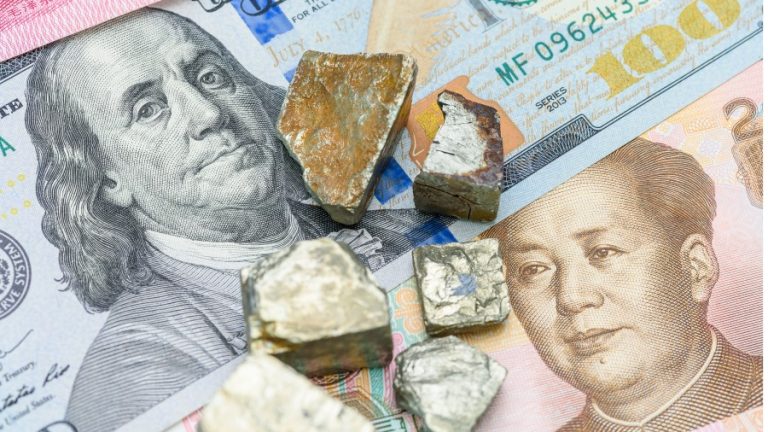
In recent days, China’s rare earths have once again become the focus of global attention. As a strategic mineral, they have risen to become a core bargaining chip in international competition. But behind China’s rare earth resources lies a shocking reality: sacrificed land and ecosystems, and the tangled battles between political factions and capital. With 70 percent of the world’s rare-earth mining and 90 percent of its processing capacity, the CCP has turned these unremarkable minerals into a powerful tool for its global “choke-point” strategy. Yet behind this so-called “strategic advantage” is massive environmental destruction.
1. The Mao era — A forgotten mineral treasure
During the Republic of China era, a desolate area in Darhan Banner, Inner Mongolia, revealed a treasure sleeping for millions of years. On July 3, 1927, 28-year-old geologist Ding Daoheng, traveling with the Sino-Swedish Northwest Expedition, was drawn to a strange black mountain north of the Yinshan Mountains. Exploring alone, he found large amounts of high-quality iron ore scattered on the surface. Using Mongolian transliteration, he named the place “Baiyun Obo,” meaning “Abundant Sacred Mound.”
In 1933, his Report on the Baiyun Obo Iron Mine shocked the geological world. At the time, no one yet realized that these ores contained valuable rare earth elements. But Ding’s work laid the foundation for Baiyun Obo becoming the world’s largest rare-earth deposit.
In August 1950, Professor He Zuolin led a Sino-Soviet geological team to conduct detailed investigations. They confirmed that Baiyun Obo contained rich rare earth elements—cerium, lanthanum, praseodymium, yttrium, etc. But in the CCP’s early years, Mao’s focus on steel and heavy industry relegated rare earths to a “secondary” resource. Under the slogan “politics above science, struggle overrides natural laws,” rare-earth development was ignored. The Cultural Revolution then brought scientific work to a standstill. The treasure of Baiyun Obo was buried under politics, and iron, not rare earths, was prioritized.
2. The Deng Xiaoping era — Gold rush and environmental cost
After Deng Xiaoping declared “development is the hard truth” in 1978, China urgently needed foreign currency. From the late 1980s to early 1990s—as the USSR collapsed and China faced sanctions after the Tiananmen massacre—the economy slumped. In his 1992 Southern Tour, Deng tried to revive reform and famously said: “The Middle East has oil; China has rare earths.”
Success
You are now signed up for our newsletter
Success
Check your email to complete sign up
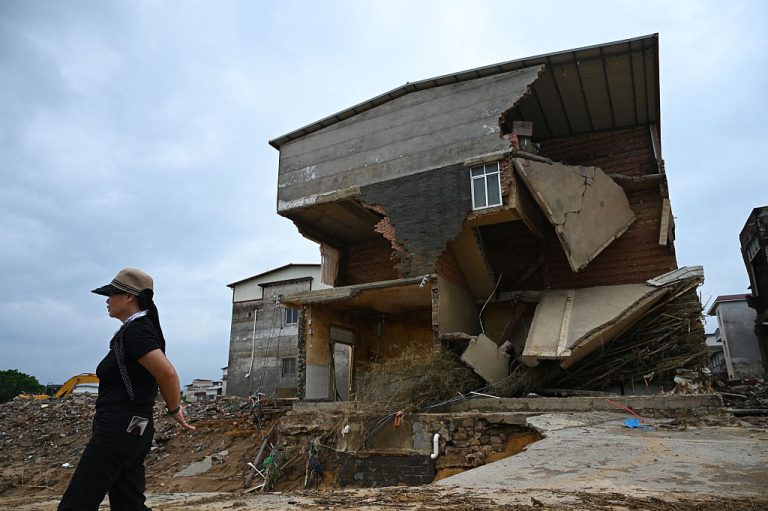
This remark launched a nationwide rare-earth “gold rush.” Baiyun Obo, Ganzhou (Jiangxi), and Guangdong mines were exploited aggressively. Local governments and companies dug feverishly. Rare earths became an important source of export dollars—but at the cost of worsening pollution, abandoned farmland, contaminated water, and a rising tide of occupational disease.
Short-term profit dominated. Oversight was weak. State-owned enterprises, local officials, and private capital rushed to extract as much as possible. Rare earths flowed out of China, earning foreign exchange, while environmental disaster took root.
3. The Jiang Zemin era — Black-gold networks and privileged elites
In the 1990s, rare-earth profits were enormous. Jiang Zemin’s political faction held strong influence across key mining regions—Inner Mongolia, Jiangxi, Guangdong, Sichuan, Shandong—turning rare earths into the Jiang faction’s financial lifeline.
The family of Liu Yunshan controlled major resources near Baiyun Obo; Zeng Qinghong and Luo Gan’s families held interests in southern rare-earth regions like Ganzhou. As export restrictions loosened and prices soared, a rare-earth “gold fever” exploded.
A common saying of the time: “Whoever controls the mining rights controls the money.”
Officials, military-industry figures, princelings, and black-market traders colluded, forming a dark chain of power. Illegal mining, smuggling, cyanide gold extraction, poisoning of water supplies, forced relocations—entire villages became wastelands.
Mining-rights battles intensified. State firms, local governments, and private capital fought like rival gangs. Illegal capacity expansion became common; workers were fired without compensation; environmental ruin deepened.
Farmers lost their land, water turned toxic, villages died. The poor paid the price while the powerful grew rich.
Princeling families and those with high-level CCP ties became early “resource aristocrats.” Examples include Wang Jun, son of Wang Zhen, who exploited rare-earth and energy investments to amass huge wealth. Others—like flamboyant entrepreneurs such as Jiang Quanlong—rose and fell amid scandals, gambling, and corruption. Some families engaged in large-scale smuggling and illegal mining tied to criminal networks.
4. The Hu Jintao & Wen Jiabao era — Pressure and hesitation
By the 2000s, chaotic mining had created severe environmental and resource pressures. The Hu–Wen government introduced export quotas and tried to curb the disorder. Ostensibly this was about “environmental protection,” but in reality it was also a move to wrest control back from local power groups.
But rare-earth controls quickly drew global backlash. The U.S., EU, and Japan accused China at the WTO of violating free-trade rules. In 2012, the WTO ruled parts of China’s policy illegal. Still, Beijing did not remove all restrictions, reflecting a mix of resource protection, environmental claims, and geopolitical strategy.
Rare earths entered global strategic competition. The Hu-Wen administration wavered—caught between environmental promises and economic pressure.
5. The Xi Jinping era — A tool for political gambling
Under Xi Jinping, global tech competition has intensified. Rare earths—used in new energy, aerospace, defense, and electronics—became more strategically important than ever.
When the 2018 U.S.–China trade war began, rare earths entered center stage. From 2019 onward, China tightened export controls and environmental regulations while the U.S. pushed to reduce dependence on Chinese supply.
In early 2025, the trade war escalated sharply. The U.S. raised tariffs above 100 percent; China hit back with stricter rare-earth licensing and broader export controls. On October 9, 2025, China announced a sweeping new rare-earth control order; Trump responded with 100 percent tariffs effective Nov. 1.
The rare-earth struggle became a geopolitical duel. Beijing consolidated Northern, Southern, and Guangming Rare Earth into a state monopoly, turning rare earths into a diplomatic weapon. Xi framed rare earths as “soft power,” but they became a tool for political pressure and a cover for internal insecurity and missteps.
Despite China’s talk of “green transition,” illegal mining, toxic tailings, and pollution still plague many regions. Locals see little benefit; ecological damage and health crises worsen.
Rare earths reveal the CCP’s decades-long web of power struggles, environmental destruction, and reckless exploitation. As China weaponizes rare-earth exports and the U.S. counters with supply-chain decoupling, the confrontation will reshape global tech and security landscapes for years to come.