Against the backdrop of intensifying U.S.-China strategic competition and persistent tensions on the Korean Peninsula, the nuclear-powered attack submarine cooperation agreement between the U.S. and South Korea is emerging as a key event reshaping East Asia’s geopolitical landscape. Candid remarks by U.S. Navy Chief of Operations, Admiral Michael Gilday, revealed Washington’s true strategic intent behind this military collaboration: the expectation that South Korea will use nuclear submarine capabilities to counter the CCP threat, described as a “natural expectation.” This agreement not only marks a deepening of the U.S.-South Korea alliance but also reflects a significant adjustment in the Trump administration’s strategic layout in the Indo-Pacific.
Admiral Gilday recently stated in an interview that it is a “natural expectation” for South Korea to use nuclear submarines to counter the CCP, as the U.S. views China as an “encroaching threat,” and South Korea is similarly concerned about Beijing’s actions. He further emphasized that once South Korea possesses such capabilities, the U.S. expects a closer allied partnership to achieve strategic objectives, integrating nuclear submarine capacity into broader strategic planning.
These remarks clearly reveal the Trump administration’s reinterpretation of the concept of “collective defense.” Amid escalating U.S.-China competition, Washington is actively seeking to strengthen ties with allies and encourage them to increase defense spending, contributing more to the collective effort against China. South Korea’s nuclear submarine program is a concrete embodiment of this strategy, as the U.S. aims to use technology transfer and collaboration to have South Korea assume greater regional security responsibilities and become a key balancing force against China in East Asia.
From the U.S. perspective, supporting South Korea’s nuclear submarine plan has “multiple benefits.” First, it aligns with Washington’s long-standing policy of urging allies to increase defense spending, helping ease the U.S. military’s deployment burden in the Indo-Pacific. Second, the long-range mobility and multi-mission adaptability of nuclear attack submarines complement U.S. undersea forces, strengthening the overall joint operational system. Third, this move sends a clear strategic signal to China: the U.S. is not only deploying fleets in the South China Sea and along the First Island Chain but also enhancing allies’ undersea denial capabilities.
Agreement details and Trump-Yi summit outcomes
The agreement reached between U.S. President Trump and South Korean President Lee Jae-myung at their October 29 summit builds on previous trade negotiation results. According to a joint statement from the White House, the U.S. has officially approved South Korea’s plan to build its first nuclear-powered “attack” submarine and agreed to close cooperation on fuel resources. This military cooperation is closely tied to economic agreements: reciprocal tariffs are reduced from 25 percent to 15 percent, and South Korea has pledged $350 billion in investment in the U.S., including $200 billion in cash investment and $150 billion specifically for the shipbuilding sector.
Success
You are now signed up for our newsletter
Success
Check your email to complete sign up
During the summit, Lee publicly requested that Trump allow South Korea access to nuclear submarine fuel to enhance tracking capabilities against North Korean and Chinese vessels. He emphasized that this would help reduce the U.S. military’s operational burden and demonstrate South Korea’s willingness to take on greater responsibility for regional security. Trump later confirmed on his social platform “Truth Social” that he had approved South Korea’s nuclear submarine construction to replace its existing “older, far less flexible diesel submarines.”
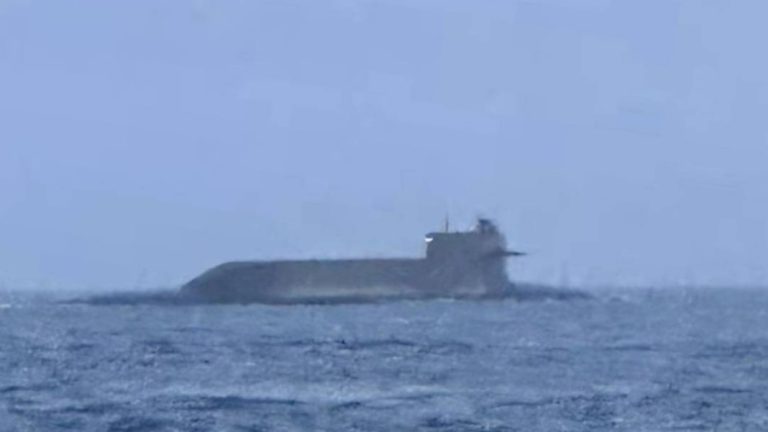
Currently, only six countries in the world operate nuclear-powered strategic submarines: the U.S., China, Russia, the U.K., France, and India. South Korea has about 20 submarines, all diesel-powered, requiring more frequent surfacing for resupply. In contrast, nuclear submarines can travel farther and faster, remain submerged longer, and offer greater stealth, providing significant advantages in anti-submarine, anti-ship, and intelligence-gathering missions.
However, a disagreement arose regarding the construction site. Trump stated that the submarine would be built in a Philadelphia shipyard operated by South Korea’s Hanwha Group, bringing U.S. jobs. South Korean officials insist the submarine must be built domestically. Prime Minister Kim Min-seok testified to the National Assembly that the Philadelphia shipyard “lacks the capability” to build such vessels, whereas South Korea’s existing facilities can complete construction more quickly.
South Korea’s strategic needs and the North Korean threat
South Korea’s direct motivation for pursuing nuclear submarines is to counter North Korea’s escalating nuclear threat. North Korea is also actively pursuing nuclear submarines, reportedly with possible Russian assistance. In March 2025, North Korea released photos of its claimed nuclear-powered submarine under construction and footage of Kim Jong-un inspecting the shipyard. North Korea possesses about 50 nuclear weapons as part of its broader nuclear program.
South Korean Defense Minister Ahn Gyu-bok said in a television interview that nuclear submarines will become a “source of national pride” and a significant step forward in defending against North Korea. He noted that the submarines’ stealth will make North Korean leader Kim Jong-un “lose sleep at night.” While South Korea is a major player in civilian nuclear energy, it faces restrictions in military nuclear technology. In the 1970s, South Korea pursued nuclear weapons development but was forced to abandon the program under U.S. pressure, with enrichment and reprocessing capabilities strictly limited, making it entirely dependent on imports.
Experts differ on the practical utility of nuclear submarines. Cho Pi-joo, a researcher at the Sejong Institute, said that acquiring nuclear submarines would help South Korea maintain relative balance amid the escalating East Asian arms race. She emphasized: “North Korea’s nuclear capability is a given; nuclear submarines are just a step in a trend of rising tensions.” She sees the agreement as giving South Korea a strategic advantage, marking a “major shift” that turns the country into a regional actor.
However, Yang Wook of the Asan Institute offers a more cautious view. He argues that the primary function of nuclear submarines is to reassure South Korean voters that the government is actively responding to the North Korean nuclear threat. “South Korea cannot develop nuclear weapons independently to counter North Korea, so what can they do? Deploy nuclear submarines.” He also warns that North Korea may welcome this change, as it strengthens the legitimacy of its own nuclear program, making it harder to demand denuclearization.
Growing Chinese naval activity near South Korea
The U.S.-South Korea nuclear submarine cooperation agreement will have profound implications for East Asian geopolitics. For Washington, supporting South Korea’s nuclear submarine plan is aimed at pressuring both North Korea and China. Dr. Yang explains: “Trump shifts the burden of defense spending onto South Korea, which will significantly increase its defense budget and act as a U.S. proxy to exert pressure on China and North Korea.”
The long-running U.S.-China competition for strategic influence over South Korea places Seoul in a delicate geopolitical position. Recently, China has increased naval activity near South Korea’s maritime borders, mirroring its expansion in the South China Sea. The deployment of South Korean nuclear submarines will significantly alter the regional military balance, exerting greater pressure on Chinese fleet movements, submarine routes, and nearshore training.
China has responded cautiously but clearly with displeasure. After the agreement was announced, Chinese Ambassador to South Korea Dai Bing stated that he hopes South Korea will “handle this matter prudently and consider all parties’ concerns,” emphasizing through diplomatic channels that “the security situation on the Korean Peninsula and the region remains complex and sensitive.” Experts believe Beijing is “very angry” about the U.S.-South Korea nuclear submarine agreement, viewing it as a precedent for U.S. expansion in the military application of nuclear technology.
The U.S.-South Korea nuclear submarine agreement marks a significant adjustment in the Trump administration’s East Asia strategy. It not only enhances South Korea’s military capability but also reshapes the strategic balance in the region. For South Korea, this is more than a shipbuilding project—it represents a long-term strategic upgrade, transforming the country from a traditional peninsula defender into a regional maritime power. For the U.S., it is both an alliance evolution and a practical test of turning “collective defense” from slogan into operational capability.
Faced with the dual challenges of China’s rise and North Korea’s nuclear threat, the U.S. has chosen to use technology transfer and military cooperation to have its allies assume greater regional security responsibilities. This approach aligns with the Trump administration’s “America First” policy while reflecting a pragmatic response to the changing East Asian strategic environment.
Yang Tianzi