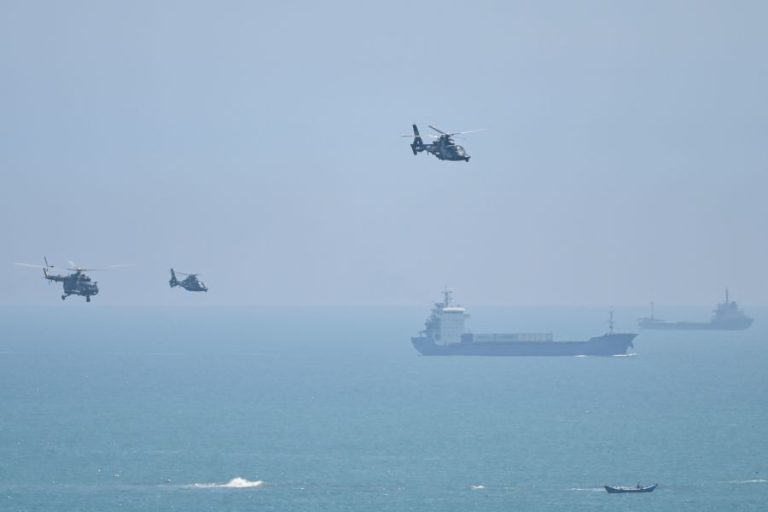
On Monday, Nov. 17, the U.S.-based Foundation for Defense of Democracies (FDD) released a report warning that the Chinese Communist Party (CCP) could potentially paralyze Taiwan without firing a single shot.
The report noted that Beijing could gradually cut off Taiwan’s fuel and electricity supplies through maritime inspections, administrative measures, and cyberattacks, pressuring Taipei to yield under long-term strain. Such an “energy siege,” if successful, could severely disrupt U.S. and global supply chains.
The FDD report suggested that the CCP may not begin with missiles or large-scale military operations. Instead, it could start with “routine inspections,” “new customs regulations,” and “coast guard patrols,” combined with cyber intrusions and disinformation campaigns to gradually restrict Taiwan’s energy imports while maintaining plausible deniability.
The strategy, the report emphasized, is not immediate invasion but making Taiwan believe resistance is futile. This gray-zone pressure has been described as a “slow-motion tightening strategy.”
Fox News reported that the analysis comes from a war game conducted this summer by FDD in collaboration with Taiwan’s National Chengchi University Center for Innovation in Democracy and Sustainability. The simulation found that if the CCP applied weeks of administrative delays, cyberattacks, and disinformation targeting Taiwan’s liquefied natural gas (LNG) imports, the island’s power grid could suffer widespread paralysis.
Success
You are now signed up for our newsletter
Success
Check your email to complete sign up
Taiwan’s energy highly dependent on imports
Taiwan relies heavily on imported energy, with natural gas accounting for 50 percent and coal about 30 percent. Overall reserves “can only last a few weeks.” Its three main LNG terminals and Taichung coal port are concentrated on the west coast. Supply ships must pass through the narrow Taiwan Strait, entirely within the range of CCP missiles, making Taiwan one of the world’s most energy-vulnerable economies.
The report noted that a significant power shortage would force the government into difficult choices: prioritize electricity for hospitals or maintain operations at semiconductor factories like TSMC and UMC.
Taiwan produces about 60 percent of the world’s semiconductors and over 90 percent of advanced chips. The report warned that an energy-induced shutdown in Taiwan would immediately impact the global electronics industry and defense manufacturing, extending beyond Asia to U.S. supply chains and global financial markets.
“Gradually shutting down industrial capacity would ultimately turn Taiwan’s crisis into a global disaster, because most mature and nearly all advanced chips would stop circulating,” the report said.
The report highlighted that CCP cyberattacks targeting Taiwan’s energy systems have doubled over the past year. Simulations assumed that the CCP could implant malware in LNG terminals and power plant control systems to disrupt energy transportation and distribution.
Beijing may also use disinformation to paralyze Taiwanese society, spreading rumors about blackouts, hoarding, and government incompetence to weaken public trust. The report stressed, “Disinformation is not a secondary tool; it is Beijing’s primary weapon.”
It also warned that the CCP’s information warfare could extend to U.S. public opinion, seeking to weaken domestic support for protective measures.
Calls for US LNG expansion to strengthen Taiwan’s energy resilience
The report urged the U.S. to expand its LNG export capacity, including advancing new projects in Alaska, to ensure future direct energy supplies to Taiwan. It also recommended that Taiwan build larger LNG reserves and seek more U.S. imports.
The report suggested U.S. naval escort for energy transport ships to enhance Taiwan’s strategic resilience.
Mark Montgomery, the report’s author, stated: “Beijing believes that ‘pressure + patience = political collapse.’ What truly worries China is not Taiwan’s resistance but whether the Taiwanese people can withstand coercion.”
While the threat remains theoretical for now, the report warned that as the CCP accelerates its tools to strangle Taiwan’s energy supply and shape overseas public opinion, the line between peace and pressure is narrowing. Simulations indicate that in the next Taiwan crisis, “the first shot may not even be fired.”
Meanwhile, Taiwan will begin distributing millions of civil defense manuals nationwide this week, marking the first large-scale effort of its kind. The manuals aim to help citizens prepare for potential emergencies, including possible CCP attacks.
Released in September, the manual for the first time includes guidance on how civilians should respond if encountering enemy soldiers and stresses that any claim of “Taiwan has surrendered” should be treated as false. It also provides practical instructions for finding air-raid shelters and preparing emergency kits.
As Beijing continues to increase military and political pressure and repeatedly claims sovereignty over Taiwan, the Taiwanese government is accelerating related preparations. The distribution of civil defense manuals is viewed as the latest step in strengthening nationwide resilience.
By Gao Yun