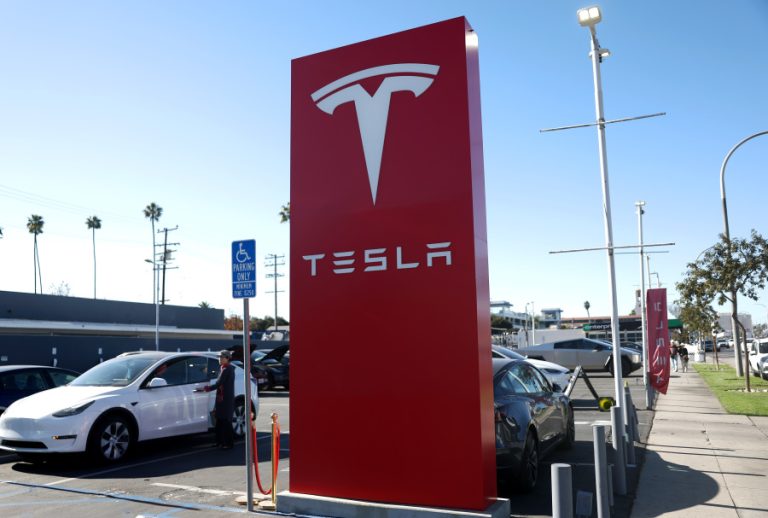
Tesla is moving to eliminate China-made parts from all vehicles built in the United States within the next two years, a shift driven by rising tariffs, geopolitical risks, and growing uncertainty in U.S.–China relations. The decision reflects a wider retreat by multinational companies as China’s economy slows and the consumer market weakens.
Suppliers say Tesla’s directive is clear: prepare for a supply chain no longer tied to China. Industry analysts view the move as part of a broader global restructuring already reshaping trade and manufacturing networks.
Tesla has instructed suppliers to phase out all China-sourced components, citing tariff volatility and political instability as major risks. General Motors has reportedly issued similar requirements, asking upstream and downstream partners to stop procuring Chinese raw materials by 2027.
The pandemic accelerated Tesla’s diversification strategy, prompting the company to encourage Chinese suppliers to build facilities in Mexico and Southeast Asia. But the decisive shift came this year after President Trump imposed steep tariffs on Chinese imports, raising fears that continuing to rely on China-made parts would drive up production costs and weaken competitiveness.
For Tesla, removing China from the equation is now seen as essential for long-term stability.
Reshaping its battery strategy
Success
You are now signed up for our newsletter
Success
Check your email to complete sign up
Tesla is also restructuring its battery supply network. Once dependent on China’s CATL for lithium iron phosphate (LFP) batteries, the company now plans to manufacture batteries in Nevada, with production expected to begin in 2026.
Critics warn that celebrating foreign companies’ exit from China is shortsighted. Without Tesla, Volkswagen, Toyota, or Audi, prices for domestic cars could surge due to reduced competition. These companies also support millions of jobs across the supply chain.
Online commenters argue that China still needs balanced competition and that monopolizing the auto market would leave consumers worse off.
Tesla’s decline and China’s ‘raise, pen, slaughter’ model
Tesla’s recent decline in China—falling sales and shrinking market share—appears to follow a familiar pattern experienced by other foreign firms. Analysts describe it as a “raise, pen, slaughter” cycle:
- Raise: attract foreign companies with incentives and market access.
- Pen: require technology sharing through joint ventures or supply-chain integration.
- Slaughter: replace foreign firms with strengthened domestic competitors.
When Tesla broke ground on its Shanghai plant in 2019, Beijing treated the company as a flagship investment project. Six years later, domestic automakers such as BYD and Xiaomi Auto have overtaken Tesla with lower prices and feature-rich EVs.
In the first two months of 2025, BYD sold 480,000 vehicles, up 75 percent year-on-year. Tesla, meanwhile, sold just over 60,000, a 14 percent drop. Its market share fell from 11 percent in 2021 to 4 percent in 2025, while BYD surged to 29 percent.
Tesla’s Shanghai Gigafactory once represented nearly half of its global output. As cooperation deepened, Chinese companies absorbed Tesla’s technology—then became its toughest rivals.
Foreign retail brands quietly retreat
The retreat is not limited to automakers. Retail companies have also begun scaling back in China.
Sports retailer Decathlon is reportedly preparing to sell part of its China business.
IKEA’s shopping-center operations have quietly appeared on lists of assets seeking buyers.
A growing number of familiar foreign brands have changed hands or are actively looking to exit the market.
The broader trend reflects a core issue: a weakening consumer market driven by the erosion of China’s middle class.
Middle-class strain: Job losses and falling home prices
China’s middle class faces mounting pressure from wage cuts, layoffs, and declining property values.
A Beijing migrant worker wrote that more people are leaving the city with suitcases in hand, discouraged by shrinking job opportunities. Many struggle to explain their situation to families back home, fearing misunderstanding or disappointment.
She described 2025 as an especially difficult year, but hopes hardships are temporary. Still, the departure of foreign companies suggests that employment opportunities may continue to contract.
Japan quietly reduces its reliance on China
Japan is also accelerating its “de-Chinafication” strategy. Shoppers report that Uniqlo products increasingly show tags from Vietnam, Laos, and Bangladesh, rather than China.
While rising labor costs are often cited, analysts say geopolitical realignment with the U.S. and Europe is the deeper reason. Companies now view overreliance on China as a strategic vulnerability.
Commentators note that Tesla’s shift reflects multiple pressures—tariffs, political uncertainty, and evolving global supply chains. Yet they also acknowledge that fully decoupling from China will be difficult, given its dense industrial ecosystem and supply-chain efficiencies.
Even so, Tesla’s move could reshape global automotive production as other companies follow suit, prioritizing diversification and risk reduction.