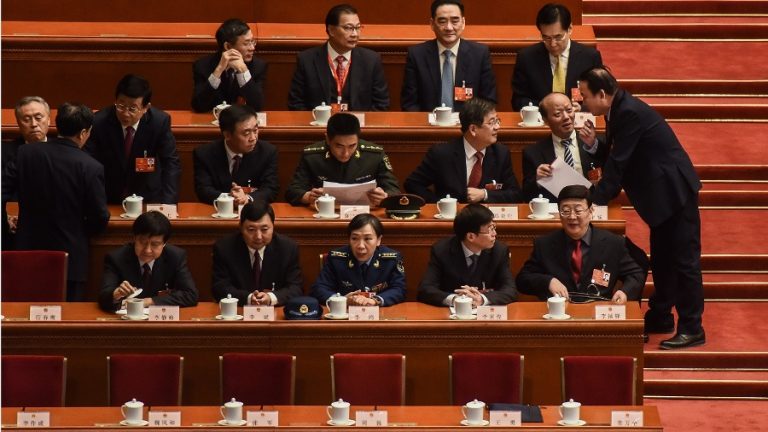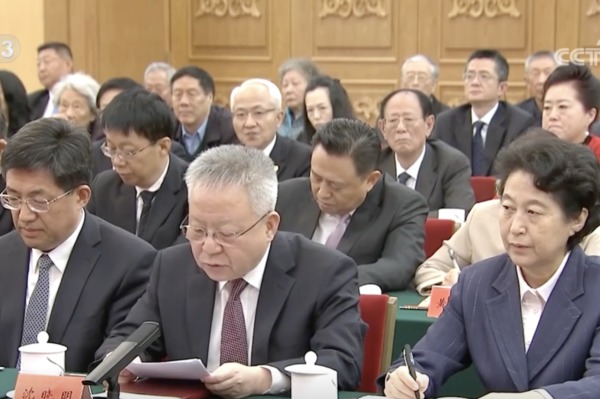
On Nov. 20, 2025, the Chinese Communist Party (CCP) held a symposium at Beijing’s Great Hall of the People marking the 110th anniversary of former Party leader Hu Yaobang’s birth. CCP leader Xi Jinping attended the event and gave a keynote speech. The session was chaired by Cai Qi, a Politburo Standing Committee member and director of the Central Office, whose recent 11-day absence from public view had sparked speculation.
Other attendees included Li Xi and senior officials Shi Taifeng, Li Ganjie, Li Shulei, Liu Jinguo, Wang Xiaohong, and Zhang Shengmin.
Among those present were Hu Deping, Hu Yaobang’s eldest son, and Liu Yuan, son of Liu Shaoqi. Both appeared stern throughout the ceremony. Hu’s relatives, friends, and representatives from his hometown were also invited to the event, Xinhua reported.
State broadcaster CCTV avoided close-ups of Hu Deping, who sat in the third row, visibly tense. When the camera briefly passed over Liu Yuan in his military uniform, he also appeared stern. Xi Yuanping, Xi Jinping’s younger brother, also attended the event.
During his speech, Xi Jinping praised Hu Yaobang as a leader who “championed reform and opening up,” urging Party members to emulate his stance against corruption.
Success
You are now signed up for our newsletter
Success
Check your email to complete sign up
Political commentator Li Linyi told overseas Chinese media that the event conformed superficially to CCP tradition: the Party typically commemorates national-level leaders on major anniversaries. But he argued the event was largely symbolic and revealed deeper tensions, particularly between Xi and Hu’s son.
For critics who see Xi as authoritarian and “reversing reforms,” his warm praise of Hu Yaobang—long seen as a symbol of political liberalization—had an unmistakably ironic tone.
Xi–Hu Yaobang family ties and long-standing friction
Commentator Cai Shenkun warned against reading too much into Xi’s praise of Hu Yaobang. The official assessment of Hu, he noted, was set years ago under former Central Office director Wen Jiabao and has remained largely unchanged.
Despite shared personal and political ties, relations cooled after Hu Yaobang’s third son, Hu Dehua, publicly criticized Xi. This dispute weakened Hu Deping’s ability to offer policy advice, Cai said. Whether Xi–Hu relations improve following Hu Dehua’s death earlier this year remains uncertain.
Hu Dehua, a former deputy editor of Yanhuang Chunqiu, passed away in March 2025. At a 2013 gathering, he criticized Xi for “not reading much.” Xi was said to have reacted angrily. Soon after, authorities banned any improper discussion of the Party Center and shut down Yanhuang Chunqiu.
Australian scholar Feng Chongyi noted that after Xi closed Yanhuang Chunqiu (reformist magazine) in 2016, relations between reform-minded princelings and Xi soured completely.
After his political rehabilitation in 1978, Xi Zhongxun returned to Beijing with help from Hu Yaobang, then head of the Party’s Organization Department. Hu Deping and Xi Jinping also maintained cordial relations earlier in their careers. Still, the relationship was strained.
Cai Shenkun revealed that ahead of the 18th Party Congress, Xi quietly sought the support of influential princelings. During one meeting, when Hu Deping proposed political reforms, Xi reportedly replied: “You think too highly of me. I’m just here to keep the ship steady—I can’t take on these big tasks.” Cai said the exchange marked the end of the long-standing relationship between the two families.
At China’s 2015 military parade commemorating the end of World War II, portraits of many senior Party figures were on prominent display. Hu Yaobang’s portrait, however, was missing — as was any mention of his family.
After the Sept. 3, 2025 parade, Xi Yuanping hosted a gathering of more than 100 princelings, but several prominent figures — including Liu Yuan, Deng Pufang, and Hu Deping — were absent.
A high-profile commemoration seen as a political reversal
U.S.-based commentator Tang Jingyuan said the unusually high profile of this year’s commemoration suggested a shift inside the Party.
The official report said Xi Jinping attended the event and delivered the keynote address. Cai Qi chaired the session, while Politburo Standing Committee member Li Xi—who oversees Party discipline—also took part. All members of the Party Secretariat were present.
Tang compared the event to the CCP’s internal rules for commemorating past leaders:
- Category One: Mao Zedong (a unique classification)
- Category Two: Zhou Enlai, Liu Shaoqi, Zhu De, Chen Yun—core Party leaders
For Category Two figures:
- Every 10 years → commemorative articles + symposium with leadership attendance
- Every 50 years → centrally organized symposium with top leaders delivering speeches
- Every 100 years → full memorial conference with the highest-level protocol
Hu Yaobang, as a former General Secretary, belongs to the second tier but not to the exalted rank of Mao or Deng..
In 2015, the centenary of Hu’s birth, Xi attended a high-profile memorial alongside all seven members of the Politburo Standing Committee and other senior officials.
By contrast, General Secretary Hu Jintao was absent from the 90th anniversary commemoration held in 2005. Premier Wen Jiabao attended without speaking, while Zeng Qinghong, then vice president and a member of the Politburo Standing Committee, delivered the main address. The event followed the Party’s standard ten-year format.
By that logic, the 110th anniversary in 2025 should have followed the lower-profile format used for the 90th.
Instead, the ceremony matched the protocol of a 50-year commemoration, featuring Xi’s keynote speech and the full presence of top Party leadership.
Tang noted that Hu Yaobang was forced to resign in 1987 for “violating collective leadership principles,” and his death helped trigger the 1989 Tiananmen protests—making his commemoration politically sensitive. Given Xi’s strained ties with the Hu family, a smaller event would have seemed more likely. Instead, the symposium took on an unusually high profile.
Tang suggested the decision to raise the event’s profile may not have come from Xi himself. Rather, it may have been orchestrated by factions inside the Party more sympathetic to the Hu family. Xi’s attendance and speech were part of this arrangement, he said—signaling shifting power dynamics inside the CCP.
Tang concluded that although Xi remains China’s top leader in name, the symposium hints that his grip on the Party’s machinery may be loosening.