The uneasy on-camera return of security chief Wang Xiaohong, a wave of Japanese satire aimed at Xi Jinping, and a forceful essay by U.S.-based scholar Miles Yu each reveal different kinds of tension — inside the Party, in public opinion, and across the world stage.
Rumors about Wang Xiaohong—China’s minister of public security and one of Xi Jinping’s closest loyalists—have swirled for weeks. The sudden, unexplained death of Dong Yijun, a Beijing deputy police chief considered part of Wang’s inner circle, only intensified questions. At the same time, Wang himself had quietly disappeared from public view.
Concerns deepened after FBI Director Kash Patel arrived in Beijing on Nov. 7 for discussions on fentanyl. Although Wang heads China’s National Narcotics Control Commission, the person who met Patel was not Wang but Vice Minister Xu Litong. For many observers, this looked less like scheduling convenience and more like a signal: something might be off with Wang’s standing.
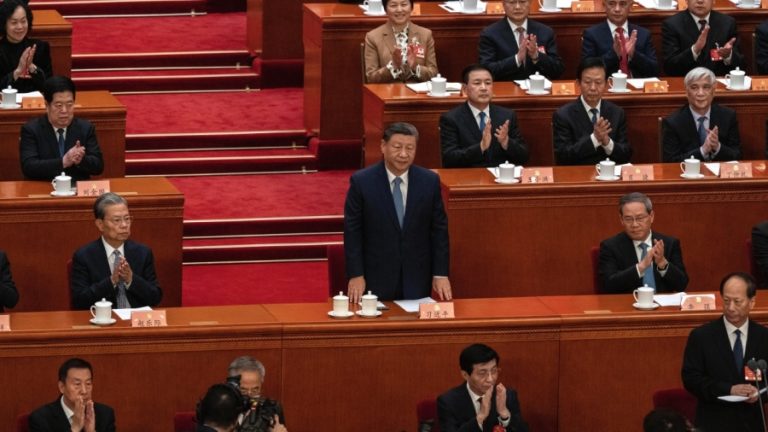
Wang eventually resurfaced on CCTV. At first glance it seemed to settle the speculation—until viewers began replaying the footage.
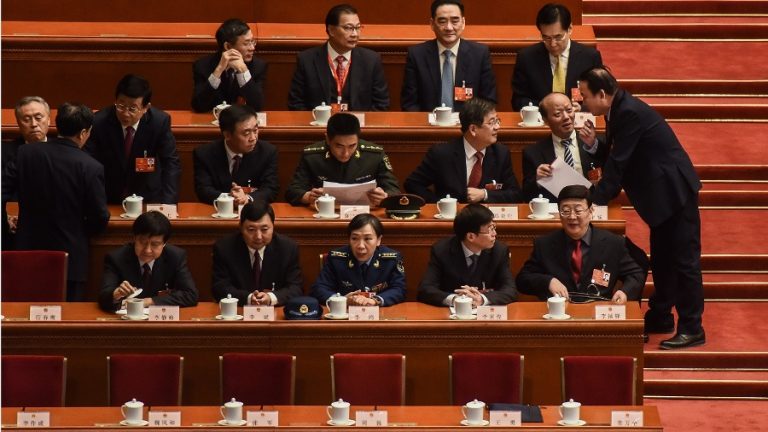
As the camera panned across the senior officials seated below the rostrum—from Shi Taifeng, to Li Hongzhong, to Wang—something stood out immediately. Wang was bent so low over his desk that he appeared almost folded into it. The image suggested intense note-taking, but the posture was so exaggerated that it drew more attention than it deflected.
Success
You are now signed up for our newsletter
Success
Check your email to complete sign up
None of the officials near him adopted anything close to that posture. Only Wang leaned forward to such an extent, as if using his own body to obscure his face from the camera. The contrast was striking enough that online analysts quickly seized on it: this was not how a confident security chief behaved during a televised political meeting.
Given Wang’s role as Xi’s “knife handle”—the man entrusted with policing the system—commentators argued that such visible tension rarely appears without cause. Combined with the fall or strange deaths of multiple subordinates, the footage prompted speculation that while Wang still moves in public, an internal political review may already be underway. To some, it echoed earlier purges of senior military leaders such as Miao Hua and He Weidong.
Japanese netizens mock Xi Jinping
While Wang’s posture was being dissected online, an unrelated episode in Japan drew its own wave of attention.
Two years ago, Tokyo’s “Xitaihou” restaurant helped create a trend: using “Xi Winnie-the-Pooh” imagery to mock the CCP and provoke nationalist “Little Pink” users. The meme quickly spread, spawning merchandise such as kneeling Pooh dolls packaged with Chinese-language stating, “sincere apologies.”
Now Japanese netizens have come up with a new tactic. This time they brought loudspeakers to the front of the Chinese embassy in Tokyo and played recordings of Taiwanese influencer Chen Zhihan (known for his fiery language) openly cursing Xi Jinping.
A Taiwanese user who shared the video noted how Japanese netizens labeled the stunt: “Broadcasting the Imperial Voice of pro-China influencer Chen Zhihan in front of the Embassy of the People’s Republic of China.”
The phrase “Imperial Voice Broadcast” added a layer of parody that quickly went viral. Some joked that Xi would be infuriated; others pointed out that many Chinese diplomats have their own quiet frustrations with Xi and might have found the moment unusually satisfying.
The incident also underlined a broader dynamic: Xi often warns that “the Chinese people are not to be provoked,” yet these episodes show that Japanese netizens—playful, persistent, and unafraid of satire—can be just as unyielding, especially when Xi is the target.
Meanwhile, the CCP found itself facing another embarrassment. In Taiwan, Shen Boyang, whom Beijing recently threatened with “global arrest,” is now rumored as a possible 2026 Taipei mayoral candidate. Former UMC chairman Cao Xingcheng floated the proposal, and Shen’s own remark—“warriors rarely choose their battlefield”—was widely interpreted as a sign he might be open to the idea, even after he later said the election wasn’t in his current plans.
Rather than undermining him, Beijing’s threats have boosted Shen’s profile and stirred a new wave of public resentment against the CCP. Commentators believe that if he ultimately enters the race, many Taiwanese would treat their votes as a direct message to Beijing.
Scholar Miles Yu says CCP drives global instability
The third subject drawing attention is a new essay by Miles Yu, the prominent scholar and former U.S. State Department official known for his unflinching assessments of Beijing. His latest piece offers a sweeping reconsideration of the Chinese Communist Party’s influence on global instability.
Yu begins by arguing that, contrary to the claims of some Western analysts, it is not Washington but the CCP that has repeatedly destabilized the post-World War II order. He describes the Party as a revolutionary regime that relies on continual struggle, conquest, and expansion for its own survival.
In Yu’s view, this impulse begins with ideology. Communism, he writes, treats peace as nothing more than a lull between conflicts. Mao Zedong built his authority on the premise of “continuous revolution” and on the belief that political power ultimately rests on force. To preserve the myth of its perpetual correctness, Yu says, the CCP—much like the Soviet Union—has repeatedly projected strength beyond its borders.
He traces this pattern across a series of major confrontations: the Korean War, where China’s intervention prolonged the fighting; the bombardments of Kinmen and Matsu in 1954 and 1958; the 1962 war with India; the deadly 1969 clashes with the Soviet Union; and the 1979 invasion of Vietnam. No other major state, Yu notes, has initiated as many wars and border conflicts in the postwar era.
Despite this record, Yu argues, influential Western figures—from Henry Kissinger to Jeffrey Sachs—continue to portray China as essentially peaceful and non-expansionist. The evidence, he contends, suggests the opposite. None of the CCP’s wars were defensive; all reflected ideological ambition. And in Yu’s reading, Beijing has spent decades trying to weaken the United States through indirect conflict. “Since the founding of the communist state in 1949,” he writes, “Beijing has been the unseen hand supporting America’s enemies and prolonging instability.”
He cites the Korean War, which might have ended quickly without Chinese intervention, and China’s sustained support to Hanoi in the 1960s and 1970s—arms, equipment, advisers—that transformed a limited dispute into a war of attrition.
Yu argues that the same logic extends into the present. China’s backing has helped Russia endure sanctions; its $400 billion strategic partnership with Iran has enabled Tehran to support groups such as Hamas and Hezbollah; and authoritarian governments like Venezuela also benefit from Chinese support. He even describes the Oct. 7, 2023 Hamas attack on Israel as the predictable result of Beijing’s decision to empower what he calls the world’s most active state sponsor of terrorism.
All of this, Yu concludes, reflects a coherent strategy: allow others to fight while Beijing profits from the chaos; drain U.S. resources through peripheral conflicts; and fracture Western alliances while normalizing authoritarian rule as part of the global order.
He criticizes American commentators—“tenured professors, think-tank eccentrics, greedy Wall Street financiers, and nerdy Silicon Valley elites”—who claim Washington is the true source of global instability. A clear reading of history, he argues, points elsewhere. The CCP has never stopped engaging in conflict, whether through military action, proxies, economic pressure, or ideological campaigns. In Yu’s assessment, it remains “the most destructive and most militant regime in the world,” driven by principles fundamentally incompatible with lasting peace.
Taken together, these moments — Wang’s anxious posture on state television, the irreverent protests in Tokyo, and Yu’s scathing indictment of the Party’s global conduct — capture a wider unease about China’s direction. At home, loyalty looks increasingly performative; abroad, ridicule and criticism grow louder. For a government obsessed with control, both kinds of attention may be equally unsettling.