
By Li Jingyao, Vision Times
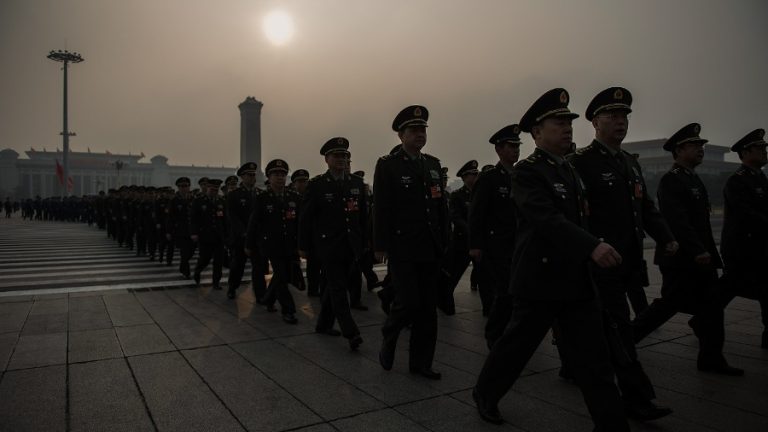
In the aftermath of the dramatic purges of Vice Chairman He Weidong and Political Commissar Miao Hua, the Chinese military has once again plunged into a climate of fear and suspicion. Officers at every level are bracing for the next wave of downfalls within the Chinese Communist Party (CCP). At the same time, open calls for a military uprising have appeared on the social platform X (previously known as Twitter) — a sign, analysts say, that lower-level resentment may be reaching a dangerous threshold.
According to former insiders from China’s People’s Liberation Army (PLA), the armed forces increasingly hope to see current CCP leader Xi Jinping removed from his post. And in this high-stakes power struggle, they believe the first step is to take down his closest and most indispensable enforcer: Cai Qi.
RELATED: Xi’s Inner Circle Falters: Inside the Disappearances of Cai Qi and Wang Xiaohong
Calls of a ‘second Wuchang uprising’
On Nov. 7, an X account known as “Beijing Democracy Forces Spokesperson” published a manifesto titled “A Call for the Liberation Army to Rise Up.” It urged: “Revolt! The time has come to launch a second ‘Wuchang Uprising’!”
Success
You are now signed up for our newsletter
Success
Check your email to complete sign up
Whether such appeals can spark real action remains uncertain, though the CCP maintains some of the strictest military controls in the world. But independent commentator Du Zheng believes the fact that such calls are circulating at all is significant, especially given the CCP’s strict censorship protocols.
Writing in “Up Media,” he noted that a December 2024 “PLA Daily” article warned of “lax discipline” among frontline troops and condemned unauthorized attempts to “climb over the Great Firewall” to access outside information.
RELATED: He Weidong and Miao Hua Purge Signals Deep Military Turmoil in China
To Du, the implication was obvious: “This proves that climbing the firewall has already become a widespread phenomenon,”he said, adding, “If soldiers are secretly accessing outside information, the impact on military morale will be enormous.”
Lower level mutiny
Based on conversations with contacts in the military and political circles, Du argues that senior generals, known for being deeply corrupt and tied to factional networks, lack the courage to rebel. However: “Lower-level uprisings may already be accumulating energy,” he said.
Tension is evident. On Nov. 11, CMC Vice Chairman Zhang Youxia wrote in People’s Daily that the PLA must prevent “two-faced behavior” and root out “fake loyalty,” insisting that obedience to the CCP core must be “implanted deeply into the minds of all officers and soldiers.”
Translated through the lens of anti-regime sentiment, Du writes: “When the CCP condemns ‘two-facedness’ or ‘fake loyalty,’ it often means people are biding their time—enduring for now, waiting for the right moment. This exists everywhere in the system, but in the high-pressure environment of the PLA, it is even more prevalent.”
Long-term resentment also runs deep. Soldiers see retired veterans denied benefits, suppressed when petitioning, and treated as disposable. Viral videos this year showed a Jiangsu veteran shouting: “Becoming a soldier was a mistake. Joining the CCP was a mistake.”
One contact told Du early this year that a small group of officers in a battle zone headquarters had discussed “emulating the Wuchang Uprising” when the right moment arrives, either during a crisis over Taiwan or if Xi Jinping dies suddenly and chaos ensues.
‘Taking Cai Qi out first’
Before the Fourth Plenum, rumors circulated that Xi might relinquish one or two of his positions. But afterward, Xi remained atop the Party, state, and military. Former PLA Naval Officer Yao Cheng says that does not reflect military sentiment: “Inside and outside the Fourth Plenum venue, military delegates showed firm determination to oppose Xi. But since they are few in number, the goal wasn’t reached.”
According to Yao, the PLA leadership broadly hopes Xi will step down. But the first step is clear: “To take down Xi, you must first remove Cai Qi.”
Cai Qi, known as Xi’s political gatekeeper and head of the Central Office, has been missing from public view for an extended period, which Yao says is no accident: “Cai Qi’s disappearance was expected. Before removing Xi, they had to remove Cai Qi. He is the number-two figure in real power. If someone this important disappears for ten days, it’s basically confirmed he has been taken.”
Yao asserts that Zhang Youxia personally traveled to Guangzhou to detain Cai, citing military sources.
A ‘leaderless’ PLA
Yao describes the post-purge military as dangerously adrift: “Since the Fourth Plenum, the Central Military Commission must convene an expanded meeting. Many services and branches have gone one or two years without commanders or political commissars. The troops are leaderless.”
Without top brass to give orders or approve decisions, uncertainty paralyzes the ranks. In wartime, Yao adds, the principle is always: “To capture the bandit, capture the king first.”
For the PLA, that means removing Xi’s control nodes before addressing Xi himself. “They must remove Cai Qi,” notes Yao. “Once he is gone, Xi will be left helpless.” The message being sent to Xi, Yao notes, is unmistakable: “You should step down. If you don’t, the consequences are obvious. If you continue, you will plunge the country into chaos and destroy national defense.”
Yao predicts that the crucial expanded CMC meeting should take place in December. “Therefore, Xi Jinping must step down before or during December,” says Yao.
A military on the brink
Between high-level purges, open calls for mutiny, and reports of generals turning against the commander-in-chief, analysts say the CCP military apparatus is approaching a dangerous inflection point. Though speculation swirled for months that Xi would step down from his role during the CCP’s Fourth Plenum that concluded on Oct. 24, Xi still retains all his official titles.
If Xi refuses to step down and the CMC remains paralyzed, some fear that lower-ranking officers — angry, ideologically fractured, and exposed to outside information — may see a moment of crisis as the opportunity to act and finally take Xi down for good.
Whether such an uprising materializes remains uncertain. But one thing is clear: For the first time in decades, the CCP’s control over the military no longer appears as iron-fisted and absolute.