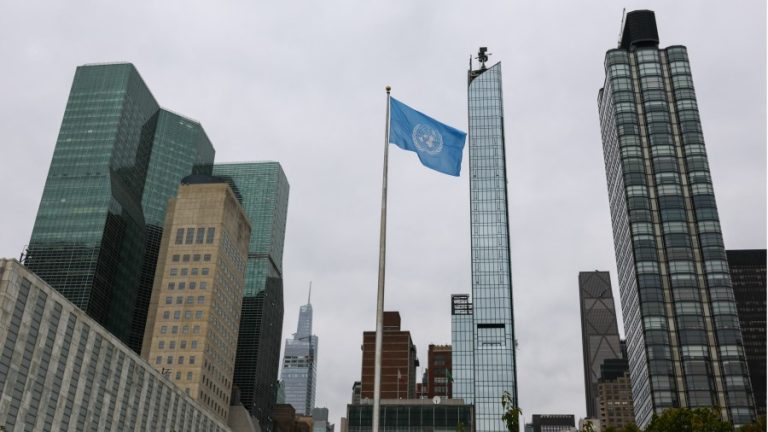
On Nov. 20, at the 80th United Nations General Assembly Third Committee (Social, Humanitarian, and Cultural Committee) meeting, 15 countries from Europe, the Asia-Pacific, the Americas, and Oceania unusually joined together to submit and publicly read a joint statement on China’s human rights situation. The statement expressed “deep concern” over the Chinese Communist Party’s (CCP) ongoing, systematic human rights violations both domestically and abroad, and issued a clear call to action.
The statement, jointly signed by Albania, Australia, the Czech Republic, Estonia, Israel, Japan, Latvia, Lithuania, North Macedonia, Palau, Paraguay, San Marino, Ukraine, the United States, and the United Kingdom, directly accused China’s communist authorities of “serious human rights abuses,” specifically including:
- Arbitrary detention and forced labor;
- Illegal, widespread, and arbitrary surveillance;
- Systematic restrictions on religious freedom and cultural activities;
- Targeted repression of ethnic and religious minorities, especially Uyghurs and other Muslim minorities, Tibetans, Christians, and Falun Gong practitioners, including forcibly sending children to boarding schools separated from their families, torture, and destruction of cultural and religious heritage.
The statement singled out the situation in Hong Kong, noting that long-held civil liberties and the rule of law there have been severely eroded. Beijing authorities have even conducted cross-border pursuits and offered bounties on dissidents outside Hong Kong, posing a direct threat to freedom of expression.
The 15 countries emphasized that, both online and offline, the CCP uses state censorship and surveillance machinery to control the flow of information and suppress public discourse, punishing anyone who challenges the official narrative. Journalists, human rights defenders, lawyers, and other groups continue to face repression, and cross-border crackdowns create a “climate of fear that silences critics” globally. These actions not only severely undermine international trust but also contradict the fundamental principles of global stability and human progress.
The statement issued two clear demands to the CCP:
- Immediately and unconditionally release all individuals unjustly detained solely for exercising human rights and fundamental freedoms;
- Fully implement obligations under the Universal Declaration of Human Rights and other signed international human rights treaties.
Success
You are now signed up for our newsletter
Success
Check your email to complete sign up
Well-documented human rights violations
The 15 countries also called on all UN member states to take collective action, urging the CCP to address the extensive, well-documented human rights violations and to promote effective accountability mechanisms.
Notably, the countries initiating the joint statement span multiple regions and ideological lines: NATO and EU member states, key democracies in the Asia-Pacific, and countries with historically independent stances on human rights such as Israel, Palau, and Paraguay. This demonstrates that international concern over China’s deteriorating human rights situation has transcended traditional geopolitical boundaries, forming an increasingly broad consensus.
In recent years, the UN High Commissioner for Human Rights’ 2022 assessment of Xinjiang, various country reports by special rapporteurs, and evidence from numerous NGOs and exiled witnesses have all pointed to CCP policies in Xinjiang that may constitute “crimes against humanity.” Meanwhile, since the implementation of Hong Kong’s National Security Law, mass arrests of pro-democracy figures, media closures, and the shrinking of civil society have deepened international concern that “one country, two systems” has effectively collapsed.
This joint statement by 15 countries is seen as another strong collective action on China’s human rights record at the UN, following a previous Canada-led joint statement on Xinjiang co-signed by 50 countries. Diplomats note that as more countries refuse to remain silent on human rights, future similar joint initiatives targeting the CCP are likely to involve even broader participation, potentially leading to more binding draft resolutions at the UN Human Rights Council or General Assembly plenary sessions.
At the Third Committee meeting, the joint statement received applause from multiple country representatives and NGOs. The Chinese delegation, as usual, accused the relevant countries of “interfering in China’s internal affairs under the guise of human rights” and claimed that China’s human rights situation is “at its best in history.”
However, as the statement emphasized in conclusion: “Human rights and fundamental freedoms are the cornerstone of legitimate governance and global trust.” When a country persistently and systematically violates these universal values, not only are its citizens deeply harmed, but the foundation of international trust and cooperation is also undermined.
The action by these 15 countries signals that, in defending universal human rights and fundamental freedoms, silence and concession are no longer options.