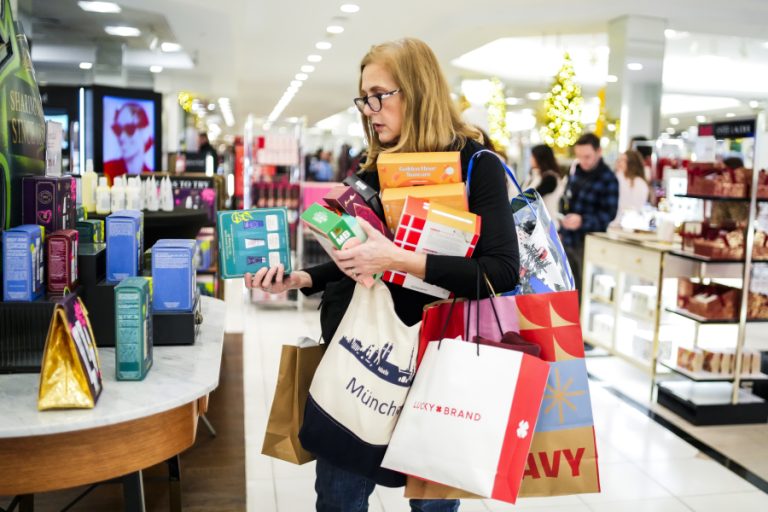
Black Friday set another record for U.S. retailers this year, even as the underlying data shows an increasingly uneven consumer landscape.
Mastercard SpendingPulse reported Saturday that overall retail sales climbed 4.1 percent from a year earlier. Adobe Analytics recorded $11.8 billion in online purchases—a 9.1 percent increase over 2024.
Economists say the top-line numbers look stronger than the reality. With inflation still running near 3 percent, much of the apparent growth reflects higher prices rather than a real surge in purchasing. “If inflation is three percent, then a 4.1 percent increase doesn’t reflect much real growth,” said economic analyst Rick Newman.
The Federal Reserve’s latest Beige Book points to the same split: low- and middle-income households are cutting back, while higher earners continue to spend heavily on luxury goods and travel.
National consumer specialist Claudia Lombana said shoppers bought fewer items this year but paid more per purchase. “High-income consumers are buying what they want. Those with less disposable income are budgeting far more tightly,” she said.
Success
You are now signed up for our newsletter
Success
Check your email to complete sign up
K-shaped economy widens the gap
The contrast is a textbook example of a K-shaped recovery.
Households with stock gains or rising home values—the upper arm of the “K”—feel secure enough to spend freely.
Those without such assets are absorbing rising costs, job uncertainty, and a decline in purchasing power.
“If you own stocks or property, you feel comfortable shopping,” Newman said. “If you don’t, you’re watching every dollar. This group will likely spend less on everything this holiday season, from gifts to household basics.”
Heating bills are expected to rise as natural-gas prices climb, and food and rent continue to rise faster than overall inflation—further straining low-income budgets.
The National Retail Federation (NRF) found that 85 percent of consumers expect President Donald Trump’s tariffs to push prices higher. “People may not calculate item by item how much tariffs add, but they feel the impact,” Newman said.
Value-driven shopping shapes holiday behavior
Inflation, a cooling job market, and reduced federal benefits for low-income families have pushed shoppers toward retailers that offer more value for each dollar spent.
Walmart, TJ Maxx, and Gap all reported strong results, with Walmart gaining traction across income levels.
Target and Bath & Body Works saw weaker sales, with the latter noting a decline in “treat-yourself” buying compared with previous holiday seasons.
Even with these shifts, NRF expects November and December retail sales to grow between 3.7 and 4.2 percent, roughly matching last year’s pace.
Holiday spending nears $1 trillion as BNPL use accelerates
NRF expects total holiday spending to reach $1 trillion, up from last year’s $976 billion.
Adobe’s category breakdown shows:
• online apparel sales up 6.1 percent
• in-store apparel purchases up 5.4 percent
Thanksgiving Day online spending reached a record $6.4 billion.
Adobe analyst Vivek Pandya said retailers leaned more heavily on aggressive promotions to lift online demand.
Buy now, pay later (BNPL) options continue to gain traction. Adobe expects BNPL purchases to total $20.2 billion for November and December—an 11 percent increase from 2024.
Lombana said half of U.S. shoppers started buying holiday gifts before Halloween, and she expects Cyber Monday to remain the year’s strongest online shopping day.
Black Friday breaks new records despite caution in stores
Adobe estimates consumers spent $5.5 billion on Saturday and $5.9 billion on Sunday—gains of 3.8 and 5.4 percent, respectively.
Salesforce reported total U.S. Black Friday spending at $18 billion, up 3 percent from last year, driven by strong demand for luxury apparel and accessories.
But Salesforce also found that rising prices held down online order volumes, with shoppers buying fewer items per checkout than a year ago.
In physical stores, concerns about inflation, tariff uncertainty, and a softening labor market kept many shoppers cautious.
Adobe projects Cyber Monday will once again rank as the year’s biggest online shopping day, with spending expected to reach $14.2 billion—up 6.3 percent from 2024.