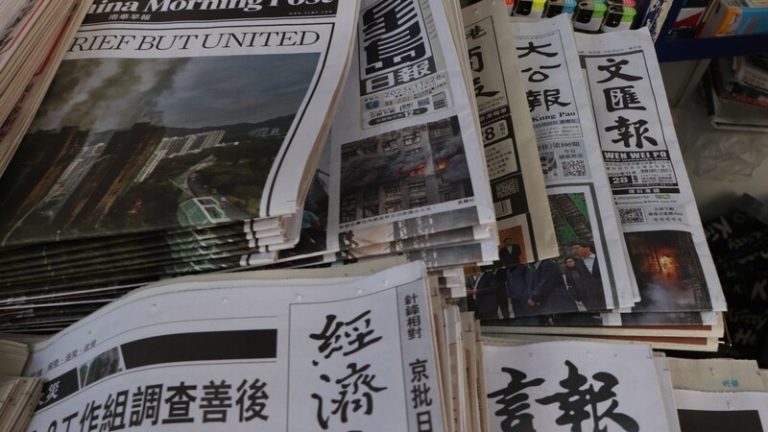
As public anger mounted over the government’s handling of the catastrophic Wang Fuk Court fire, in which over 150 people burned to death in a blaze aprtially caused by unsafe rennovations, Beijing’s Office for Safeguarding National Security accused what it called “anti-China and destabilizing forces” of trying to turn the tragedy into a “political weapon.”
According to the office, these groups were spreading false information, attacking the government’s rescue efforts, and stirring up hostility toward Chief Executive John Lee. It warned that anyone accused of “using disaster to destabilize Hong Kong” could face charges under the National Security Law.
The fire broke out on Nov. 26 and tore through seven residential blocks in the Tai Po district of Hong Kong. Currently, police have reported at least 159 dead, scores injured, and dozens missing, figures that drew global attention and intense local grief.
From Nov. 29 to Dec. 1, all government buildings across the city flew flags at half-staff. Senior officials canceled non-essential public activities.
Even so, public frustration kept growing. John Lee’s Facebook page was quickly overwhelmed with angry comments, and analysts noted that Hong Kong was facing its most serious governance crisis since the 2019 anti-extradition movement.
Success
You are now signed up for our newsletter
Success
Check your email to complete sign up
On the afternoon of Nov. 29, Beijing’s national security office issued a statement titled “Firmly Supporting the Hong Kong SAR in Severely Punishing Anti-China Destabilizing Forces for ‘Using Disaster to Destabilize Hong Kong.’”
According to Hong Kong media, the spokesperson said that even during a moment of widespread sorrow, some people were “eager to act,” spreading rumors, attacking rescue operations, and exploiting the pain of victims to push political agendas — actions the spokesperson suggested could drag Hong Kong back to the turmoil of the extradition bill crisis.
The statement added that the central government fully supports the Hong Kong SAR in punishing activities that threaten national security, countering foreign interference, and preserving stability. It warned that anyone accused of “using disaster to destabilize Hong Kong” would face consequences under both the National Security Law and the Safeguarding National Security Ordinance.
Wang Fuk Court fire renews scrutiny on repair contract
The tragedy has also intensified scrutiny of a major repair project at Wang Fuk Court, which some residents believe may have played a role in the disaster. Senior figures from Hong Yip Construction and its associated consultancy, Heung Yee Architects, were recently arrested.
Project documents show that Hong Yip Construction received the highest score in the bidding process, with evaluators saying the company had “generally demonstrated sufficient capability and professional standards.”
In January 2024, the Wang Fuk Court Owners’ Corporation approved a HK$330 million repair plan (about USD 42 million). Each household was required to pay HK$160,000–180,000 (about USD 20,000–23,000), a cost that triggered widespread dissatisfaction. Renovation work began in July 2024.
In September that year, some owners held a special meeting that removed the long-serving Owners’ Corporation board and elected new representatives. But because the previous board had already signed a contract with Hong Yip, the repair project continued.
Public records show that in 2009, former Hong Yip shareholder Tso Tak-kwong was convicted in a corruption case involving a refurbishment project in Yuen Long and was sentenced to 18 months in prison. Hong Yip Construction has also been linked to several regulatory violations in past engineering work.
Disputes over large-scale building repairs are common in Hong Kong, and several bid-rigging cases have resulted in court convictions.
Commenting on the controversy, Hong Kong scholar Chan Kin-man — now based in Taiwan and a visiting research fellow at Academia Sinica’s Institute of Sociology — noted that opposition politicians, being the most vocal about rectifying cases of corruption, have mostly been silenced since the Chinese Communist Party (CCP) imposed the National Security Law on Hong Kong in June 2020.
He wrote on Facebook:
“The lawmakers who put the most effort into overseeing the government and fighting bid-rigging are all in jail. It’s such an injustice.”