A quiet mountain, a philosophical calling
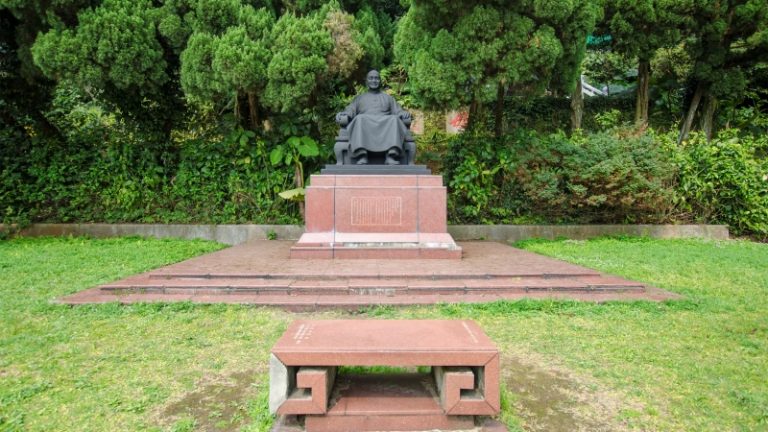
North of Taipei rises a quiet, mist-covered peak once known as Grass Mountain. After retreating to Taiwan, Chiang Kai-shek chose this place as his residence and renamed it Yangmingshan, honoring the Ming dynasty philosopher Wang Yangming.
This was more than symbolic geography. Chiang often said he first encountered Wang’s idea of the “unity of knowledge and action” as a teenager and returned to it throughout his life. He reread The Instructions for Practical Living and The Great Learning Expanded so frequently that he once remarked he considered them lifelong guides for governance and character.
The imprint of classical virtues even shaped Taipei’s street grid. Major east–west boulevards were renamed Zhongxiao, Renai, Xinyi, and Heping, with others like Siwei and Bade drawn from Confucian texts. For Chiang, rooting Taiwan’s urban life in cultural symbolism was an assertion of identity and continuity at a moment of national displacement.
Two Chinas, two futures for one civilization
In 1966, Mao Zedong launched the Cultural Revolution, unleashing Red Guards who burned temples, smashed ancestral tablets, and denounced centuries of tradition as “feudal poison.” It was an attempt to sever China from its cultural inheritance.
Chiang saw the crisis through a civilizational lens. In his National Day message that same year, he warned that a nation whose traditional culture is destroyed will see its spirit—and ultimately its existence—collapse. To him, the chaos on the mainland was not simply political turmoil but the unraveling of China’s historical continuity.
Success
You are now signed up for our newsletter
Success
Check your email to complete sign up
One month later, more than 1,500 leading cultural figures petitioned for a Movement for the Revival of Chinese Culture. By July 1967, the movement formally launched with Chiang as chair, aiming to preserve the cultural traditions being uprooted across the Strait.
Building institutions for a cultural defense line
The movement bore Chiang’s personal stamp. Under his direction, Taiwan created committees dedicated to different aspects of cultural preservation—from literature and ethics to scientific heritage and national arts.
These institutions undertook large-scale publication projects, producing annotated and accessible editions of classical works: The Analects, Mencius, The Book of Songs, the Daodejing, and the Book of Changes. Modern-language editions of Records of the Grand Historian and Comprehensive Mirror for Aid in Governance were aimed at younger readers.
To restore civic etiquette, the National Life Guidance Committee released manuals on everyday behavior, culminating in the National Etiquette Standards of 1970. These efforts formed a civilizational shield, mirroring—yet opposing—the ideological campaigns unfolding on the mainland.
Education as the backbone of cultural survival
Chiang viewed education as the most reliable vessel for preserving tradition. After decades during which Japanese colonial authorities had removed Chinese history from classrooms, Taiwan placed classical learning at the heart of its postwar education system.
By directive, Chinese language, ethics, history, and classical culture occupied large portions of the curriculum. Mandatory courses such as Life and Ethics and Fundamentals of Chinese Culture trained students in classical texts, historical memory, and traditional virtues.
In 1969, Chiang expanded compulsory education from six to nine years—a move that strengthened literacy, bolstered social cohesion, and helped prepare Taiwan for its coming economic rise.
Traditional festivals and rituals were also revived. Confucius’ birthday once again became a formal ceremony, and schools across the island adopted mottos emphasizing propriety, justice, integrity, and honor.
A renaissance in exile
While the Cultural Revolution devastated China’s academic and literary communities, Taiwan experienced an unexpected cultural renaissance.
New Confucian philosophers such as Xu Fuguan and Mou Zongsan argued that China’s civilizational spirit needed to be renewed, not discarded. Their Manifesto on Chinese Culture urged a reinvigoration of Confucian thought as a guide for modern humanity.
Meanwhile, literature flourished. Yen Yuan-shu’s writings on nationalist literature, Wen Rui-an’s Shenzhou Poetry Society, and Kao Hsin-chiang’s literary journals created an environment rich with cultural confidence. Poetry gatherings, academic debates, and traditional arts all blossomed; while modes of expression were silenced on the mainland.
Taiwan became the primary refuge for Chinese cultural life during one of its darkest decades.
Chiang Kai-shek and the Rescue of China’s Imperial Treasures
Long before the cultural movement, Chiang made one of the century’s most consequential preservation decisions: relocating the National Palace Museum treasures from Beijing to Taiwan.
This safeguarded hundreds of thousands of imperial artifacts—bronzes, ceramics, calligraphy, and scrolls—that could have been destroyed during the Cultural Revolution’s iconoclasm. These pieces became a living archive of Chinese civilization and a foundation for Taiwan’s cultural scholarship, as it developed in exile.
Historians often note that many of these works likely would not have survived had they remained on the mainland.
A legacy carried forward
Chiang Kai-shek died on April 5, 1975. In his final testament, he described the revival of Chinese culture and the defense of democratic society as the missions that defined his life.
The movement continued under Chiang Ching-kuo, influencing education, scholarship, and civic life for decades. Today, Taiwan remains the most intact repository of traditional Chinese culture in the Chinese-speaking world.
Confucius ceremonies still draw crowds, poetry gatherings remain part of social life, and students grow up reading the classics. In an era when one side of the Strait tried to erase its cultural inheritance, the other sought to preserve it.
Taiwan, in many ways, became the unexpected guardian of a civilization’s memory, and its living traditions.