By Li Deyan, Vision Times
New leaks claim that the corruption case surrounding former Xinjiang Party Secretary Ma Xingrui now involves as much as 300 billion yuan (about USD $42 billion), with the most extensive abuses allegedly taking place during his tenure in Xinjiang. Sources say the case could also implicate Hubei Party Secretary Wang Zhonglin, a senior official widely viewed as a close confidant of Chinese President Xi Jinping.
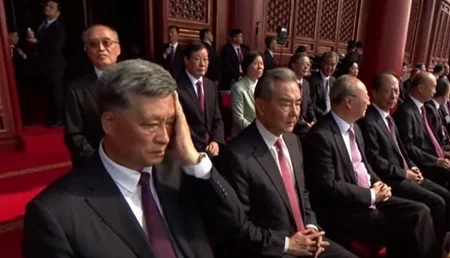
On Nov. 28, Chinese state media footage from a Politburo meeting revealed that Li Xi, head of the Central Commission for Discipline Inspection (CCDI), and Politburo member Ma Xingrui were both absent — a move that immediately drew attention. The Politburo serves as China’s top ruling body.
Days earlier, on Nov. 19, Australia-based political commentator Jiang Wangzheng reported that Ma had already been placed under CCDI custody at a “high-level retention facility” in Huangshan, Anhui. On Nov. 30, Ma’s subordinate, Chen Weijun, vice chairman of the Xinjiang regional government, was officially announced to be under investigation.
RELATED: Reports: Ma Xingrui and Wife Detained as Xi’s Inner Security Network Dwindles
How Xinjiang became the epicenter of ‘extreme corruption’
Success
You are now signed up for our newsletter
Success
Check your email to complete sign up
According to the disclosures, Ma’s corruption during earlier postings in China’s aerospace system and in Guangdong was relatively limited. His alleged “true large-scale plunder” began only after he assumed leadership in Xinjiang — a region with unique fiscal characteristics.
Xinjiang relies heavily on central government transfer payments, operated under a “planned allocation plus advance-payment system.” Each year, Beijing pre-approves and pre-pays massive sums, often thousands of billions of yuan, for infrastructure, poverty relief, security, and ethnic-stability projects. Funds are disbursed before projects formally begin, then reconciled later.
RELATED: Leaked Claims Tie Ma Xingrui’s Corruption Case to Xi Jinping’s Wife Peng Liyuan
Commentator Tang Jingyuan explained that under normal conditions, these funds flow from Beijing into the Xinjiang Department of Finance, passing through multiple layers of supervision. But according to insiders, Ma Xingrui and Chen Weijun allegedly bypassed the regional finance department, directing advance payments straight into companies controlled by their “white-glove” proxies.
Once transferred, the funds were allegedly rerouted through layers of corporate intermediaries, ultimately entering private pockets within Ma’s political circle. Tang stated that this network may involve relatives of Li Xi, Peng Liyuan, Chen Quanguo, and Wang Zhonglin, with more figures yet to surface.
One major alleged example is the Urumqi Airport expansion project, a centerpiece of China’s 13th and 14th Five-Year Plans, which sources say became a cash channel. Tang described the operation as a turning point. “This effectively turned Xinjiang’s entire annual budget into Ma Xingrui’s personal ATM.”
Diverting funds
Tang cautioned that strictly speaking, central transfer funds must technically enter official accounts. Instead of openly bypassing Xinjiang’s finance system, Ma may have concentrated decision-making power, rapidly approving project prepayments to a small number of state platforms or SOEs, such as urban investment, transport, or construction firms, which then quietly diverted funds.
“These entities were not the final destination,” Tang said. “They were just transit stations. Once the money entered, it took a turn — and disappeared.” This approach, he argued, hollowed out fiscal oversight without formally violating procedural steps, making it difficult to detect — at least initially.
Tang further asserted that the Ma Xingrui case may implicate Wang Zhonglin, currently the Party Secretary of Hubei Province. Born in 1962 in Shandong, Wang spent 34 consecutive years rising through Shandong’s political system. His first transfer out of the province came in February 2020, when he was abruptly dispatched to Wuhan at the height of the COVID outbreak — a move widely interpreted as a sign of Xi Jinping’s extraordinary trust.
Tang said that trust was not accidental: Wang is considered a core member of Peng Liyuan’s “Shandong faction” and may have been personally recommended to Xi. In March 2020, Wang triggered widespread backlash by calling on Wuhan residents to “be grateful to the Party and grateful to Xi Jinping,” forcing authorities to quickly delete reports and contain public outrage.
Despite this, Wang was promoted to Hubei governor in 2021 and elevated again in December 2024 to provincial Party Secretary.
Shandong faction cracking under pressure
Signs of broader turmoil within the so-called “Shandong faction” have intensified. With Peng Liyuan’s longtime associates Zhang Jianchun and Ma Xingrui both reportedly in trouble — and Politburo member Li Ganjie unexpectedly reassigned from head of the Organization Department to the United Front Work Department — analysts see evidence of escalating internal power struggles.
Between July and September 2025, the CCP’s Ninth Central Inspection Group conducted an intensive sweep of Shandong Province, triggering a wave of arrests across Jinan and Qingdao.
On Dec. 3, Sun Bin, Party secretary of the Jinan High-Tech Development Zone, was investigated. Days later, Jiang Wangzheng claimed Sun’s case involved 16 billion yuan, part of which allegedly linked back to Ma Xingrui, Rong Li (Ma’s wife), and Wang Zhonglin through an asset package reportedly provided by Jinan High-Tech Holding Group. Jiang added that numerous Jinan officials had since been summoned and suggested that Wang Zhonglin’s position is increasingly precarious.
Though Ma Xingrui’s case has not yet been formally announced, it continues to expand, now overlapping with Shandong, Xinjiang, Hubei, and the highest levels of CCP factional politics. As rumors swirl around one of Xi Jinping’s most trusted provincial chiefs, and as officials tied to his home power base fall in rapid succession, observers say the political aftershocks are only beginning.
Editorial note: This article is based on publicly circulating reports and commentary from independent analysts. The claims described have not been independently verified by Vision Times, and relevant authorities have not publicly confirmed the allegations.