By Li Deyan
Chinese vice president Han Zheng has not appeared in public since early November, a silence long enough to ignite familiar speculation—from illness to internal investigations to outright defection. Online chatter even placed him in Russia seeking protection. But analysts who have tracked Han Zheng’s career and China’s elite politics say the rumors do not hold up. His disappearance, they argue, fits a pattern seen before—and the idea that he fled to Russia is the least plausible of all.
A disappearance that looks dramatic—but isn’t new
Han Zheng’s last public appearance came on Nov. 4 in Doha at the World Summit on Social Development. Since then, he has vanished from state media. In a system as opaque as Zhongnanhai, even a brief absence can trigger waves of speculation. But Han Zheng, a former Politburo Standing Committee member now reduced to the ceremonial post of state vice president, has disappeared for far longer stretches.
Commentator Chen Pokong points out that Han holds no real authority and is not even a Politburo member. His public schedule has always been light, and he has never shown signs of open conflict with Xi Jinping, making a purge unlikely. Given the country’s ongoing waves of respiratory illness, Chen notes that a health issue is at least as plausible as any political explanation.
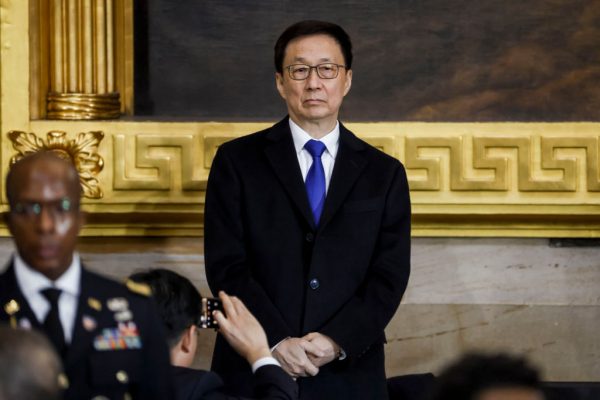
More importantly, Han has a well-established record of long absences. His longest gap—after attending the U.N. General Assembly in September 2023—lasted 216 days, nearly seven months, with virtually no official reporting. Another gap of 88 days followed the 2024 Third Plenum before he reappeared in Washington as Xi’s special envoy at President Trump’s inauguration.
Success
You are now signed up for our newsletter
Success
Check your email to complete sign up
Seen against this history, a one-month silence is far from extraordinary.
Other senior officials have faced similar scrutiny. In March, NPC chairman Zhao Leji abruptly missed the closing session, prompting speculation until he reappeared the next day. Cai Qi—Xi’s powerful chief of staff—disappeared for 12 days in November, fueling rumors until he resurfaced looking noticeably strained. In today’s Beijing, absence itself has become a political event.
READ MORE: The Political Fragmentation Inside Xi Jinping’s China
Why Han Zheng defecting to Russia doesn’t add up
Commentator Tang Jingyuan addressed the viral claim that Han fled to Russia after a Middle East trip, prompting Li Qiang and Zhang Youxia to travel to Moscow “to retrieve him.” Some versions went further, alleging Putin handed Han over to the UK.
Tang says these stories fall apart under minimal scrutiny and contradict basic political logic.
1. Han Zheng has vanished for far longer before
One month is nothing compared with his previous half-year silence. As a largely symbolic vice president, Han has often been offstage for extended periods. There is nothing unprecedented about the current gap.
2. Han is not a target—and not important enough to take down
Han Zheng came up through the Shanghai faction and once worked directly with Xi during the latter’s brief tenure as Shanghai Party secretary. Xi’s anti-corruption purges sidelined many Jiang-era figures, but Han was promoted—first into the Politburo Standing Committee, then to state vice president.
Today he holds no operational power and sits on the political margins. Neither Xi’s camp nor rival factions appear motivated to move against him. As Tang notes, far more consequential figures—Cai Qi, Wang Xiaohong, Li Shulei—remain untouched. Targeting Han would be both unnecessary and illogical.
3. Even if Han Zheng wanted to defect, Russia makes no sense
Even if Han Zheng were under pressure—and there is no evidence he is—Russia would be the last place he would go.
Putin relies heavily on Beijing’s economic and diplomatic support to withstand Western sanctions and continue the war in Ukraine. Taking in a Chinese state leader, even a sidelined one, would be interpreted in Beijing as a hostile act. Moscow cannot afford that risk.
Tang notes that when former Chongqing police chief Wang Lijun tried to defect to the U.S. in 2012, Washington refused to take him for fear of destabilizing U.S.–China relations. Russia today is even more dependent on China and therefore even less likely to shelter a Chinese official with little strategic value.
Han’s background reinforces this point: as a Shanghai technocrat with traditionally pro-Western economic ties, he would be far more likely to head toward the West than toward Russia.
Han Zheng’s current absence remains unexplained, but his history of long disappearances, his marginal role in the current leadership, and the geopolitics of China–Russia relations all point toward a simple conclusion: this is not a defection drama.
It is a routine silence in a political system where silence often means nothing—and speculation fills every gap.