By Xiao Guang
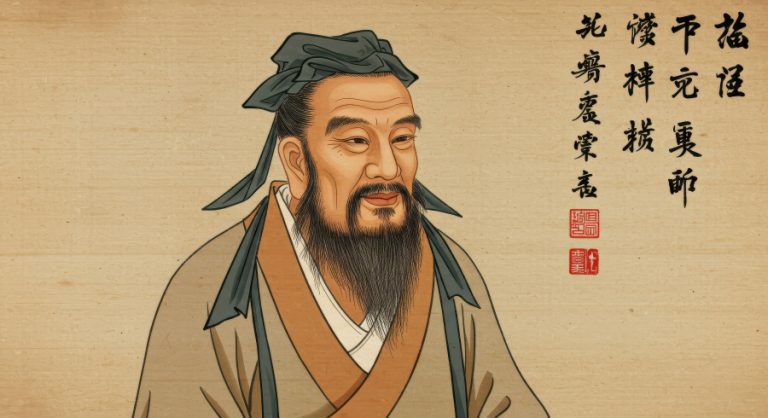
Among the many stories preserved in Chinese history, one episode involving Confucius continues to resonate with unusual clarity.
While traveling between the states of Chen and Cai, Confucius and his disciples were cut off from food for seven days. They were hungry, exhausted, and surrounded by uncertainty. Yet Confucius remained calm. He continued to recite poetry, teach the classics, and play music, as if the absence of food had not disturbed his inner balance.
His students could not understand this composure.
Zilu, one of his closest disciples, finally asked why their teacher could still sing and play music under such conditions. Confucius answered with a line that would echo through centuries of moral philosophy: “A gentleman remains steadfast in hardship; a petty man loses himself when faced with poverty.”
Success
You are now signed up for our newsletter
Success
Check your email to complete sign up
What he meant was simple but demanding.
A person of integrity does not abandon moral direction when circumstances collapse. Hardship reveals character rather than excusing its erosion.
For Confucius, the most urgent task in moments of crisis was not securing food, but preserving inner orientation. To lose one’s ethical compass in extreme conditions was, in his view, a deeper failure than physical deprivation itself.
This understanding rests on a central Confucian idea: the Dao as the foundation of human life.
In this tradition, the Dao is not an abstract belief or distant ideal. It is the source of value, the framework that gives coherence to a person’s inner world. It orders thought, stabilizes emotion, and anchors action.
When Confucius faced hunger, danger, and isolation, his calm was not denial or optimism. It reflected a life structured around meaning rather than circumstance.
From this standpoint, adversity becomes the ultimate test of one’s inner life.
To “remain content in poverty while holding fast to the Dao” does not suggest resignation or passivity. It means allowing a higher sense of purpose to govern suffering, so that external hardship does not dismantle internal order.
Meaning does not erase pain, but it prevents pain from becoming chaos.

Confucius reverberates across centuries
Centuries later, a similar insight emerged from a radically different context.
Viktor Frankl, an Austrian psychiatrist imprisoned in Nazi concentration camps during World War II, confronted suffering on a scale that defies comprehension. After surviving, he developed what came to be known as logotherapy, or meaning-centered therapy.
His core argument challenged many assumptions of modern psychology: the primary human drive is not pleasure or power, but the search for meaning.
Frankl’s ideas were shaped directly by what he witnessed in the camps.
He observed that survival was closely tied to a person’s inner orientation. Those who retained a sense of purpose—devotion to loved ones, responsibility toward unfinished work, or faith in something beyond immediate suffering—were often able to endure.
Those who lost that sense of meaning frequently lost the will to live.
Frankl noted a small but telling detail.
Cigarettes in the camps could be traded for food. When a prisoner chose to smoke his or her last cigarette rather than exchange it, it often signaled resignation. The act was less about nicotine than about the collapse of future expectation.
Without a reason to endure, even survival lost its urgency.
Frankl himself survived by deliberately strengthening his inner world.
He frequently recalled his wife, Tilly, even though he did not know whether she was still alive. The imagined presence of love—the sense of connection and responsibility—became a source of inner stability.
His work emphasized that human beings live not only in external reality, but also within an inner moral and emotional landscape. Even under absolute coercion, that inner space remains, to some degree, a realm of choice.
This insight helps explain why suffering does not have a uniform effect.
Pain is unavoidable in human life, but its meaning is not predetermined. When hardship is understood as part of something larger—love, responsibility, growth, or fidelity to values—it becomes bearable.
Caring for an ill family member, for example, can be exhausting. Yet when that hardship is rooted in love, it no longer feels empty.
Modern life rarely resembles the extremity of ancient exile or concentration camps. Still, its pressures are persistent and corrosive.
Anxiety about the future, emotional exhaustion, and loneliness have become common experiences. Many people live in a state of continuous tension, pulled between external demands and internal uncertainty.
From Confucius’ quiet endurance, a lesson emerges that feels unexpectedly contemporary.
Stability does not come from eliminating pressure, but from cultivating inner coherence. In moments of anxiety, direction matters more than relief. In moments of hardship, fidelity to values matters more than comfort.
To “remain content in poverty while holding fast to the Dao” is not an antiquated moral slogan. It is a reminder that inner order does not depend on ideal conditions.
Meaning does not wait for stability. It is built precisely in moments of disorder.
We do not need a perfect world to begin shaping an inner life with direction and purpose. Understanding why we endure is itself a form of resistance—one that allows the human spirit to remain intact even when circumstances fail to cooperate.