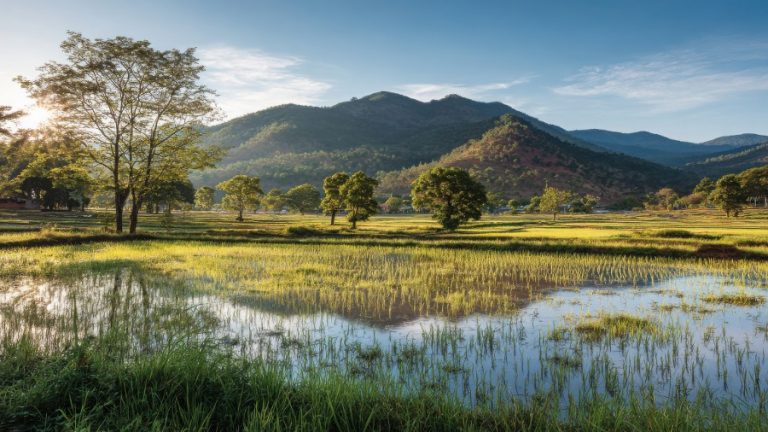
Officials in a southern Chinese county were assigned a rice quotas that exceeded the total amount of farmland they were legally required to protect. With no way to meet the quota, village officials were each told to record a fictitious block of rice acreage in government ledgers—without planting seedlings, harvesting grain, or claiming the subsidies available for real rice production. Beijing received paperwork describing fields of rice that did not exist. On the ground, those same fields were growing pumpkins, taro, and monk fruit.
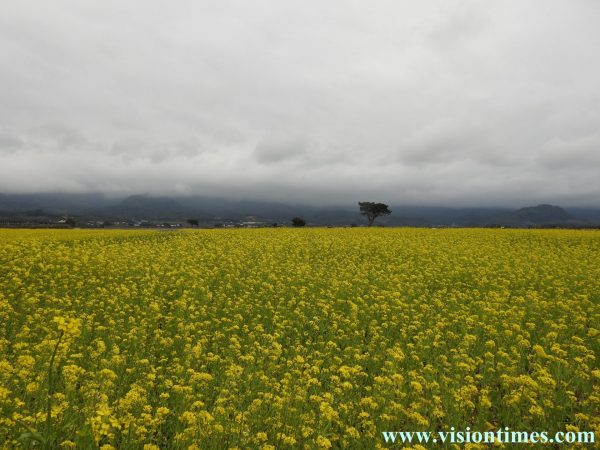
China Central Television broadcast the findings on July 14 on Focus Report, its main investigative program, under the title “When grain acreage becomes a numbers game.” State media rarely films this kind of thing, and the footage is specific. In one village beside National Highway 207, pumpkin vines were spreading across the paddies. In another, a billboard reading “Guarantee grain production” stood in the middle of a field of monk fruit and taro. At a site marked as a double-season rice demonstration base, a drone sent up by the reporters found monk fruit growing behind the sign. All of it sat on land the state classifies as permanent basic farmland, which by law must grow grain.
Jianghua County lies in the hills of Hunan province, in an area set aside for the Yao, one of China’s ethnic minorities. It holds 53,000 acres of permanent basic farmland. Higher authorities ordered it to plant 64,000 acres of rice. No amount of work closes a gap of 11,500 acres, because the land does not exist.
The county closed it by counting the same fields twice. Some paddies can carry two rice crops a year, so the county counted a single field once for each crop and added the totals. The number that reached the provincial government described a county larger than the one that exists.
An official at the agriculture office in Taowei township described the rest to the CCTV reporters without much attempt to hide it. “We can only manage 20,000 mu,” he said, referring to about 3,300 acres of real early rice. “What do we do about the other 20,000? Every village cadre takes on a 200-mu rice quota.” That is 33 acres each, recorded and never planted.
Success
You are now signed up for our newsletter
Success
Check your email to complete sign up
Two sets of books came out of this. One tracked the real crops, and it listed the pumpkin, the taro, and the monk fruit accurately, because the township needed to know what was actually in the ground. The other existed for inspectors, and it grew rice.
Growing rice on this land loses farmers money
Village officials told the reporters what any farmer there could have told them. Monk fruit, taro, and pumpkin pay. Rice does not. The government keeps grain prices low, and a farmer may clear only a few dozen dollars on an acre of it.
Meeting the quota made this worse. Fields suited to a single mid-season crop were forced over to early rice, and hill land that cannot support two rice crops a year was pushed into growing them anyway. Yields came in low. Costs for fertilizer, pesticide, water, and labor doubled. Farmers who planted more lost more.
The Party’s bureaucracy has never argued economics with farmers. Three weeks before the broadcast, on June 24, CCP general secretary Xi Jinping, China’s top leader, walked through farmland in Dezhou, Shandong, and claimed the rule as his own in remarks carried by state media. “I was the one who set out that the red line of 1.8 billion mu of arable land cannot be broken, and that good farmland must grow grain,” he said. “However modern this country becomes, we have to rely mainly on ourselves for grain. Nobody else can be counted on to feed 1.4 billion people.” The red line covers 300 million acres nationwide. Xi has told officials there is “not the slightest room for bargaining” over it, and that a man who breaches it will be pursued after he retires.
In November 2020, the State Council ordered that protected farmland be kept for grain, and grain acreage was written into the annual review that grades every local government on food security. Provinces divided the targets among cities, cities among counties, counties among townships, and townships among the men who run the villages. Hunan is one of thirteen provinces Beijing counts on for the national grain supply, so the pressure arrived early and heavy.
Miss the number and you are named in a report and disciplined. Fake the number and you pass. The system pushes out the officials who respect what the land can do and keeps the ones who lie. Lying is the only sensible move left to anyone who wants to keep working. The same pressure produced the earlier campaigns, when officials tore out orchards to plant grain and sent crews to cut down green wheat to hit a planting target. Only the crop has changed.
State television blamed the county for the fake farmland
Viewers who do not know how Chinese propaganda works see a broadcast like this as proof that Beijing polices its own ranks. That reading is the point, and it is the trap.
Watch where the response went. Within hours of the broadcast, the city government of Yongzhou sent a task force down to Jianghua overnight, promised to correct everything the program had shown, and undertook to deal severely with whatever the inspection turned up. Every arrow points at the county. Nobody has been asked why a county with 53,000 acres of protected farmland was ordered to plant 64,000. Three weeks earlier the man who set that rule had stood in a field and said there was no room to bargain over it.
The scale of the repair says the rest. Taowei township, which had already begun fixing things in June after the reporters came through, has put 574 mu back into late rice, according to the same official statement. That is about 95 acres, set against a gap of 11,500. The quota that produced the fraud is still in force.
Party propaganda holds one line permanently: the policy from the center was correct, and the people below ruined it in the execution. That line does the system’s most useful work, because it leaves the public unable to find the source of the harm. Name a county, punish a few small officials, and public anger settles on the men who carried out the order rather than on the order itself.
The Party’s campaign against corruption runs on the same method. Corruption has grown worse the longer the campaigns have gone on, because one party holds all the power and answers to no one. Stopping it would take a free press and courts the Party does not control, and either one would cost the Party its grip. So it jails a steady supply of officials in public and leaves the machine that produces them running.
Officials faked harvest figures in 1958 and millions starved
In June 1958, the People’s Daily, the Party’s main newspaper, ran a story on its front page. A farming cooperative in Suiping County, Henan province, had harvested 2,105 jin of wheat from a single mu of land, roughly ten times what such a field can grow.
That front page set off a national competition in lying. Officials everywhere raised their figures to please their superiors and keep their posts. By August, Macheng County in Hubei was claiming a rice harvest of 36,956 jin per mu. No field on earth has ever produced anything close to that.
Everyone knew. Provincial Party bosses knew, and so did the men running the villages. Under a totalitarian system that permitted no doubt and no objection, anyone who told the truth was branded a right deviationist, a political crime under Mao, and sent to a labor camp. The men who told the biggest lies were promoted. The famine that followed starved tens of millions of peasants to death.
Nearly seventy years on, the surface has changed and the structure underneath has not. A township keeping one honest ledger and one for inspectors works exactly as Suiping and Macheng did in 1958. The men at the top give orders behind closed doors and believe only the figures they want to see. The men below them produce those figures. The propaganda machine in the middle tidies up the mess and finds someone junior to blame.
Power stays unlimited, responsibility stays near zero, and the public counts for nothing. Beijing set the quota to protect the national food supply, and what it has bought is a set of county records that describe land nobody has seen. A government that has to lie to itself about its own harvest is smaller than it looks. It is already inside the bubble it inflated, and moving toward collapse. Under this system nobody is safe. Anyone can become the piece the Party gives up to protect its own image.