By Xiao Ran
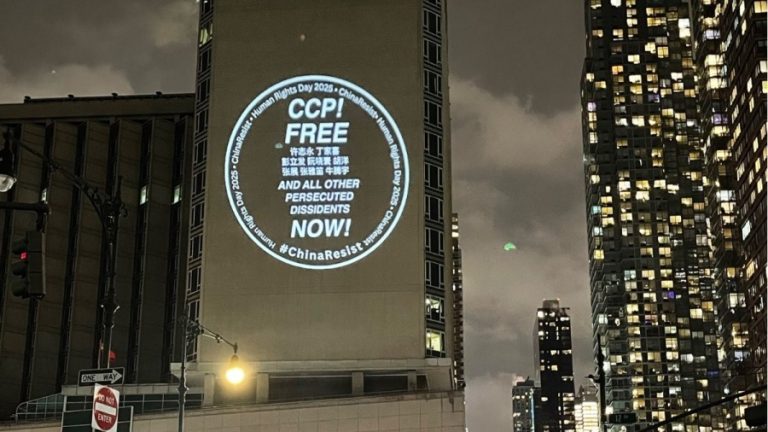
On the evening of Dec. 10, International Human Rights Day, at 7 p.m., a high-intensity projection beam cut across the night sky directly opposite the Chinese Consulate General in New York. An 18-meter-wide image instantly covered the off-white exterior wall, displaying bilingual Chinese and English messages calling for the release of prisoners of conscience such as Xu Zhiyong, Ding Jiaxi, Zhang Zhan, and Niu Tengyu.
This was the second projection action at the same location organized by the overseas non-profit “China Action,” following their first projection on Nov. 26 marking the third anniversary of the “White Paper Movement.” The projection lasted about 15 minutes, with no interference from New York police or consulate staff. Spokesperson Su Yutong said that she welcomed how the innovative abilities of the younger “white paper generation” helped advance the longstanding efforts of the overseas democracy movement.
Su Yutong said in a recent interview that choosing International Human Rights Day for the action was meant to shine a spotlight on the world’s most systematic human rights abuses. Videos and images from the event have already garnered nearly a million views on Twitter.
According to the annual report by the U.S. Congressional-Executive Commission on China (CECC), China’s political prisoner database records 11,262 individuals. “These Chinese political prisoners have lost their freedom—or even their lives—simply for exercising rights of speech, association, assembly, belief, and civil disobedience.” For this reason, the projection specifically highlighted the theme of “release conscience prisoners.”
Success
You are now signed up for our newsletter
Success
Check your email to complete sign up
Due to limited space for each projected image, the team selected the most representative names to display on the consulate wall: key figures of the New Citizens’ Movement Xu Zhiyong and Ding Jiaxi, Shitongqiao activist Peng Lifa, citizen journalist Zhang Zhan, truth-spreading programmer Ruan Xiaohuan, Tibetan culture-supporting student Zhang Yadi, young internet activist Niu Tengyu, and overseas student Hu Yang, who was arrested months ago.
Human rights across generations
Su Yutong emphasized that the list spans generations from the 1970s to the 2000s, covering lawyers, journalists, students, and programmers—but all share the same fate: losing their freedom for speaking the truth. She said, “On the basic demand of releasing conscience prisoners, the white paper generation and traditional overseas democracy advocates are aligned. Both generations defend universal values and democratic ideals, so spiritually they are not divided.” She revealed that this action marked the first deep collaboration between the two generations: “The innovation of the younger generation, in a sense, assisted the work that the overseas democracy movement has been promoting for years.”
Compared to traditional placard protests, projection actions have a stronger visual impact. Su described it: “When the light hits the consulate wall, it’s like watching a condensed blockbuster. Each image carries a story, emotions, and an attitude.” She believes this visually appealing format naturally lends itself to viral spread, suggesting that “light-and-shadow resistance may become a mainstream mode of protest in the future.”
Technically, this action was smoother than the first. Su revealed that the team is now planning themes according to an “anti-CCP calendar,” with dedicated content for key dates like International Human Rights Day, June 4, and July 20. The projection went uninterrupted; she joked, “If U.S. police were present, I think they would only protect our legal rights, and so far the Chinese Consulate has fully respected U.S. law, not daring to overreach across borders.”
The projection is only part of China Action’s broader strategy. In August, the organization released the “Declaration of Mass Resistance” simultaneously in over ten cities worldwide, calling for large-scale nonviolent noncooperation in China. Last Friday (Dec. 5), they hosted a Space discussion about the projection on X, with many Chinese university students connecting via VPN. Su recalled: “Many students expressed excitement seeing our projections, because it reflected their own voices. At that moment, they felt they had found like-minded people or partners.”