By Chen Jing
In 2025, Chinese citizens are facing the sharpest rollback of outbound freedom since the reform era began. The door to the outside world hasn’t fully closed, but the threshold has been raised so high that most people can no longer cross it.
For years, the question for many was whether they should “run”—a slang term for leaving the country in search of better opportunities. But this year, the reality has shifted: people want to leave, foreign governments are turning them away, and Chinese authorities are increasingly deciding who may travel at all.
A weakening economy, rising geopolitical tensions, and a growing wave of outward migration have all contributed to tightening China’s controls on who may leave.
A passport no longer feels like a right
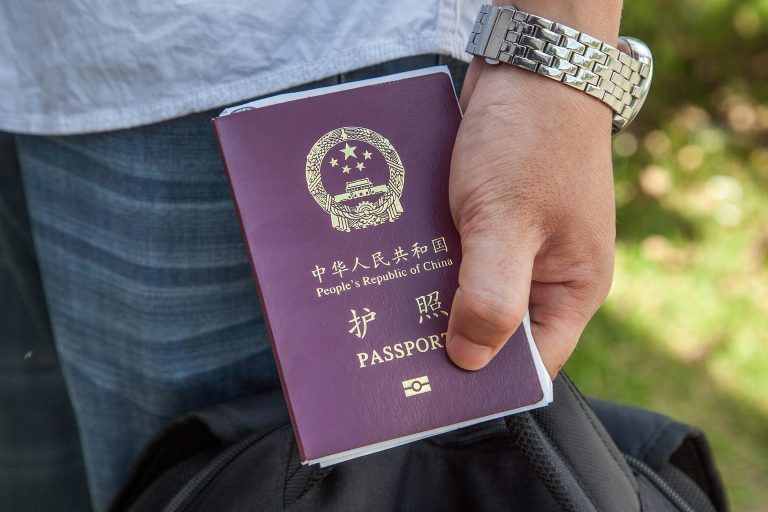
A popular comment circulating on X captured the mood succinctly: “Getting a passport now feels like being interrogated.” Another user warned, “If you don’t have one yet, apply soon—many offices now want invitation letters.”
Success
You are now signed up for our newsletter
Success
Check your email to complete sign up
Examples of the shift are emerging across the country.
A student in Xinjiang was told he needed to present an admission letter from a foreign university before he could apply for a passport—an impossible requirement for someone who needs the passport in order to apply.
A 22-year-old seeking a tourist passport was informed that the officer had to call his father to confirm “permission.”
In Fujian, Jiangxi, Hunan, and several other provinces, passport counters have adopted questioning that resembles a security interview: Where are you going? With whom? Have you bought tickets? Why do you need to travel?
Different regions may follow different procedures, but the pattern is increasingly consistent: applying for a passport now requires justification.
More documents, more questions for passport applicants
Although China’s National Immigration Administration has not announced any formal restrictions, local offices across the country have begun imposing new documentation requirements.
For tourist travel, some offices now ask applicants to provide a travel agency invoice costing RMB 150–300 (US$21–43). Those hoping to visit relatives abroad may need to show the family member’s overseas identification.Students are required to present official admission letters. In some cases, passport officers ask parents to accompany adult applicants or verify the request over the phone.
What was once a routine administrative process now depends on proving the legitimacy of your reason for leaving.

Certain groups face new barriers to leaving China
Rumors began circulating that dozens of regions had started restricting overseas travel. The belief gained traction after a new risk-assessment system was introduced in September 2025.
Under the new rules, people working in border areas, state-owned enterprises, schools, and other “sensitive” sectors must obtain employer approval—and often an invitation letter—before they can leave the country.
For many, the system feels only partially open. Travel is still possible, but only for those who can clear the additional layers of scrutiny.
China closes loopholes on dual citizenship
For years, some Chinese citizens were able to navigate between different passports or maintain dual identities. But by 2025, new technology has closed nearly all of those gaps.
China now uses fingerprint and iris matching, integrated entry–exit databases, and enhanced nationality checks. These upgrades have made it far easier for authorities to identify discrepancies.
One overseas Chinese traveler was stopped at Shanghai Pudong Airport and told he had to cancel his household registration before he could fly.
Another traveler—an Australian citizen of Chinese origin—was instructed to cut the corner off his old Chinese passport in order to enter the country.
The ambiguity that once allowed people to move between identities has largely vanished. Automation now makes those inconsistencies impossible to hide.
Foreign immigration rules get tougher for Chinese nationals
Foreign immigration systems have tightened significantly for Chinese nationals.
In Australia, language requirements have been raised, visa rejection rates have climbed to nearly 40 percent, and a two-year ban now applies after certain refusals. Several visa categories have also quietly downgraded the Chinese passport to a lower tier.
Canada has reduced its skilled-migration quota by 10 percent, extended processing times to as long as five years, and closed its French-language PEQ channel.
In the United States, both EB-1 and H-1B petitions now undergo retroactive examination, effectively dismantling the once-common “immigration packaging” industry.
Japan has raised its startup visa threshold from JPY 5 million to 30 million, shutting out smaller entrepreneurs.
Thailand now permits visa-free entry only twice a year; a third attempt triggers on-site deportation. Thousands of Chinese travelers have reportedly been turned back at airports.
The United Kingdom has raised its annual student surcharge by £925, a move widely viewed as targeting Chinese applicants.

Sending money abroad now requires verification
A new regulation taking effect in 2026 imposes strict controls on moving money out of China. Any overseas transfer above RMB 5,000 (US$714) now requires identity verification, and the same rules apply to Alipay and WeChat payments. Splitting transactions no longer works, and even tuition payments must go through multiple layers of review.
As one user remarked: “Sending money out is easy. Getting it back? Only if you earned blessings in a past life.”
Travelers may also have their phones or laptops searched for immigration-related files—an inspection that can be used to deny departure at the border.
For many, the path outward now feels blocked from both sides.
The forces behind the 2025 crackdown
Several forces converged in 2025 to tighten both China’s outbound controls and foreign governments’ willingness to accept Chinese travelers.
Economically, the slowdown pushed more people to consider leaving. The Hurun Report shows a two-year decline in the number of households with assets above RMB 6 million (US$857,000). As the middle class contracts, the desire to exit grows—and authorities respond with tighter controls.
Internationally, concerns about espionage, telecommunications fraud, money laundering, and geopolitical rivalry have led many countries to scrutinize Chinese applicants more closely. Visa openness is now treated as a security calculation.
Domestically, the government has shifted its priorities toward limiting population movement. Controlling departures, capital outflow, and talent loss has become a matter of national stability.
Once again, stability overrides everything else.
The end of China’s era of easy mobility
Around 2010, Chinese citizens experienced what many now consider a golden age of outbound mobility. Passports were easy to obtain, visas became more accessible, money moved freely, and the world welcomed Chinese tourists, students, and investors.
By 2025, that landscape has fundamentally changed.
China is narrowing the path outward, and other countries are narrowing the path inward. The harshest truth is not simply that travel has become difficult; it is the growing sense that the world is increasingly saying: “We are not welcoming you.”