By Yuanshan
In the days marking the third anniversary of the White Paper protests, a massive fire tore through a public housing estate in Hong Kong, exposing what critics describe as a profound collapse in governance. The blaze not only claimed scores of lives but also reignited public anger over regulatory failure, official-business collusion, and the city’s accelerating “mainlandization” under Beijing’s rule.
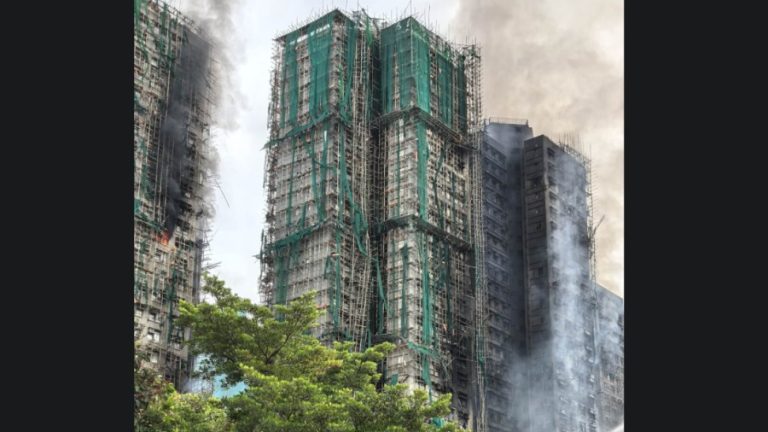
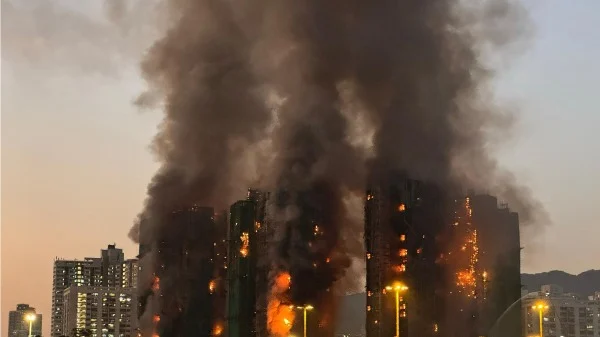
The fire broke out at 2:51 p.m. on November 26, 2025, at Hung Fuk Estate in Tai Po, a public housing complex more than 40 years old. The estate consists of eight residential blocks with 1,984 flats and is home to roughly 4,600 residents. Witnesses described orange flames shooting skyward, accompanied by repeated explosions—an apocalyptic scene visible from afar.
According to figures released by the Hong Kong Fire Services Department and the Hospital Authority on November 29, the blaze left at least 128 people dead and more than 70 injured. A 37-year-old firefighter was killed in the line of duty, and many residents were initially reported missing. The disaster is now considered the deadliest fire since Hong Kong became a port city in 1841.
Most fatalities were concentrated in two residential towers—Hong Cheong House and Hung Tai House—where many elderly residents with limited mobility lived. Several had moved into the estate in their youth and remained there through retirement.
Success
You are now signed up for our newsletter
Success
Check your email to complete sign up
Among those who witnessed the fire was Lisa Tse Ka-yee, a former Miss Hong Kong contestant frequently described by local media as “the most beautiful Miss Hong Kong.” She told reporters she watched helplessly as her grandmother’s flat was engulfed by flames. “I saw my grandmother’s home burning right in front of my eyes,” she said. “It was a heartbreaking day.”
Other residents described losing not only their homes but their life savings. “Everything we had went into buying this flat,” one resident said. “Now it’s all gone. We don’t even have a place to stay. It makes you feel like there’s no reason to go on.”
For many Hong Kong residents, the tragedy came to symbolize more than a single disaster. Since the imposition of the National Security Law, public frustration in the city has increasingly mirrored the resignation and anger seen on the Chinese mainland.

Smoking on site and ignored warnings
What caused the fire remains fiercely disputed. Public attention quickly turned to a short video that spread widely online after the disaster.
In the footage, a construction worker wearing a yellow uniform is seen squatting beside bamboo scaffolding while smoking. A woman filming confronts him, asking, “You’re smoking here again?” Startled, the man turns toward the camera. The clip fueled widespread suspicion that careless behavior during construction may have sparked the blaze.
Residents insist this was not an isolated incident. During the renovation period, they repeatedly saw uniformed workers smoking on site and discarding cigarette butts. Complaints were reportedly filed as early as a year before the fire, shortly after the project began. According to residents, regulators failed to respond.
Another video, shared by a construction worker who was on duty that day, shows a small glow on the exterior of a neighboring building. He said he evacuated immediately. Within minutes, the glow turned into thick smoke and an uncontrollable fire.
Some commentators questioned why bamboo scaffolding—now banned on the Chinese mainland—was still in use in Hong Kong. Others countered that bamboo scaffolding has been safely used for decades in one of the world’s densest high-rise cities and should not be scapegoated.
Critics argued that the real issue was not bamboo itself, but whether flammable and non-compliant materials were used. They accused state-affiliated media of fixating on bamboo scaffolding to deflect responsibility from deeper structural failures.
A costly contract and allegations of material fraud
Scrutiny soon shifted to the renovation project and the companies behind it.
In January last year, Hung Fuk Estate approved a major renovation plan costing HK$330 million (about US$42 million), reportedly more than double market estimates. The winning bidder was Hongye Construction Engineering Co., a subsidiary of China Railway Construction Corporation (CRCC), one of China’s largest state-owned construction groups.
Public records show the company was founded in 2004 and is controlled by Hou Huajian, with He Jianye listed as a director. A former shareholder, Cao Deguang, had previously been involved in multiple cases related to construction safety violations and labor disputes.
After the contract was awarded, residents received legal notices demanding renovation payments of HK$150,000 to HK$190,000 (about US$19,000–24,000) per household. Requests to convene a residents’ meeting were reportedly ignored, and construction began as scheduled.
Whistleblowers later alleged that the project involved multiple layers of subcontracting. The protective mesh covering the scaffolding was reportedly supplied by a mainland company in Shandong Province which claimed its products were flame-retardant. Certificates attributed to the Binzhou Testing and Inspection Center circulated online.
Critics alleged the certificates were fraudulent and that highly flammable synthetic mesh had been passed off as fire-resistant material. One netizen said the supplier lacked the capacity to handle a project of this scale.
Ho Bing-tak, chairman of the Hong Kong Bamboo Scaffolding Workers’ Union, said certified flame-retardant netting costs around HK$90 (about US$11.50), while ordinary netting costs just over HK$50 (about US$6.40), creating strong incentives to cut corners.
Residents said the danger was obvious. Some claimed they ignited samples of the green mesh, which burned away almost instantly. Hong Kong labor regulations require all scaffolding coverings to meet recognized flame-retardant standards.
Firefighters later reported that exterior protective materials burned with “highly unusual” speed and intensity.
Calls for accountability—and a swift clampdown
In the early hours of Nov. 27, Poon Cheuk-hung, a construction industry businessman and chairman of Zhongke Oversight, a private engineering safety watchdog, posted a scathing critique on Facebook. He accused the project of failing to use flame-retardant netting and identified this as a key factor in the fire’s rapid spread. He also named Andy Yeung Yan-kin, Director of the Hong Kong Fire Services Department, accusing him of refusing to address the issue. Poon called for a full investigation and Yeung’s resignation. His post was shared tens of thousands of times.
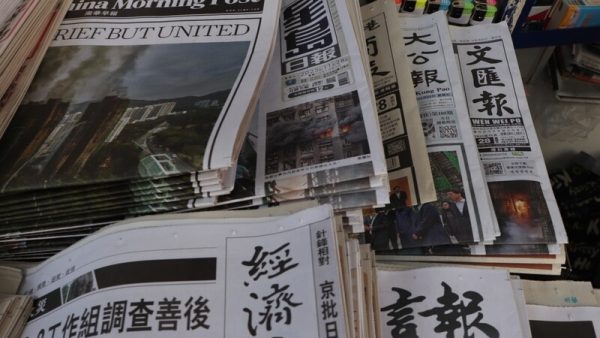
Public pressure mounted, with residents putting forward four key demands, including an independent inquiry. The official response, however, focused on suppression. On November 29, police arrested a man accused of attempting to “use the disaster to disrupt Hong Kong,” warning that “anti-China elements” were exploiting the tragedy.
To critics, the response epitomized Hong Kong’s mainland-style governance: stability and narrative control over transparency and accountability.
Attention also turned to John Lee Ka-chiu, Hong Kong’s chief executive and a former senior police officer appointed after the National Security Law took effect. At public appearances, Lee emphasized loyalty to Beijing and repeatedly thanked Xi Jinping, China’s top leader. At one press conference, a reporter challenged him directly for thanking Beijing before acknowledging firefighters’ sacrifices.
Beyond Hong Kong: Xi Jinping’s deeper fear
It is said that CCP General Secretary Xi Jinping was furious and ordered a thorough investigation. However, there are serious doubts about whether such an investigation could uncover anything substantive. More importantly, what truly worries Xi is not the Hong Kong fire itself, but something else altogether: mounting instability on the mainland.
That concern surfaced at a recent meeting of China’s Ministry of Agriculture and Rural Affairs, which focused on the policy of “two stabilizations and one prevention”—stabilizing migrant worker employment and income, and preventing large-scale return-to-poverty caused by unemployment.
With the Lunar New Year approaching, authorities are bracing for a surge of unemployed migrant workers returning home, underscoring the severity of China’s economic downturn.
What Xi Jinping fears most is not the death toll from the Hong Kong fire. What actually concerns him is the possibility of China’s rural population rising up against him—and against the Communist Party itself. He fears the emergence of another Li Zicheng, the 17th-century peasant rebel whose uprising helped topple the Ming dynasty, a historical specter that continues to haunt China’s rulers.
A fire that rekindles old fears
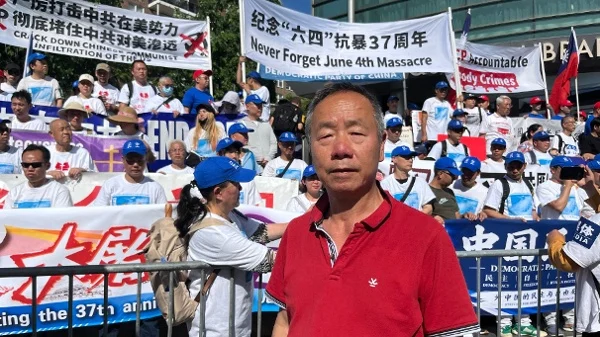
On Nov. 18, Tang Boqiao, chairman of the China Peace and Democracy Federation and a survivor of the 1989 Tiananmen movement, disclosed on X that his team had conducted months-long covert investigations across multiple provinces. He described widespread public resentment, a collapsing property market, accelerating capital flight, and deepening fractures within the ruling elite.
Tang also alleged that forced organ harvesting and cross-border fraud networks, if fully exposed, could deal a fatal blow to the Chinese Communist Party’s legitimacy.
“These are only the tip of the iceberg,” he wrote. “What we lack is not justification—but action.”
Three years ago, the Urumqi fire under the CCP’s zero-COVID lockdown claimed 44 lives. Desperate pleas for help sent by victims through WeChat groups became their final words. That tragedy directly ignited the White Paper Movement. Now, as the third anniversary of the White Paper protests approaches, a once-in-a-century inferno in Hong Kong has erupted again—raising the question: what kind of earth-shaking upheaval might this fire spark next?
The flames at Hung Fuk Estate have been extinguished. What they revealed—a crisis of accountability, governance, and legitimacy—remains unresolved.