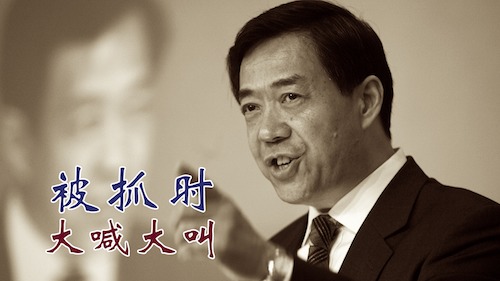
Bo Xilai’s political ambition was never subtle. Born into the family of Bo Yibo—one of the Chinese Communist Party’s “Eight Immortals”—Bo Xilai was raised within the system’s innermost circles and received elite education from an early age. Unlike many CCP officials who advance through discretion and silence, Bo cultivated visibility. He was theatrical, confrontational, and acutely aware of the power of media exposure, presenting himself not as a faceless bureaucrat but as a political personality.
Known for his forceful rhetoric and flamboyant public presence, Bo repeatedly positioned himself as a “political star.” During periods of rapid promotion, he made little effort to conceal his aspirations. By multiple accounts, he was never content with being a powerful regional official; he aimed for a seat at the very apex of Party power.
Wherever he served, Bo left conspicuous personal imprints. Accounts describe oversized architectural projects that exceeded standard specifications, as well as bronze-cast impressions of his own footprints embedded in public squares—details frequently cited by critics as evidence of an inflated ego and an emerging personality cult.
Advancement through repression
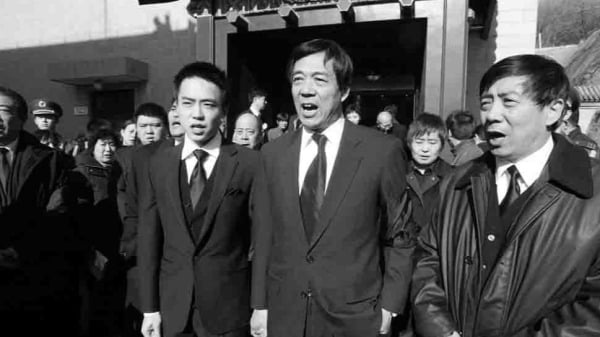
Public records show that in September 1999, Bo was promoted to standing committee member of the Liaoning Provincial Party Committee and Party secretary of Dalian. From December 2000 to February 2001, he rose again—first to deputy Party secretary of Liaoning, then to provincial governor. These promotions occurred during the period when Jiang Zemin remained the dominant figure within the CCP.
It was also during Bo’s tenure in Liaoning that the province became notorious among human-rights groups and overseas observers for the severity of its persecution of Falun Gong practitioners. Critics argue that Bo’s political advancement was closely tied to his role in implementing that campaign, though Chinese authorities have never acknowledged such a connection.
Success
You are now signed up for our newsletter
Success
Check your email to complete sign up
As governor of Liaoning and later as minister of commerce, Bo promoted himself as a tough, results-driven official. He personally oversaw major projects, courted foreign investment, and cultivated an image of administrative competence. Yet accounts attributed to former colleagues and insiders paint a different picture. Bo reportedly ruled through command rather than consensus, reacted harshly to criticism, and showed little tolerance for dissent. Retired officials were said to privately describe him as arrogant and ill-suited for collective leadership at the Party’s highest levels.
Bo Xilai’s refusal that signaled defiance
According to overseas Chinese-language media citing sources such as Zhengming, Bo Xilai made a pivotal miscalculation in the mid-2000s when he declined to attend a closed-door gathering that later acquired symbolic significance.
The meeting reportedly took place as the CCP maneuvered ahead of the 18th Party Congress to shape future leadership outcomes. It was organized within the “princeling” network—the children of senior revolutionary leaders—who had emerged as a powerful intermediary bloc. The gathering was said to have been initiated by Hu Shiying, daughter of former Party ideologue Hu Qiaomu, and hosted by then–Zhejiang Party Secretary Xi Jinping, a choice widely interpreted as signaling Xi’s rising status.
Reported attendees included Wang Qishan, Liu Yuan, and Chen Yuan—figures who would later occupy central positions in China’s power structure.
Bo, then serving as minister of commerce and widely regarded as a rising star, would ordinarily have been expected to attend. Instead, according to people described as familiar with his thinking, he refused. He reportedly viewed the meeting as an early “division of spoils”—an attempt to prearrange the outcome of the 18th Party Congress and consolidate support behind Xi Jinping.
Believing his own credentials to be no weaker than anyone else’s, Bo rejected the gathering outright. His younger brother, Bo Xicheng, attended in his place—a gesture some interpreted as a calculated half-refusal. Within princeling circles, Bo’s absence was widely seen as a declaration that he would not submit to collective arrangements. Several figures were later quoted in overseas commentary as privately criticizing him as politically reckless.
In hindsight, analysts argue that this episode marked Bo’s estrangement from the very network that would later dominate leadership selection at the 18th Party Congress.
Losing the internal power test
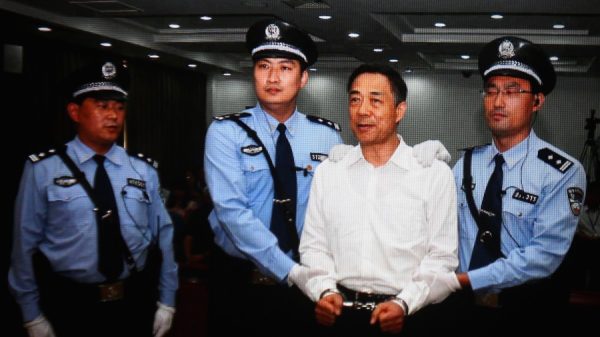
In June 2007, shortly before the 17th Party Congress, Beijing reportedly conducted a rare internal polling exercise involving more than 400 officials at vice-ministerial level and above. According to later reporting by Japan’s Asahi Shimbun, the meeting—chaired by then–Party chief Hu Jintao—was framed as an internal assessment of potential future leaders under the age of 63.
No official results were released. However, Asahi cited a CCP insider as saying that Bo Xilai performed poorly, particularly within military circles. Xi Jinping, by contrast, reportedly ranked near the top.
Following the 17th Party Congress, Xi entered the Politburo Standing Committee, effectively securing his position as Hu Jintao’s successor. Bo did not. He failed to become vice premier and was reportedly blocked by then–Vice Premier Wu Yi from entering the core economic leadership circle.
Instead, he was reassigned to Chongqing as Party secretary. Although Chongqing is a centrally administered municipality, many observers viewed the transfer as a demotion—removing Bo from Beijing at a critical moment.
The ‘Chongqing model’ and a bid for mass power
In Chongqing, Bo launched a series of highly publicized campaigns. He revived Mao-era symbolism through mass “red song” performances, mobilizing state agencies, schools, and media outlets in what critics viewed as a deliberate attempt to reclaim ideological legitimacy through nostalgia and mobilization.
Simultaneously, he initiated an aggressive “anti-crime” crackdown. While officially justified as restoring social order, the campaign resulted in the widespread targeting of private entrepreneurs and the large-scale seizure of assets, dramatically reshaping local power and wealth structures.
Chongqing’s crime statistics, urban development projects, and national media presence changed rapidly. Supporters promoted the “Chongqing model” as an alternative to the market-oriented paths of Guangdong and Jiangsu. Bo appeared constantly in the media, projecting the image of a decisive strongman willing to confront entrenched interests.
Critics argued that these moves served a broader ambition: the creation of a loyal regional power base that answered directly to Bo. His police chief, Wang Lijun, emerged as a key enforcer, controlling extensive security and intelligence resources. While the strategy elevated Bo’s national profile, it also alarmed Beijing, where leaders have long viewed independent regional power centers as existential threats.
Collapse triggered from within
Overseas reports later alleged that Bo Xilai and then–security chief Zhou Yongkang had discussed plans to block Xi Jinping’s ascent and reshape the leadership lineup. These claims have never been officially confirmed.
What is beyond dispute is that the crisis erupted on February 6, 2012, when Wang Lijun fled to the U.S. consulate in Chengdu seeking protection, reportedly carrying digital files containing sensitive material. The incident sent shockwaves through China’s political system.
As the scandal unfolded, Premier Wen Jiabao publicly stated that the Chongqing leadership “must deeply reflect” on the incident—a rare and pointed signal. Within weeks, Bo was removed as Chongqing Party secretary. In April 2012, he was stripped of his Politburo membership and placed under investigation. His wife, Gu Kailai, and aide Zhang Xiaojun were later charged in connection with the murder of British businessman Neil Heywood.
Bo vanished from public view. A remark reportedly attributed to him—“If I don’t make the Standing Committee at the 18th Party Congress, I’ll end up in prison”—soon appeared chillingly prophetic.
A life sentence as political closure
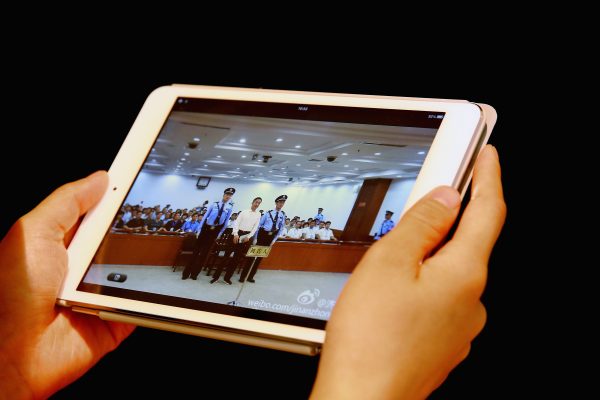
In September 2013, Bo Xilai was tried in Jinan on charges of bribery, embezzlement, and abuse of power. He was sentenced to life imprisonment, deprived of political rights for life, and had all personal assets confiscated.
During the trial, Bo mounted an unusually vigorous defense, expressing remorse toward the Party while continuing to justify his Chongqing policies. After being transferred to Qincheng Prison, he reportedly lived under strict isolation. Overseas reports claim he attempted to file appeals, all of which were rejected.
Following his fall, the princeling network largely fell silent. No prominent figures publicly defended him. Some overseas commentary revisited accounts from the Cultural Revolution in which Bo, then a Red Guard, allegedly denounced and assaulted his father—episodes that further damaged his standing among elite peers.
From Dalian to Liaoning, from Beijing to Chongqing, Bo Xilai once commanded national attention. His ambition was explicit, his challenge to the system unmistakable. Officially, he fell because of corruption.
Critics and Falun Gong practitioners argue, however, that his fate also reflects retribution for his role in the persecution campaign. What is beyond dispute is that Bo’s trajectory exposes the brutal logic of CCP elite politics: ambition is tolerated only when it aligns with the center, visibility is dangerous without protection, and defiance—however powerful the pedigree—can rapidly turn a political star into a cautionary prisoner.