By Li Muzi
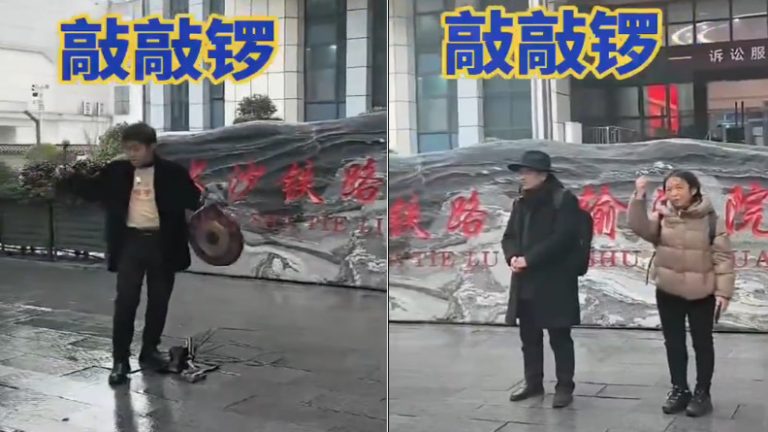
The clang of gongs cut through the air outside a courthouse in Changsha on Dec. 25 as relatives of a young medical intern stood at the entrance, trying to draw attention to a case they say has been ignored.
Luo Shuaiyu, an intern doctor at the Second Xiangya Hospital of Central South University, died last year after falling from a residential building where he lived. Police ruled out homicide, but his parents continue to dispute that conclusion, saying their son was targeted after attempting to expose alleged wrongdoing at the hospital.

A public protest at the courthouse
Luo’s family gathered outside the Changsha Railway Transportation Court, beating gongs as passersby slowed to watch. Several onlookers raised their phones to record the scene.
Footage shared online shows multiple relatives standing at the court entrance, striking the gongs and recounting details of what they described as the injustice surrounding Luo’s death.
Success
You are now signed up for our newsletter
Success
Check your email to complete sign up
Reaction followed quickly on social platforms. Some commenters questioned whether courts in China can deliver justice in sensitive cases, while others urged wider attention to the family’s allegations.
A death under dispute
Luo was born in March 1996 in Neijiang, Sichuan province. At around 8 a.m. on May 8, 2024, he fell from his dormitory building in Changsha and later died. Authorities said the circumstances surrounding his death did not involve homicide.
His parents say they do not accept that finding. According to the family, Luo sent text messages to two colleagues the day before his death: “If I don’t come to work tomorrow, hand the files on my computer to the discipline inspection authorities.”
Data recovery and organ transplant allegations
After Luo’s death, his parents said they faced obstacles in retrieving his personal belongings. Hospital staff required them to sign a document acknowledging the death as a suicide before releasing his effects, they said.
An online user using the handle “Tianyancha” said data on Luo’s computer and mobile phone had been deleted after his death. Specialists later helped the family recover files that, they believe, point to alleged illegal organ transplant practices at the Second Xiangya Hospital.
Claims circulating online include allegations that some intensive care patients were deliberately neglected to create the appearance of emergency backlogs; that patients were declared brain-dead after admission through emergency departments; and that organs were then harvested. Other allegations involve the injection of drugs to prevent patients from regaining consciousness.
According to the same account, the recovered materials totaled more than 11,000 A4 pages when printed, weighing about 16 jin (roughly 8 kilograms). The files were said to have been compiled over three years and grouped under topics including missing persons, disputed brain-death determinations, alleged organ trading networks, medical corruption, and professional ethics.
Alleged pressure on the family
In August 2024, Luo’s parents reported the Second Xiangya Hospital to the Changsha Public Security Bureau, alleging the illegal acquisition and sale of human organs.
Luo’s father later said in a video that after the family submitted complaint materials to health authorities, officials and hospital representatives approached them multiple times seeking to resolve the matter through financial compensation.
He alleged that in November 2024, individuals identified as state security officials and hospital representatives traveled to Sichuan and offered 15 million yuan (about $2.1 million) in exchange for silence. The family said they rejected the offer.
Growing public attention
The case has since drawn wider notice online. Clips posted by netizens show multiple unmarked ambulances parked outside the Second Xiangya Hospital, which some members of the public associate with possible organ-related activity.
Other images circulating online show helicopters landing and taking off from the hospital’s rooftop, prompting questions about the transport of organs for transplantation.
Public records show the Xiangya hospital system in Changsha is affiliated with Central South University and overseen by China’s National Health Commission. It includes Xiangya Hospital, the Second and Third Xiangya Hospitals, and the CITIC Xiangya Reproductive and Genetic Specialty Hospital.
A ground-level helipad at Xiangya Hospital has been operating since 2019, while a rooftop helipad at the Second Xiangya Hospital’s new outpatient building became operational in March 2024. State media say the helipads are intended to speed emergency transport for critically ill patients. Critics have questioned whether such facilities primarily serve elite patients or are linked to rapid organ transport following alleged harvesting practices.
Claims by international investigators
Investigative reports by the World Organization to Investigate the Persecution of Falun Gong (WOIPFG) identify the Second Xiangya Hospital as the largest hospital in Changsha. The organization says that since 2002, the hospital’s organ transplant volume has risen sharply, with liver and kidney transplant numbers ranking among the highest in China.
The group has also alleged that Chinese hospitals use highly efficient procurement methods, including transferring living donors directly to transplant facilities and harvesting organs on demand.