By Li Deyan
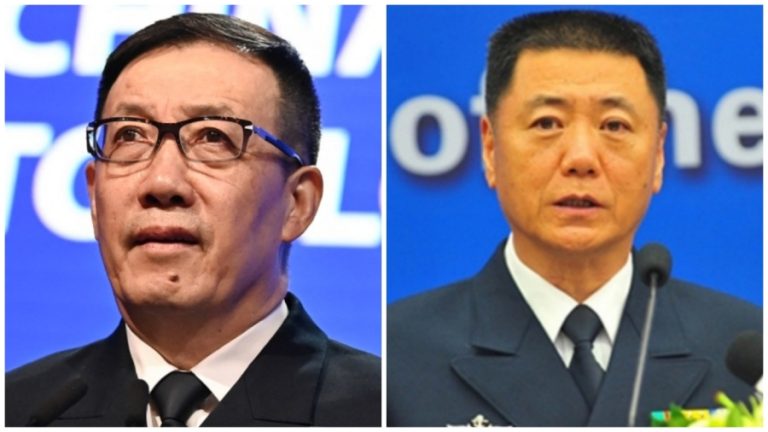
Reports have recently emerged claiming that Dong Jun, China’s defense minister, has been removed from his post. At the same time, the Chinese military newspaper PLA Daily has, for the third time, published commentary referencing what it described as “serious disciplinary and legal violations” involving senior figures including He Weidong and Miao Hua.
Dong, who rose through the navy, was rapidly promoted during Miao Hua’s tenure as political commissar of the PLA Navy. While some reports claim that Dong provided testimony unfavorable to Miao and thereby temporarily avoided investigation, analysts say that amid ongoing upheaval within the navy, Dong is unlikely to remain unaffected.

Reports claim Dong Jun removed as defense minister
On Dec. 25, 2025, U.S.-based commentator Cai Shenkun reported that Dong Jun had been removed from his position as defense minister but retained his rank as a full general. Whether Chinese authorities will pursue further investigation remains unclear, Cai said, adding that Dong’s general rank could still be revoked.
Cai further claimed that the current approach toward senior military officials is often to quietly demote them and recover illicit assets if no major political issues are involved. Under such arrangements, a full general could be reduced to a division-level post, while a major general might be demoted to company- or platoon-level rank. According to Cai, such cases are now common and frequently handled without public disclosure.
Success
You are now signed up for our newsletter
Success
Check your email to complete sign up
The self-media account “Shanhe Dongfu” also reported that a Politburo meeting held on Dec. 25 included discussion of “other matters,” which allegedly encompassed the removal of Dong Jun as defense minister.
On Dec. 12, Australia-based blogger Jiang Wangzheng claimed that the CCP’s Central Commission for Discipline Inspection had formally launched investigations into Dong Jun and Liu Zhenli, alleging that both were implicated in large-scale asset holdings in Hong Kong. Jiang added that public appearances, even at high-level meetings such as the Central Economic Work Conference, should not be interpreted as evidence of safety.
On Dec. 22, Dong Jun attended a ceremony marking the promotion of officers to the rank of full general. According to footage aired by CCP state media, only four full generals—Zhang Youxia, Zhang Shengmin, Liu Zhenli, and Dong Jun—were present, with Dong being the only one seated among the audience rather than on the stage. This appearance marked Dong’s most recent public sighting.
Dong Jun, born in 1961 in Yantai, Shandong Province, shares regional origins with Xi Jinping’s wife, Peng Liyuan. During Miao Hua’s tenure as navy political commissar and later as a member of the Central Military Commission and director of its Political Work Department, Dong was rapidly promoted to vice admiral and then admiral, serving successively as deputy chief of staff of the navy, deputy commander of the Southern Theater Command, and commander of the PLA Navy.
In December 2023, Dong was appointed minister of national defense. Observers noted, however, that despite holding the title, he was never elevated—contrary to convention—to membership in the Central Military Commission or appointed as a state councilor. Some analysts suggested this reflected concern within the CCP leadership that another defense minister’s downfall over corruption allegations would be politically embarrassing for Xi Jinping, following similar scandals involving former defense ministers Wei Fenghe and Li Shangfu.
After Miao Hua’s downfall, reports repeatedly surfaced that Dong was also under investigation. Between January and March 2025, Dong missed several events he would normally have attended as defense minister. Although he later reappeared in public, renewed reports from multiple sources amid continued criticism of the He Weidong and Miao Hua cases have fueled speculation about his fate.
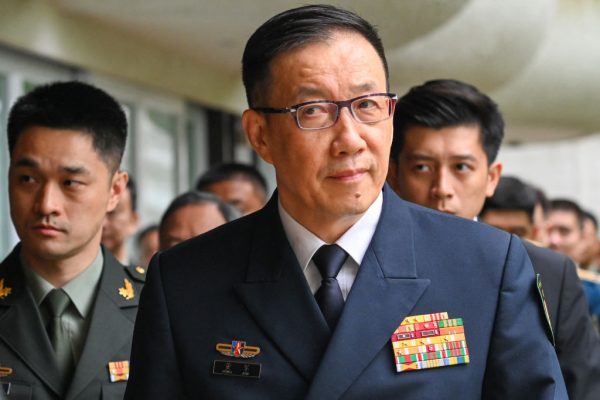
PLA Daily’s repeated references raise speculation of failed coup
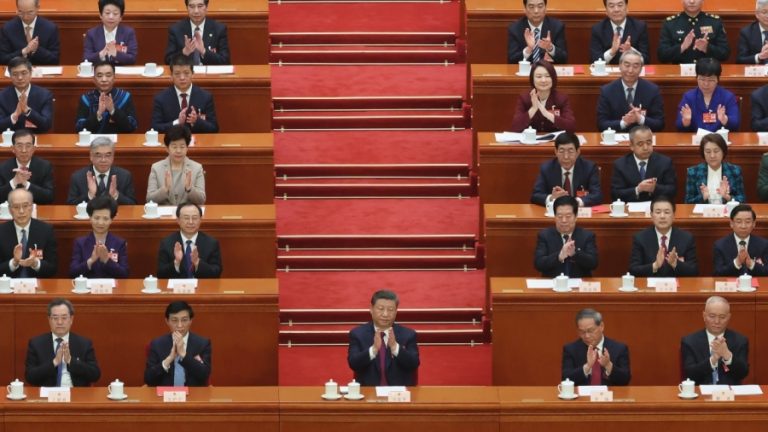
On Dec. 25, 2025, the CCP Politburo convened a meeting emphasizing the need to “advance comprehensive strict governance of the Party with higher standards and more concrete measures.”
The following day, PLA Daily published commentary again referring to the “serious disciplinary and legal violations” of figures including He Weidong and Miao Hua, declaring that “there must be no safe haven for corrupt elements in the military” and calling for the removal of “malignant actors.”
This marked the third time PLA Daily had publicly named and criticized He and Miao since official announcements of their cases, a pattern that observers say underscores the intensity of internal power struggles within the CCP.
On Oct. 17, 2025, ahead of the Fourth Plenum of the CCP’s 20th Central Committee, China’s Ministry of National Defense abruptly announced the downfall of nine full generals, including He Weidong, Miao Hua, and Lin Xiangyang. On Oct. 23, the plenum communiqué confirmed that He and Miao had been expelled from the Party.
The following day, PLA Daily published an article emphasizing military anti-corruption efforts, again referencing the cases of He and Miao and asserting that the investigations had “effectively eliminated major political risks.”
On Nov.13, PLA Daily ran another commentary warning that failure to eliminate “malignant actors” before “gunfire breaks out” would pose severe threats to political security.
Public information shows that during Xi Jinping’s 13 years in power, 81 officers have been promoted to the rank of full general. Yet at the Dec. 22 promotion ceremony, aside from two newly promoted theater commanders, only four active-duty full generals were present—suggesting that the majority of those previously promoted are no longer in active service.
Su Ziyun, director at Taiwan’s Institute for National Defense and Security Research, said PLA Daily’s reporting appeared aimed at deflecting responsibility from Xi Jinping. Su noted that many of the fallen generals were widely regarded as members of Xi’s inner circle, including figures associated with the so-called “Fujian faction.” According to Su, framing the purge as anti-corruption obscures the reality of factional political struggles and is ultimately unconvincing.
Commentator Li Linyi told overseas Chinese-language media that while anti-corruption rhetoric within the military is common, repeated references to “major political risks” and the need to act before “gunfire breaks out” inevitably evoke the possibility of mutiny or armed rebellion—suggesting that an organized action was allegedly imminent but disrupted before it could unfold.
On Oct. 25, 2025, Cai Xia, a retired professor at the CCP Central Party School now living overseas, claimed that the real reason behind the investigations into He Weidong and Miao Hua may have involved plans to establish a “non-regular force,” or so-called private army, in the Tianjin–Langfang area. According to Cai, such a force could have been activated in the event of Xi Jinping losing power, potentially to help him reclaim control of the military or the Party—an outcome allegedly unacceptable to figures such as Zhang Youxia and senior CCP elders, who may have viewed it as a coup attempt.
While Vision Times has been unable to independently verify these claims, observers note that PLA Daily’s repeated emphasis on “major political risks” and preemptive action lends context to speculation about what such warnings may be alluding to.
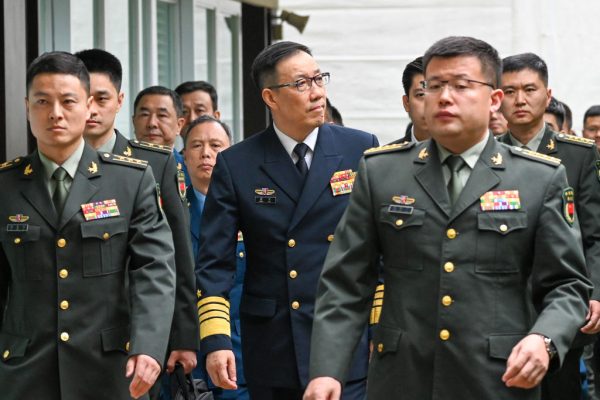
Navy leadership purged as analysts say Dong Jun unlikely to escape
On Nov. 28, 2024, former PLA Navy lieutenant colonel Yao Cheng said on his self-media channel that a joint investigative team from the CCP’s central and military discipline bodies had been formed to probe Miao Hua. According to Yao, former navy political commissars Qin Shengxiang and Yuan Huazhi, along with Dong Jun, provided testimony unfavorable to Miao.
On July 29, 2025, U.S.-based former Chinese journalist Zhao Lanjian reported that Qin Shengxiang, former director of the Political Work Department of the Central Military Commission Joint Staff Department, was taken away for investigation after suddenly losing contact the previous day. Qin later failed to appear at official events, including the Aug. 1 military reception and the Fourth Plenum.
On Oct. 17, 2025, Yuan Huazhi was officially announced among the nine full generals who had fallen, alongside He Weidong and Miao Hua. From August 2021 to December 2023, Dong Jun served as commander of the PLA Navy, working closely with Qin and later Yuan as political commissars. With both former commissars now implicated, analysts say Dong’s position appears increasingly precarious.
U.S.-based commentator Chen Pokong said in a self-media program that Miao Hua, as former navy political commissar and later head of the Political Work Department, controlled personnel and ideological affairs across the military. Once Miao fell, those connected to him—including senior navy commanders—were bound to follow.
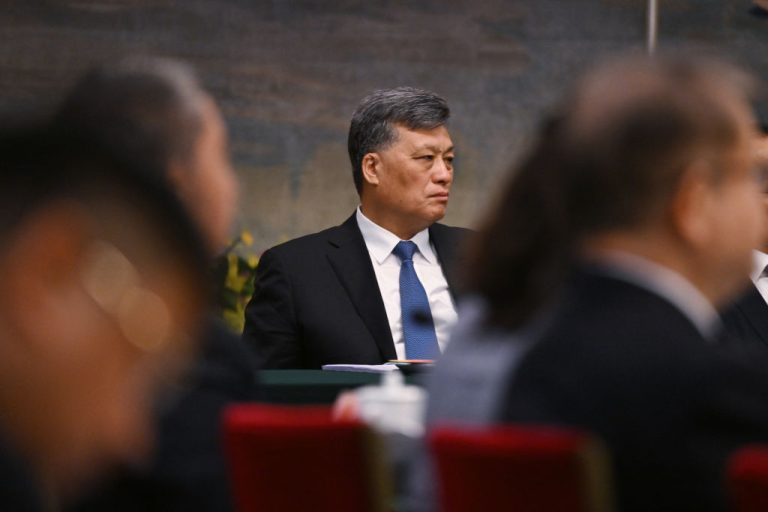
Chen further argued that with the navy’s top leadership effectively collapsing, Dong Jun’s prospects of remaining untouched were slim. He drew parallels with former Xinjiang political-legal chief Ma Xingrui, who was reportedly sidelined under the guise of reassignment before eventually disappearing from public view. According to Chen, even if Dong continues to make appearances for now, an official announcement of his downfall may simply be a matter of time.