By Li Zexu
Taiwan’s Ministry of National Defense said large-scale Chinese military drills conducted on Dec. 29 and 30 around the island involved the firing of 27 missiles, drawing international concern. The exercises coincided with another rejection in Taiwan’s legislature of a proposed NT$1.25 trillion special defense budget, preventing it from being sent to committee for review.
The ministry held an unscheduled press briefing on the evening of Dec. 30. Lt. Gen. Hsieh Jih-sheng, deputy chief of the intelligence staff, noted that the People’s Liberation Army launched two waves of multiple-launch rocket fire between 9 a.m. and 1 p.m. from areas near Pingtan and Shishi in China’s Fujian Province. According to the ministry, 17 rockets were fired toward waters north of Taiwan and 10 toward the southwestern maritime area.
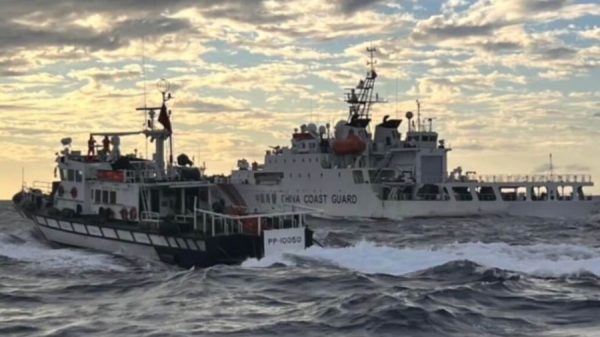
Between 6 a.m. and 3 p.m. on Dec. 30, Taiwan detected 71 PLA aircraft sorties, including 35 that crossed the median line of the Taiwan Strait and entered Taiwan’s northern, central, and southwestern air defense zones. Authorities also reported the presence of 13 PLA naval vessels, including 11 that entered Taiwan’s contiguous zone, 15 Chinese coast guard vessels operating near Taiwan and its outlying islands, and a four-ship amphibious assault group in the western Pacific. No PLA vessels or official ships entered Taiwan’s 12-nautical-mile territorial waters.
Hsieh warned that the live-fire drills marked a notable escalation, with missile impact points falling closer to Taiwan than in previous exercises. He said some projectiles landed within 24 nautical miles of the island. According to the ministry, the first wave was launched at 9 a.m. from Pingtan, with missiles landing about 70 nautical miles northeast of Keelung without passing over Taiwan. The second wave, fired at 1 p.m. from Shishi near Quanzhou, involved 10 rockets landing roughly 50 nautical miles west of Tainan.
Success
You are now signed up for our newsletter
Success
Check your email to complete sign up
Hsieh said the targeted drills not only threatened Taiwan but also posed serious risks to international aviation and maritime safety. Data from Taiwan’s Civil Aeronautics Administration showed that 941 international transit flights were affected that day, along with an unspecified number of commercial vessels and fishing boats operating in the exercise zones.
‘Joint Sword-2025’
China’s Eastern Theater Command recently announced the launch of joint exercises code-named “Joint Sword–2025,” covering multiple air and maritime areas around Taiwan and involving simulated blockades and precision strikes. Beijing described the drills as a warning to what it called “Taiwan independence separatist forces.” Taiwan’s defense ministry said it had fully monitored the exercises and responded appropriately, stressing that it would not escalate tensions or provoke conflict while remaining firm in safeguarding national security.
At the same time, Taiwan’s Legislative Yuan Procedural Committee met at midday, where lawmakers from the Kuomintang and the Taiwan People’s Party used their numerical advantage to block, for the fifth time, the Cabinet’s proposed NT$1.25 trillion special defense budget and a related fiscal bill from being placed on the agenda of the Jan. 2 plenary session. As a result, the proposal was not referred to committee for review.
The Democratic Progressive Party argued in a statement that while China was conducting military drills around Taiwan, opposition parties continued to obstruct the defense budget, delaying measures critical to the defense of Taiwan, Penghu, Kinmen, and Matsu, as well as the safety of frontline military and coast guard personnel. Party officials said the move risked sending the wrong signal internationally by suggesting a lack of resolve to defend the island.
Strategic analyst Su Tzu-yun said the PLA’s “Joint Sword” exercise was neither just nor legitimate, describing it as hastily assembled and aimed at intimidating Taiwan through force and psychological operations. He said Beijing had circulated what it claimed were drone images of Taipei 101 and Taiwan’s Central Mountain Range, but analysis showed the visuals were fabricated, even as some lawmakers shared them online.

China seeks to exploit psychological warfare
Su said China was seeking to exploit psychological warfare to instill fear and prompt the public to give up resistance, adding that Taiwan’s greatest threat lay in domestic collaborators spreading disinformation. He said authorities should respond quickly to false claims and hold individuals legally accountable for spreading misinformation to curb its impact.
He added that without sufficient defensive capabilities, Taiwan would effectively be inviting aggression. He cited integrated air defense systems included in the special defense budget, saying they could deter missile and drone threats and strengthen Taiwan’s overall defense while also supporting industrial upgrading.
German lawmakers also voiced concern over the PLA drills. Roderich Kiesewetter, a member of the German Bundestag, urged Berlin to clearly condemn China’s actions, publicly support Taiwan as a democratic and sovereign state, and reconsider aspects of Germany’s past adherence to Beijing’s interpretation of the “one China” policy. He warned that Europe should not remain passive as China expanded military preparations in the Indo-Pacific and employed hybrid tactics.
In a post on social media platform X, Kiesewetter said China’s large-scale military exercises around Taiwan were intended to intimidate a sovereign country and undermine the rules-based international order. He warned that the combination of live-fire drills, naval deployments, and drone operations again demonstrated China’s intention to attack and annex Taiwan in the foreseeable future.

A deliberate show of intimidation
Another German lawmaker, Klaus-Peter Willsch, described the exercises as a deliberate show of intimidation, saying the encirclement drills represented a unilateral escalation that undermined peace and stability in the Taiwan Strait and reflected China’s continued use of gray-zone tactics and military coercion to systematically weaken the status quo. He said peace in the Taiwan Strait was an international consensus and that any attempt to challenge it through military force amounted to a departure from international law.
The Inter-Parliamentary Alliance on China, a coalition of lawmakers from Europe, North America, and Asia, also issued a statement condemning the PLA’s multi-axis, cross-service encirclement and blockade simulations around Taiwan. The group urged governments to respond with unity and urgency, warning that the drills increased the risk of miscalculation, undermined stability in the Taiwan Strait, and threatened broader Indo-Pacific security and global prosperity.
IPAC said democratic nations should go beyond opposing unilateral changes to the status quo and instead develop coordinated deterrence measures, raise the cost of aggression, and strengthen collective defense preparedness. It said any further escalation would be met with a firm and coordinated response from democratic countries.