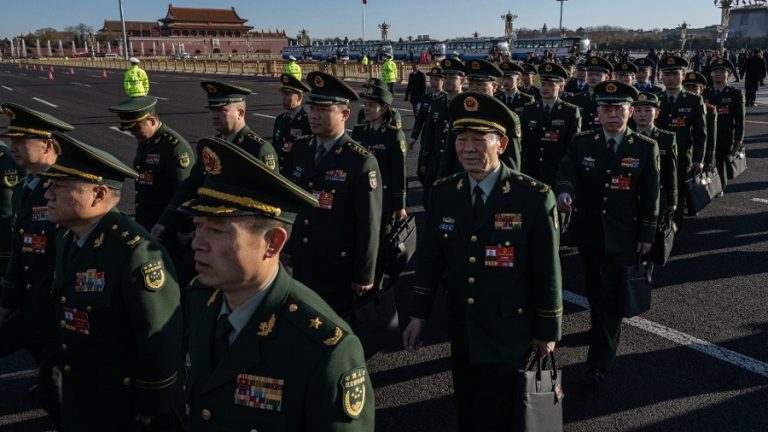
On July 3, 2026, Xi Jinping promoted two officers to the rank of full general, the highest active-duty rank in China’s armed forces, at a ceremony that began to refill a military high command his own purges had emptied out. The two were Zhang Shuguang, the officer now in charge of rooting out corruption inside the military, and Wang Gang, the new commander of the air force. Xi, who leads the Chinese Communist Party and chairs its Central Military Commission, the body that commands China’s armed forces, handed each man his order of appointment.
The speed of the promotions drew notice, and so did a coincidence the overseas Chinese press dwelled on. Zhang Shuguang’s surname is written with a character that contains the sign for a bow, and a bow runs through a superstition that has shadowed Xi’s assault on his own generals. The most senior officer Xi purged in January, Zhang Youxia, carried the same “bow” in his name, as does Zhang Shengmin, the one vice chairman Xi has left in place.
Xi held the first promotion ceremony since purging his two most senior generals
The July 3 ceremony was the Chinese military leadership’s first since the January purge stripped its command down to two men. Xi’s official news agency, Xinhua, placed it at the Bayi Building, the military’s headquarters in Beijing, named for the August 1 anniversary of the People’s Liberation Army’s founding. The one remaining vice chairman of the Central Military Commission, Zhang Shengmin, presided, and officials from the commission’s departments and from military units stationed in the capital attended. Zhang Shuguang now holds enormous power over his fellow officers as secretary of the commission’s Discipline Inspection Commission and director of its Supervision Commission, a single body operating under two names, and the post he inherits from Zhang Shengmin makes him the military’s top anti-graft enforcer.
The two promotions raised the number of full generals in the top leadership from four to six, a shift that bears directly on the personnel lineup for the Central Military Commission that will be set at the 21st Party Congress in 2027. The move had been signaled days earlier. At a June 29 concert in Beijing marking the Party’s 105th anniversary, Zhang Shuguang and Wang Gang, then both lieutenant generals, were seated in the same row as two full generals, the navy’s Dong Jun, who serves as China’s defense minister, and the air force’s Han Shengyan. An X account that tracks Chinese personnel moves, “China Personnel Watch,” wrote that the seating showed the two men had reached full theater-command grade and would soon be promoted.

Wang Gang’s promotion to Air Force commander signals his predecessor’s downfall
Wang Gang’s elevation to command of the People’s Liberation Army Air Force appears to confirm the downfall of the man who held the post before him, General Chang Dingqiu, who has been missing from public view for roughly half a year. Wang’s own rise has been quick: he became chief of staff of the Central Theater Command’s air force in 2019, commanded the aerial formations at the large military parade in Beijing in September 2025, and moved up through the air force’s senior ranks late that year.
Success
You are now signed up for our newsletter
Success
Check your email to complete sign up
In mid-December 2025, a prominent Chinese political scholar now at Harvard’s Fairbank Center for Chinese Studies, Liu Junning, wrote on X that Chang, the sitting air force commander, had died of a sudden heart attack while being held for questioning by the military’s disciplinary investigators, a form of incommunicado detention the Party calls liuzhi. Liu himself noted the report was unconfirmed. No official confirmation has followed, but Baidu Baike, China’s main online encyclopedia, quietly deleted Chang’s entry, and Chang, once the youngest full general in the military and a man Xi had personally fast-tracked, has not been seen since. Wang may already have been running the air force in his place. On July 3, an X user posting as “Vincent” wrote that the two promotions confirmed both that Zhang Shuguang was bound for the Central Military Commission and that Wang had moved from acting to full air force commander, which in turn confirmed that Chang had run into trouble.
The official record has stayed silent on Chang. Late on the night of June 26, 2026, after the standing committee of China’s rubber-stamp legislature, the National People’s Congress, closed a session, Xinhua published a notice stripping more than a dozen officials of their seats as delegates, among them a former air force political commissar, Guo Puxiao. The notice said nothing about Chang Dingqiu.

The new discipline chief built his career alongside the generals Xi just purged
Zhang Shuguang’s record places him close to the very officers Xi has been removing. Public records show that he ran the case-review bureau in the discipline department of the military’s former General Political Department, and later headed the discipline and inspection bureau of the Central Military Commission’s disciplinary commission, a post that made him a subordinate of Zhang Shengmin. His troop postings then ran through the Northern Theater Command and the army, which were Zhang Youxia’s strongholds during the years Zhang Youxia served as a vice chairman of the commission, a position he took in March 2018 alongside another vice chairman, Xu Qiliang. In 2018, Zhang Shuguang became discipline secretary of the Northern Theater Command’s air force, and in December 2021 he was made discipline secretary of the army and promoted to lieutenant general. Those assignments placed him among the army’s senior leadership beside Liu Zhenli, who became army commander in June 2021 and served as joint staff chief until his fall this year.
A US-based commentator, Tang Jingyuan, said on his online program that this web of postings shows how closely Zhang Shuguang is tied to Zhang Youxia, Liu Zhenli, and Zhang Shengmin alike.
On January 24, 2026, China’s defense ministry announced that Zhang Youxia and Liu Zhenli had been placed under investigation for what it called serious violations of discipline and law. Their fall completed the emptying of the commission: of the seven men seated on it after the 20th Party Congress, purges had already claimed a defense minister, the admiral who ran its political work department, and a vice chairman, and the January removals left only Xi and Zhang Shengmin. Observers said the body had been left paralyzed.
Analysts say Zhang Shuguang has locked in a Central Military Commission seat
Zhang Shuguang has effectively reserved himself a seat on the Central Military Commission, China’s top military decision-making body, according to analysts tracking the reshuffle. “China Personnel Watch” noted that he has moved from army discipline secretary to secretary of the commission’s own disciplinary commission and won his fourth star, and that by custom the disciplinary post is held by a sitting member of the commission.
With only Xi and Zhang Shengmin left, the account predicted, Zhang Shuguang could be added as a vice chairman or an ordinary member as early as the Fifth Plenum of the Party’s 20th Central Committee late this year, or else after the 21st Party Congress in 2027. The commission cannot run normally, it argued, until at least one more vice chairman is installed to oversee military operations and the body is restored to its usual pair of deputies, and Zhang Shuguang might be brought in as a member alongside that new deputy. He might also have to wait until the first plenum of the 21st Central Committee at the end of 2027 to take his seat.
The same account raised the question of whether the defense minister, Admiral Dong Jun, might be added to the commission at the same time. Its answer was pointed: if Zhang Shuguang were brought in while Dong Jun was passed over, that would signal that Dong Jun is headed for an ordinary retirement and will have no place on the commission seated after the 21st Party Congress.

An ancient prophecy about a bow-bearing soldier feeds Xi’s fear of generals named Zhang
Around the time Zhang Youxia fell, a line from the Tui Bei Tu, a famous book of prophecy from imperial China, spread through Chinese-language social media. Its forty-sixth image is read to foretell “a military man carrying a bow,” a phrase long treated as a coded warning to the ruler. The surname Zhang is written with a character built around the element for a bow, so the prophecy has been read as pointing to a general named Zhang. Some have speculated that Zhang Youxia’s removal was tied to that superstition, and to the “bow” concealed in his name.
The officers closest to Xi still carry the same sign. Zhang Shengmin, the single vice chairman Xi has kept, is a Zhang, and so is Zhang Shuguang, the newly promoted general who has spent his career in close contact with him. In a military purge that promotes and removes commanders at the same time, Xi Jinping has once again drawn “bow-bearing” men to his side, and how their stories end is anyone’s guess. With the Party’s internal power struggle sharpening ahead of the 21st Party Congress, the makeup of China’s military leadership will bear close watching in the months ahead.
By Li Deyan