By Li Jingru
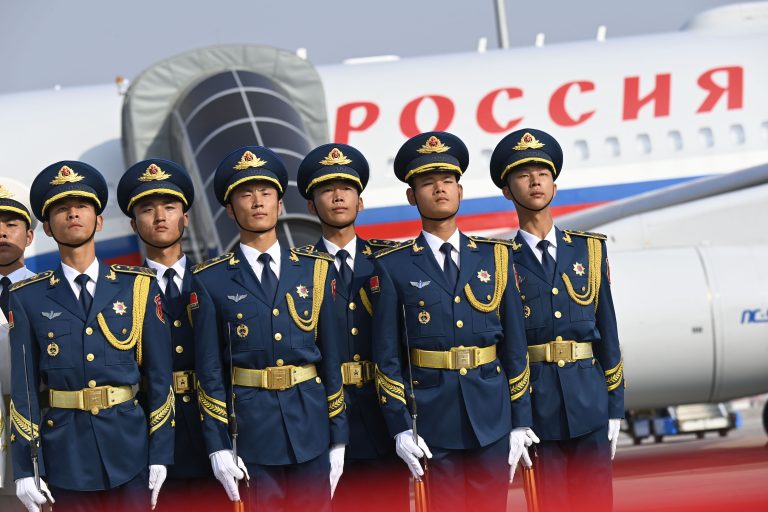
On Dec. 22, Xi Jinping appeared in Beijing to preside over a ceremony promoting commanders from two major military theater commands. Yang Zhibin, head of the Eastern Theater Command, and Han Shengyan, commander of the Central Theater Command, were elevated to the rank of full general, with Xi personally handing them their certificates.
For outside observers, the ceremony initially appeared to signal something familiar in Chinese politics: that a prolonged wave of purges might be easing, replaced by cautious normalization. That assumption did not survive the week.
Three days later, at a Politburo meeting chaired by Xi, the Chinese Communist Party made clear that its anti-corruption campaign would continue into 2026 “without pause and without retreat.” The message was unambiguous. Promotions did not mark reconciliation. They reflected a much narrower and more fragile political calculation.
Understanding that calculation requires looking beyond official rhetoric and into how power is currently being managed within China’s political and military systems. For that, Vision Times spoke with Yuan Hongbing, a legal scholar now living in Australia who has long relayed insider accounts circulating among China’s elite circles.
Success
You are now signed up for our newsletter
Success
Check your email to complete sign up
A ceremony defined more by who was missing than who appeared
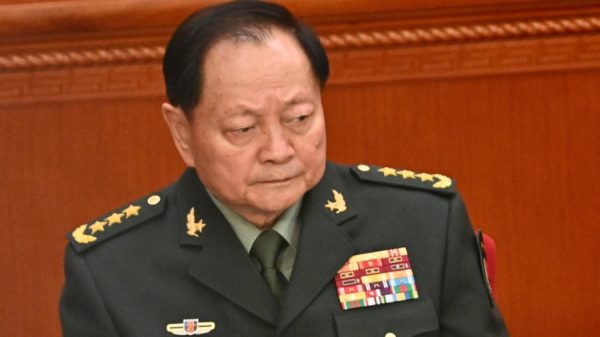
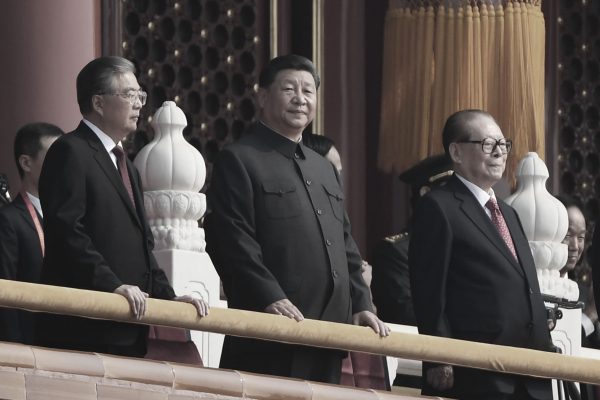
The Dec. 22 promotion ceremony followed standard choreography but featured unusually thin attendance. Official footage showed only three full generals—Zhang Youxia, Zhang Shengmin, and Liu Zhenli—standing beside Xi on the podium.
Several figures who would normally be expected to attend were absent. Among them were senior air force commanders and Chen Hui, the army’s political commissar who had been promoted only the previous year. All had appeared publicly only weeks earlier at the Fourth Plenum.
For Yuan, the absences mattered more than the promotions themselves.
China commands the world’s largest military, encompassing the army, navy, air force, rocket force, armed police, reserves, and militias, with millions of personnel. Yet, Yuan said, only four full generals now appear visibly active at the top of the command structure.
Dozens of others, he said, have effectively vanished from public view through detention, investigation, or prolonged political limbo. What was once the institutional core of the People’s Liberation Army—the corps of full generals—has been hollowed out.
Inside Beijing’s political circles, Yuan said, the imagery surrounding the ceremony triggered unusually bleak historical associations. The scene was read less as a display of authority than as a sign of exhaustion within the system itself.
In Yuan’s assessment, the ceremony underscored how deeply the PLA’s leadership hierarchy has been destabilized by successive purges, leaving behind a force that retains its size but has lost much of its internal cohesion.
Why air force promotions do not mean air force favoritism
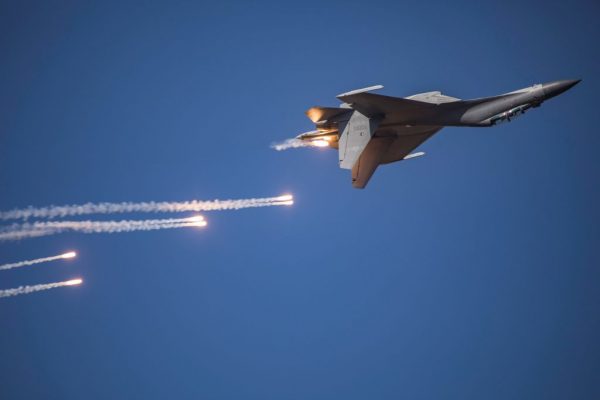
Some analysts pointed to the backgrounds of the newly promoted generals—both from the air force—as evidence that Xi is shifting reliance toward that branch. Yuan rejected that interpretation.
Only two months earlier, he noted, both the air force commander and political commissar—full generals who had attended the Fourth Plenum—were themselves removed. In fact, three consecutive air force commanders have now been caught up in disciplinary action.
The pattern, Yuan argued, reflects not favoritism but structural failure.
At the center of the current air force purge, he said, is the long-delayed strategic bomber program. Years ago, a senior commander publicly declared that China’s long-range bomber would soon enter service. It still has not.
Yuan attributed the delay to entrenched corruption. Senior officers within the air force, he said, allegedly colluded with civilian officials in the aerospace sector to divert large sums earmarked for the program, leaving it stalled despite years of investment.
Seen this way, recent promotions serve a specific function. According to Yuan, Xi is advancing two categories of officers: those marginalized during the rise of figures now accused of political disloyalty, and officials drawn from the military’s discipline inspection and legal systems.
These officers are not being groomed as battlefield commanders. Their value lies in enforcement—maintaining internal control during an extended purge.
A leadership increasingly governed by distrust
Yuan described Xi’s central dilemma as one of trust rather than numbers.
The removal of senior generals has left Xi uncertain not only about the loyalty of top commanders but also about the reliability of lieutenant generals and major generals—the ranks that form the operational backbone of the military. They lack decisive power individually, but collectively they determine whether orders are carried out.
After the 20th Party Congress, Yuan said, the logic of the purge shifted inward. Factions associated with Jiang Zemin and Hu Jintao had already been dismantled over the past decade. What followed was scrutiny of Xi’s own handpicked loyalists.
The cases involving Miao Hua and He Weidong, Yuan said, struck particularly hard. Both had been elevated by Xi and entrusted with enforcing political discipline. Their downfall intensified doubts within the leadership about whether loyalty can still be engineered from the top.
In Beijing, Yuan said, discussions increasingly focus on Xi’s inability to reconcile personal western-style loyalty expectations with a system shaped by decades of transactional politics.
Attempts to revive ideological discipline along Maoist lines, Yuan argued, collide with reality. Communist ideology, he said, no longer commands genuine belief within the system. Loyalty has become conditional, negotiated, and reversible.
Decades of corruption entrenched during earlier reform eras have only reinforced this logic. Many officials now operate on the assumption that the system itself may not endure, making personal accumulation a rational survival strategy rather than a moral failure.

Why the Politburo doubled down on anti-corruption
Against this backdrop, the Politburo’s decision to intensify anti-corruption efforts in 2026 takes on a clearer meaning.
Yuan said insiders point to two motivations. The first is psychological control. High-profile disloyalty cases have shaken confidence within the system. Sustaining pressure, he said, is intended to deter collective resentment before it can form.
The second motivation is fiscal. Yuan invoked a Qing dynasty saying: when the corrupt official Heshen fell, the imperial treasury was replenished.
Xi, Yuan argued, is pursuing a modern version of the same logic—using confiscated assets from purged officials to relieve mounting fiscal strain while continuing to fund military expansion despite economic slowdown.
The heavy emphasis on loyalty slogans surrounding the Politburo meeting, Yuan said, was itself revealing. Such displays become necessary precisely when trust has eroded to the point that even senior leaders are treated as potentially unreliable.
Nuclear forces beyond what outside assessments capture
Yuan also addressed China’s nuclear capabilities, responding to recent overseas reporting, including the U.S. Pentagon’s 2025 China Military Power Report.
He described the report as a rare acknowledgment of China’s accelerating militarization but argued that it still underestimates the depth of the system being built.
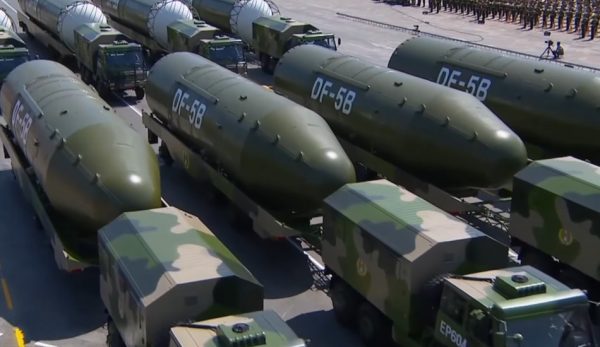
Drawing on information he attributed to insiders, Yuan claimed China’s nuclear arsenal has already surpassed 1,000 warheads, including hydrogen and neutron weapons, alongside roughly 2,000 tactical nuclear devices.
More significant than raw numbers, he said, is survivability.
Rather than relying primarily on visible launch sites or mobile platforms, China’s nuclear strategy, Yuan argued, centers on an extensive underground tunnel network stretching thousands of kilometers. Missiles can be transported, concealed, and deployed entirely below ground.
From this perspective, highly publicized missile silo construction near the Mongolian border or around Lop Nur may function as strategic distractions rather than the core of China’s deterrent.
Yuan pointed to tunnel systems reportedly extending from Beijing’s Western Hills toward central China, designed with multi-lane corridors capable of supporting missile movement and launch operations.
In his assessment, this underground infrastructure remains the least understood—and most consequential—element of China’s nuclear development. While the Pentagon report captures the direction of China’s military ambitions, Yuan said, it still falls short of describing their full maturity.