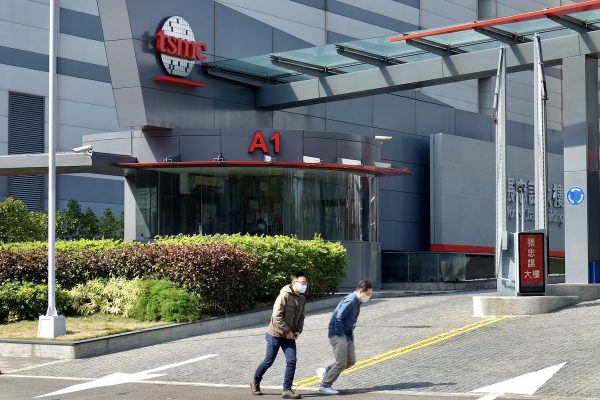
Taiwan’s leading contract chipmaker TSMC announced via a press release on June 10 that its May revenue reached $13.2 billion USD (NT$416.975 billion), up 1.5 percent month over month and 30.1 percent year over year, setting a new record for the company’s highest-ever monthly revenue.
TSMC is the backbone of Taiwan’s technology sector and the single most important global company in the semiconductor supply chain. Its influence goes far beyond Taiwan’s chip manufacturing into Taiwan’s economic and stock market growth as well as employment, government revenue, national security and a massive geopolitical footprint.
TSMC’s May revenue of NT$416.975 billion surpassed the previous monthly record of NT$415.191 billion, set in March this year. Revenue increased 1.5 percent from April and 30.1 percent compared with the same month last year. Cumulative revenue for the first five months of the year reached NT$1.9618 trillion, an increase of 30 percent year over year.
Assuming an average exchange rate of NT$31.7 per U.S. dollar in the second quarter, continued strong demand for TSMC’s advanced manufacturing processes is expected to lift second-quarter revenue to between US$39.0 billion and US$40.2 billion, representing 10 percent quarter-over-quarter growth and 32 percent year-over-year growth.
With combined revenue of NT$827.7 billion in April and May, market analysts expect TSMC to comfortably meet its second-quarter business targets. Quarterly revenue is projected to exceed NT$1.23 trillion, setting another all-time record.
Success
You are now signed up for our newsletter
Success
Check your email to complete sign up
Driven by strong demand for artificial intelligence (AI) applications and rapidly increasing computing requirements, demand for advanced-process chips remains robust. TSMC expects its U.S. dollar-denominated revenue to grow by more than 30 percent in 2026.
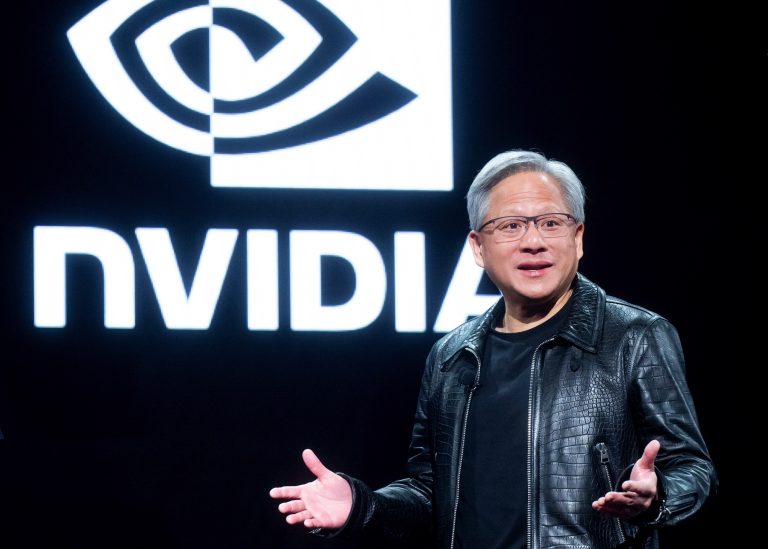
In recent years, TSMC has benefited significantly from the global AI boom, manufacturing advanced chips for major technology companies such as Nvidia and AMD. Both its operating performance and market capitalization have reached record highs. Its market value has at one point surpassed US$2 trillion, firmly placing it among the world’s ten most valuable companies.
TSMC’s market value doubles, rising to ninth globally
According to the Liberty Times, PwC recently released its “Global Top 100 Companies by Market Capitalization 2026” report. The report shows that TSMC’s market capitalization doubled to US$1.427 trillion, earning it a place in the “trillion-dollar club.” Its global ranking rose to ninth, up three places from the previous year.
The report noted that among the world’s ten most valuable companies, TSMC’s market capitalization increased from US$709 billion on March 31, 2025, to US$1.427 trillion on March 31, 2026—a 101 percent increase, the largest percentage gain among the global top ten companies by market value.
The analysis states that U.S. companies account for 75 percent of the total market capitalization of the world’s top 100 companies, underscoring the continued strengthening of the United States’ influence in the global economy. Taiwan has only one company on the list—TSMC—but its market capitalization ranking rose from seventh last year to fourth this year, trailing only the United States, China, and Saudi Arabia by country representation.
The report shows that the combined market capitalization of the world’s top 100 companies increased by US$9.211 trillion (22 percent) over the past year, significantly higher than the 7 percent (US$2.765 trillion) growth recorded the previous year. As of March 31, 2026, the world’s ten most valuable companies, led by Nvidia, were, in order: Apple, Alphabet(Google’s parent company), Microsoft, Amazon, Saudi Aramco, Broadcom, Meta (Facebook’s parent company), TSMC, and Tesla.
The report also noted that TSMC and Broadcom both surpassed the US$1 trillion market capitalization threshold over the past year, joining the “trillion-dollar club.” Notably, 11 companies among the global top 100 recorded annual market capitalization growth of more than 100 percent, compared with only two companies the previous year.

JSR to establish plant in Taiwan, strengthening TSMC’s supply chain resilience
As the AI boom continues to accelerate semiconductor process upgrades and technological iteration, international materials suppliers that do not engage in joint research and development with TSMC risk falling behind. According to Nikkei Asia, Japanese chemical manufacturer JSR plans to establish a photoresist production facility in Taiwan.
JSR said the move is intended to strengthen its supply of materials to advanced semiconductor manufacturers, including Taiwan Semiconductor Manufacturing Company (TSMC), while enhancing the resilience of the semiconductor supply chain. JSR is the world’s second-largest supplier of photoresists, with a 19 percent global market share last year.
The report noted that photoresists are essential chemicals used in the fabrication of integrated circuits. As geopolitical tensions intensify, countries are increasingly seeking to localize and diversify their supply chains. JSR’s investment in Taiwan is expected to help ensure a stable supply of critical materials for TSMC and other local chipmakers, further reinforcing Taiwan’s leadership in advanced semiconductor manufacturing.
TSMC has likened its partnership with suppliers to a Michelin-starred restaurant: Applied Materials (AMAT) provides the “kitchen equipment” (manufacturing tools), JSR supplies the “premium ingredients” (materials), and TSMCserves as the “master chef,” integrating the manufacturing processes into a complete production system.