By Xiao Ran
Born in a remote mountain village in Gao’an, Jiangxi Province, Zhang Bo once believed his life would unfold quietly and without distinction. Instead, a single detail from his family history—his grandfather’s brief involvement in the Nationalist army before 1949—cast a shadow that would follow him for decades.
According to Zhang, his grandfather had carried a rifle for just two days near the end of the Chinese Civil War and never fired a shot. Even so, after the Communist takeover, the family was permanently labeled as belonging to the “Black Five Categories,” a political classification reserved for groups deemed enemies of the new regime. That label, he explained, shaped his family’s fate across generations.
Childhood under the shadow of political stigma
Born in the 1970s, Zhang grew up in a rural household marked by constant caution and suppressed anger. His grandfather, once an honest farmer, was publicly denounced during the land reform campaigns. His father, despite strong academic performance, was unable to pursue a career in government. During the Cultural Revolution, he was instead assigned to a remote timber inspection station deep in the mountains, where he spent years guarding forests with only one other worker.
His father continued to educate himself, writing and submitting articles for publication. Yet no matter how capable he proved to be, Zhang recalled, the family’s political background remained an invisible barrier that could never be crossed. From as early as he could remember, the household atmosphere was heavy and resentful. Hatred toward the communist party, he said, had begun with his grandfather’s generation.
Success
You are now signed up for our newsletter
Success
Check your email to complete sign up
That stigma followed him into school. Throughout primary school, from first grade through fifth, he was barred from joining the Young Pioneers because of his family background. While other students stood in formation each morning wearing red scarves and saluting the flag, Zhang was required to remain in the classroom with another student labeled “problematic.”
Teachers treated him coldly. Classmates, influenced by both teachers and parents, avoided him. He remembered spending much of his childhood isolated, excluded from games and social circles. Near graduation, a teacher completed the paperwork retroactively, but Zhang never wore the red scarf even once.

A narrow escape after 1989
In 1989, Zhang was twelve years old and in his first year of middle school. Around that time, slogans reading “Down with the Chinese Communist Party” appeared in a wooded area near the county public security bureau. The name signed beneath them was Zhang Bo’s.
The slogans, he later learned, were the work of classmates playing a prank. But given his family background, police treated him as the primary suspect. Officers photographed his handwriting, compared it with the slogans, and summoned his homeroom teacher for questioning.
Although the handwriting did not match and the case was eventually dropped, the incident left his parents deeply shaken. That very night, they arranged job transfers and relocated the family to Jiujiang. Both parents worked as ordinary laborers—his mother in a collective garment factory, his father at a state-owned timber company. For the rest of their lives, Zhang noted, they remained cautious and deliberately low-profile.
A failed business and enforced silence
Adulthood brought little relief. The weight of his family history affected his studies, and he was unable to enter university, completing only adult education. After high school, he worked in sales, drifting from job to job.
After marriage, his wife specialized in early childhood education. Seeing opportunities in the private training sector, the couple began preparing in 2020 to open an education center. In 2021, they invested nearly 400,000 yuan — drawing on family savings, loans, and financial support from Zhang’s parents. Classrooms were renovated, teachers hired, and an opening date set.
Then came China’s “double reduction” policy. Overnight, all private after-school tutoring institutions were shut down nationwide. The newly renovated school was sealed without warning or compensation.
Unwilling to accept the loss, Zhang wrote to the local education bureau requesting reasonable compensation. Community officials visited his home repeatedly, urging him to accept the policy. When he persisted, authorities accused him of “picking quarrels and provoking trouble.”
Police later took him from his home and held him for nearly four days at a secluded hotel-like facility outside Jiujiang. During that time, he was deprived of sleep, kept under bright lights, and confined in a padded room. He was pressured to write a guarantee statement, provide fingerprints, and promise never to petition again or seek accountability, while admitting full personal responsibility.
At the same time, officials contacted his child’s school, implying that continued resistance could jeopardize his academically gifted eldest son’s future. That, Zhang reflected, was the moment he realized that if the family stayed, his children would relive his own life.
A long and difficult departure
After his release, Zhang remained under close community surveillance, with officials making regular visits to monitor his “ideological condition.” Determined to protect his children, he decided the family had to leave China.
First, his wife and eldest son applied to go abroad under the pretext of studying overseas. Even then, they were required to report to police and obtain certificates proving they posed “no problems.” The initial application was denied. Approval came only after intermediaries were paid.
Securing passports for Zhang himself and his younger son proved even more difficult. Applications were delayed repeatedly for unspecified reasons. After multiple appeals and intervention through connections at the deputy bureau-director level, approval was finally granted.
The process took years and required three separate departures. Eventually, the family reunited in Canada.
Awakening in a free society
Life in Canada marked a profound turning point. Zhang began attending events organized by the Chinese Democracy Party and listening to speeches by overseas Chinese democracy activists, including Wang Juntao. For the first time, he felt he truly understood the meaning of “human rights.”
“In China, as long as you’re alive and breathing, that’s considered enough,” he observed. “Here, I learned that as a human being, you have inherent rights.”
The contrast, in his view, could not have been clearer. What he left behind was a cage. What he encountered abroad was a genuinely free society.
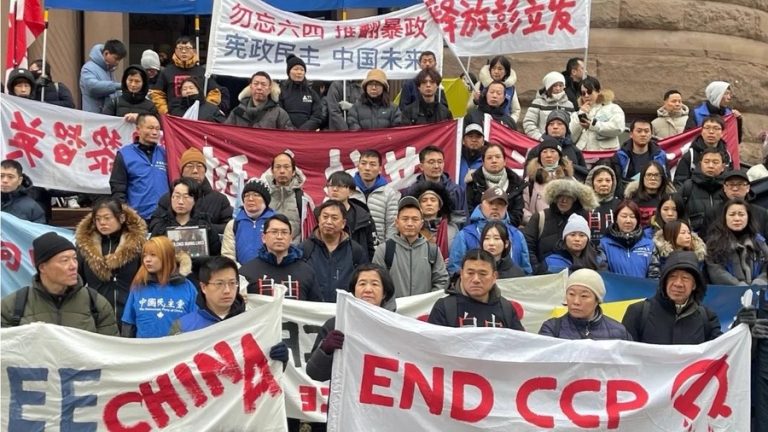
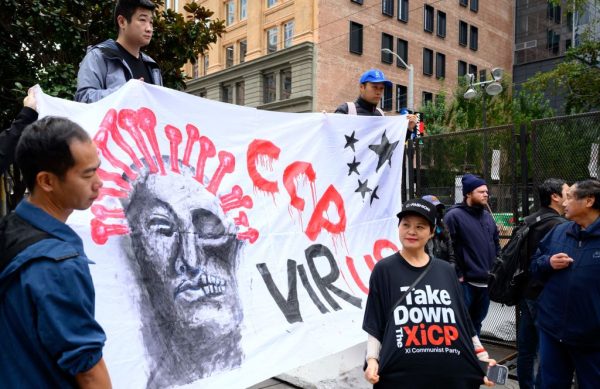
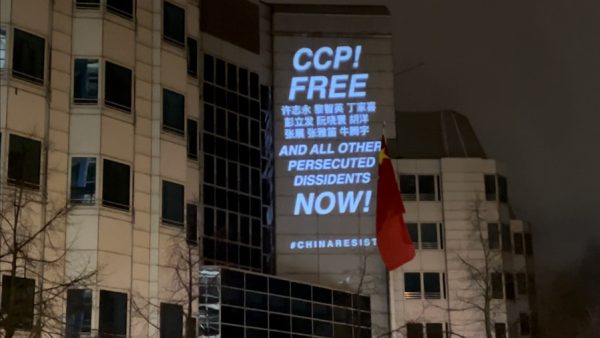
Zhang believes Chinese people living overseas have a responsibility to speak out, using their own experiences to show those still inside China what life elsewhere looks like. He makes an effort to attend protests and public events whenever possible, even when doing so requires hours of travel.
Choosing to speak out
Zhang expressed deep respect for overseas democracy activists who have persisted for decades despite hardship. Figures such as Wang Juntao, Sheng Xue, and Wang Dan, he said, represent a long journey from darkness toward light.
He also spoke at length about Nine Commentaries on the Chinese Communist Party, which he described as a work that systematically exposes the Party’s nature and the disasters it has brought upon the Chinese people. In his view, the book urges readers to make a clean break with the Party at the level of conscience. Only after such inner awakening, he believes, can meaningful action follow.
As of December 2025, data released by the Global Service Center for Quitting the Chinese Communist Party (Tuidang Center) indicate that more than 455 million Chinese have declared their withdrawal from the CCP, the Communist Youth League, and the Young Pioneers. Zhang said he, too, was moved to submit a declaration, formally withdrawing from the Young Pioneers.
Having grown up under political stigma and repression, Zhang now speaks from what he calls a place of freedom. When people are pushed to the limit, he believes, resistance inevitably follows. Persistence, he added, is what brings light closer.