By Meng Hao, Vision Times
In the early hours of Jan. 3, U.S. forces captured Venezuelan President Nicolás Maduro and his wife Cilia Flores and transferred them to New York to stand trial. The pair is currently being held at the Metropolitan Detention Center in Brooklyn, where Maduro has pled “not guilty” to all charges. The decisive move by the Trump administration has dealt a direct blow to the Chinese Communist Party’s (CCP) energy footprint in Latin America (LATAM).
As Venezuela’s largest oil buyer and a major creditor, Beijing now faces the dual risk of supply disruption and large-scale debt defaults, while U.S.–China decoupling in strategic resources accelerates into what analysts increasingly describe as a “new Cold War.”
RELATED: US Military Escorts Maduro to NY Trial as Drug Trafficking Charges Come Into Focus
Venezuela’s oil industry in collapse
According to reporting by “The Wall Street Journal,” following Maduro’s capture, U.S. President Donald Trump has signaled plans to invite tens of billions of dollars in investment from American oil majors to rehabilitate Venezuela’s devastated infrastructure and revive its economy. In fact, a month earlier, Trump had already urged energy executives to “prepare,” with the U.S. secretary of energy and secretary of state leading consultations with the industry. To date, however, no major U.S. oil company has formally committed.
Success
You are now signed up for our newsletter
Success
Check your email to complete sign up
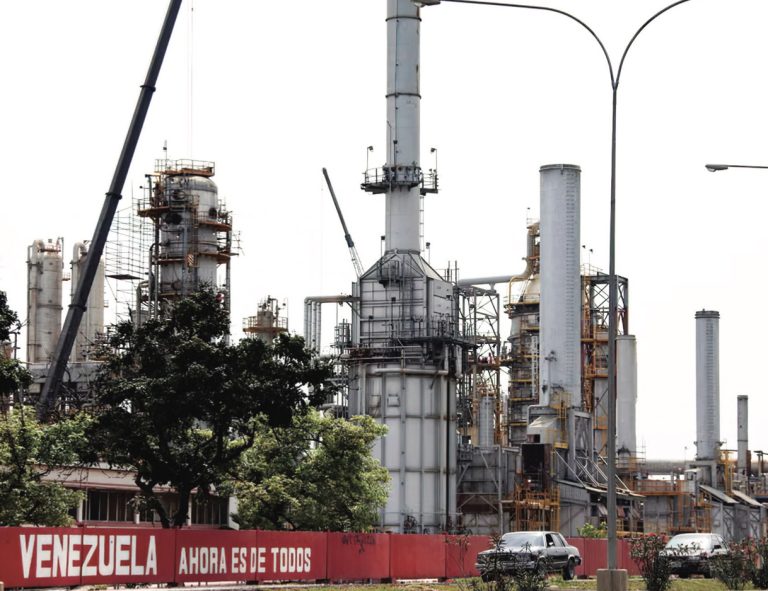
Venezuela holds the world’s largest proven oil reserves. According to BP statistics, reserves reached 303.3 billion barrels by 2019, surpassing Saudi Arabia’s 297.7 billion. Most of these reserves lie in the Orinoco Belt and consist of ultra-heavy crude, which is far more expensive to extract, transport, and refine than light oil.
RELATED: Maduro’s Capture Rattles Authoritarian Allies as Beijing Faces Energy Shock
Historically, Venezuela maintained more than a century of cooperation with the U.S. and was once a major U.S. supplier. However, nationalization waves under Hugo Chávez and later Maduro drove out foreign capital, leaving the sector under-invested. The 2002 PDVSA strike, which led to the dismissal of 18,000 employees, further crippled production capacity.
Output collapse remains the core issue. From a peak of roughly 3.5 million barrels per day in the late 1990s, production fell to about 3.1 million bpd in 2010, then plunged following the 2014 oil price crash, U.S. sanctions imposed in 2019, and chronic infrastructure decay. By late 2025, the International Energy Agency estimated output at around 1.1 million bpd. Despite vast reserves, storage bottlenecks, capital shortages, and technological decay forced further cuts, pushing the country into deep economic crisis.
Beijing’s deep entrenchment in Venezuela’s oil chain
For years, Beijing functioned as Venezuela’s financial lifeline. According to Vortexa analysis, China imported roughly 470,000 barrels per day from Venezuela in 2025, about 4.5 percent of China’s seaborne crude imports. The discounted heavy crude was primarily sold to China’s smaller “teapot” refineries capable of processing high-sulfur oil.
RELATED: Venezuela’s Opposition Declares Freedom Following Maduro’s Arrest
A significant portion of shipments serviced debt repayments. Analysts estimate outstanding obligations at over $10 billion, though cumulative exposure — under the long-running “oil-for-loans” model — runs into the tens of billions. Since 2007, Chinese policy banks, led by the China Development Bank, have extended more than $60 billion in financing in exchange for long-term oil supply, a structure that also advanced RMB internationalization, with 60–85 percent of trade settled in yuan.
Chinese firms are deeply embedded. China National Petroleum Corporation partnered with PDVSA in Sinovensa, controlling 1.6 billion barrels of reserves. Sinopec holds stakes covering roughly 2.8 billion barrels. Private firms, including China Concord Resources and Kerui Petroleum, announced ambitious investments, though execution now appears uncertain.
RELATED: As Global Tensions Rise, Analyst Says US and China Are Already In a Cold War
Following Maduro’s arrest, China’s National Financial Regulatory Administration reportedly ordered policy banks to assess loan exposure to Venezuela and strengthen risk controls. A future pro-U.S. government in Caracas could redirect exports toward American markets, sharply reducing China’s access and forcing Beijing to seek higher-cost alternatives elsewhere. With cumulative Chinese investment in Latin America estimated at $600 billion (about 20 percent of its overseas exposure) the risk of cascading defaults could extend across the region.
Geopolitical shockwaves fuel global exodus
The upheaval triggered an intense global risk-off surge. On Jan. 5, spot gold surged past $4,400 per ounce, while silver jumped nearly 5 percent in a single session. Platinum and palladium rose in tandem. So-called “war metals,” including tungsten, titanium, vanadium, chromium, manganese, tin, and cobalt, posted sharp gains, with some prices rising more than 20 percent in days.
RELATED: Silver Prices Hit Record Highs, Outpacing Gold as Buying Frenzy Sweeps China
The shock spread to industrial commodities. Copper, already constrained by demand from AI data centers, electric vehicles, and grid upgrades, saw inventories tighten further as prices neared historic highs. Goldman Sachs now forecasts an average gold price of $4,900 in 2026, with extreme scenarios reaching $5,500. Silver’s widening supply deficit could push prices beyond $100 per ounce. Central bank gold purchases continue unabated, underscoring the urgency of diversifying away from dollar-denominated assets.
Macro analyst Fu Peng argues that the turbulence marking the start of 2026 signals entry into a “new Cold War” reminiscent of the 1970s–80s, defined by the coexistence of productivity transformation (the AI era) and intensifying geopolitical confrontation. In such an environment, materials with dual attributes of “strategic security” and “productivity advancement,” are prone to explosive price increases.
He cautions that today’s price surges are driven less by actual AI-era consumption than by strategic stockpiling triggered by great-power rivalry. History shows that metals boomed during the U.S.–Soviet Cold War due to hoarding, then declined when tensions eased and inventories were released, even as the IT revolution accelerated.
For investors, Fu warns against misattributing gains solely to technological progress. Ignoring geopolitics (the primary driver) risks serious misjudgment. Only a future “Reagan–Gorbachev moment,” when confrontation recedes and strategic reserves unwind, would bring sustained price normalization.
Until then, under a new Cold War framework, geopolitical uncertainty is likely to continue dominating asset pricing, prolonging the bull market in safe-haven assets.